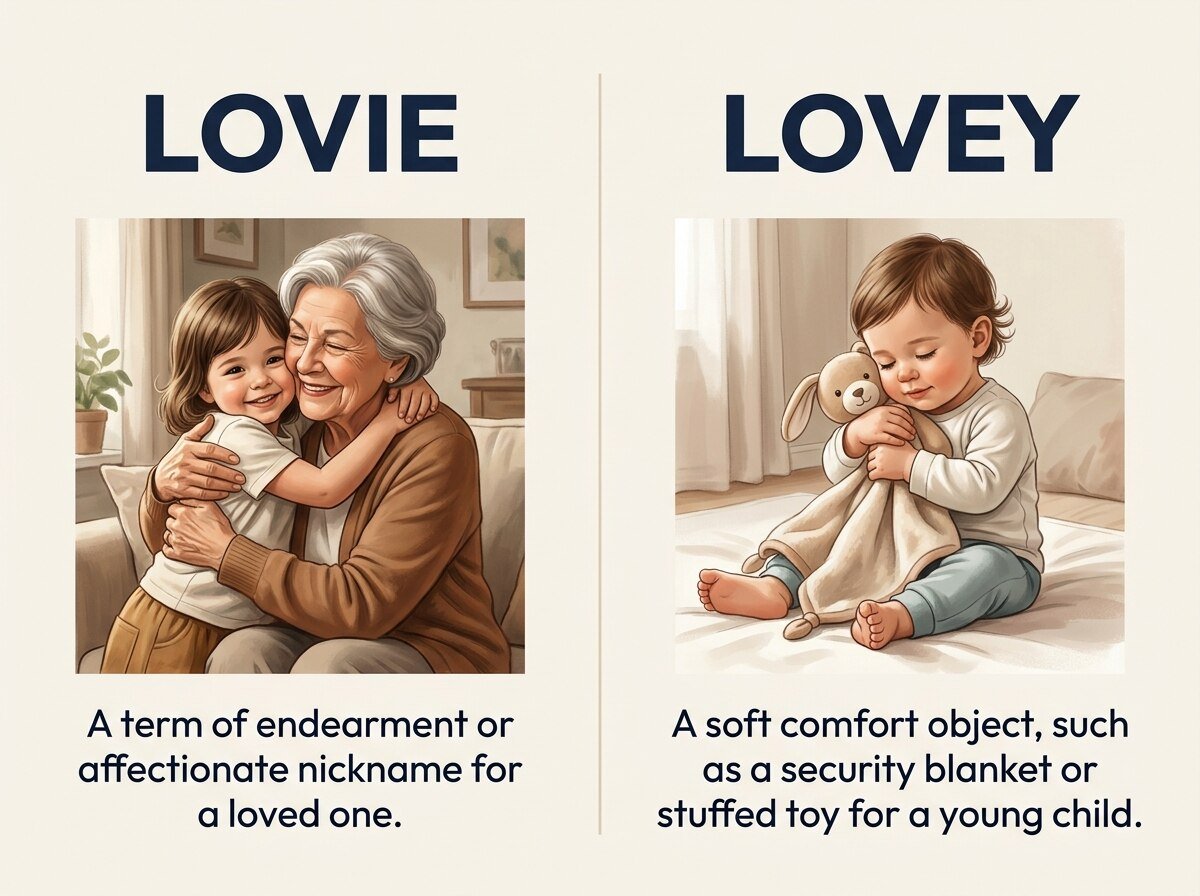
Lovey is the standard English spelling, while lovie is mainly a variant spelling, nickname, or name.
Imagine you are texting someone you care about. You want to write, “Good night, lovey!” You type lovie first, then wonder if lovey is correct. Both forms can be found, but they do not have the same level of standard use. This is why people often search for lovie or lovey before sending a message or writing something online.
Lovey is an established English word. It can be used as a friendly term of endearment, especially in British English. It can also describe something that shows strong or romantic affection. Cambridge lists lovey as an informal UK form of address and also records other uses, including a soft toy for a child.
Lovie, on the other hand, is much less common as a general English word. It may appear as a personal nickname, informal spelling, or variant. It should not normally replace lovey in standard writing.
People search for lovie or lovey because the two spellings sound almost identical. The main confusion is whether the final sound should be written with -ie or -ey. In most ordinary English writing, lovey is the safer choice.
Pronunciation of Lovie and Lovey
Lovey: /ˈlʌv.i/
Lovie: usually pronounced the same way when used as a spelling variant or nickname.
The standard pronunciation of lovey is essentially the same in US and UK English. Cambridge gives /ˈlʌv.i/ for both US and UK English.
Now let us look at the difference in meaning, spelling, history, and everyday use.
learn more about https://personaor.com/buffaloes-or-buffalos/
Difference Between Lovie or Lovey
1. Standard spelling
Lovey is the standard dictionary spelling.
Lovie is not the usual spelling for the general English term of endearment.
Examples:
- “Come here, lovey.”
- “Are you okay, lovey?”
2. Dictionary recognition
Major dictionaries recognize lovey as an English word. Collins defines it as a British informal term related to “love,” while Cambridge also records several meanings.
Examples:
- “Thanks, lovey.”
- “What happened, lovey?”
3. Use as a term of endearment
Lovey can be used to show affection.
Examples:
- “Good morning, lovey.”
- “Take care, lovey.”
4. Use in British English
Lovey has a strong connection with informal British English. It can be used when speaking warmly to someone.
Examples:
- “Are you ready, lovey?”
- “Thank you, lovey.”
5. Use in American English
American English also recognizes lovey, but it is less central to everyday American speech than in British usage.
Examples:
- “Come here, lovey.”
- “That is my little lovey.”
6. Personal nickname
Lovie may appear as a personal nickname or chosen spelling.
Examples:
- “Lovie is her nickname.”
- “She signs her messages as Lovie.”
Here, the spelling can depend on the person’s preference.
7. Informal writing
Both spellings can appear in casual online writing.
Examples:
- “Hey, lovey!”
- “Miss you, lovie!”
The second example may be an intentionally cute or personal spelling.
8. Formal writing
Neither word is common in formal professional writing.
Examples:
- Formal: “Dear Ms. Smith”
- Informal: “Hi, lovey”
Use the normal name or title in professional communication.
9. Meaning
When lovey is used as a term of address, it usually means something like dear, sweetheart, or love.
Examples:
- “Thanks, lovey.”
- “Come on, lovey.”
10. Spelling choice
If you need one safe spelling, choose lovey.
Examples:
- “Good night, lovey.” ✓
- “Good night, lovie.” Possible as a personal or playful spelling, but less standard.
Nature and Behaviour of Lovie and Lovey
Lovey
Lovey is an informal and affectionate word. It can express warmth, friendliness, or romantic affection. Its meaning depends on context and the relationship between the speakers.
It can also have other meanings. Cambridge records lovey as a soft toy or piece of cloth that comforts a baby or young child. It also records a humorous British use for an actor who behaves in an artificial or noticeable way.
Lovie
Lovie is less fixed as a general English word. It can work as a nickname, personal name, or playful spelling of lovey.
Because personal nicknames do not always follow standard spelling rules, someone may choose Lovie because they like the appearance of the word.
Why People Get Confused About Lovie or Lovey
The main reason is pronunciation.
Both spellings can represent the same basic sound. The ending -ie and -ey can sometimes have the same sound in English.
For example:
- Lovie → often sounds like “lovey.”
- Lovey → the standard dictionary spelling.
People also see different spellings in text messages, usernames, social media posts, and nicknames. Informal writing allows more freedom than formal English.
Comparison Table
| Feature | Lovey | Lovie |
| Standard English word | Yes | Less standard |
| Common dictionary entry | Yes | Limited |
| Term of endearment | Yes | Sometimes |
| British use | Commonly recognized | Less common |
| American use | Recognized | Mostly informal |
| Nickname | Yes | Yes |
| Formal writing | Rare | Rare |
| Casual texting | Common | Possible |
| Pronunciation | /ˈlʌv.i/ | Usually the same |
| Best general choice | Yes | Usually no |
The Origin of Lovey
Lovey comes from love with the suffix -y. Etymonline dates the affectionate pet-name use to around 1731.
The word developed as an affectionate way to address someone. It belongs to a larger group of English terms that turn words connected with affection into friendly forms of address.
The related expression lovey-dovey also developed from this affectionate language. Etymonline records the extended form from the early 19th century.
Research on English terms of endearment also lists lovey among older English affectionate forms.
British vs American English
There is an interesting difference in how lovey is used.
In British English, lovey is strongly associated with informal speech. Collins defines it as another informal word for “love.”
In American English, lovey is also recognized. It can mean a sweetheart or dear person, but the word is often less typical in ordinary American conversation.
Examples:
British-style:
- “What can I get you, lovey?”
- “Come along, lovey.”
American-style:
- “Goodnight, lovey.”
- “That little blanket is her lovey.”
The spelling does not normally change between British and American English. The main difference is usage and context.
Which One Should You Use?
For most English writing, use lovey.
For US English
Choose lovey when you want an affectionate informal word.
Example:
“Good night, lovey.”
For UK English
Lovey is especially natural as an informal term of address.
Example:
“Are you all right, lovey?”
For global English
Use lovey if you mean the established English word.
Use lovie only when it is a person’s chosen nickname, brand name, username, or intentional spelling.
Common Mistakes
Mistake 1: Treating both spellings as equally standard
Incorrect assumption: Lovie and lovey are always interchangeable.
Better: Use lovey as the standard general spelling.
Mistake 2: Using “lovie” in formal writing
Better: Use a person’s name or a formal greeting.
Mistake 3: Assuming “lovie” is always wrong
It is not necessarily wrong when it is a personal nickname or creative spelling.
Mistake 4: Confusing “lovey” with “lovely”
Lovey and lovely are different words.
- Lovey: an affectionate term.
- Lovely: beautiful, pleasant, or delightful.
Examples:
- “Hello, lovey.”
- “What a lovely day.”
Everyday Usage Examples
In emails
Informal:
“Thanks for your help, lovey.”
Formal:
“Thank you for your help, Sarah.”
On social media
“Happy birthday to my lovey!”
A playful spelling can also appear:
“Miss you, lovie!”
In messages
“Are you home, lovey?”
In news
The word may appear when a writer is reporting speech, describing informal language, or discussing affection.
In formal writing
Avoid lovey unless you are discussing the word itself or quoting someone.
Usage Trends
Lovey has a much stronger position in standard English than lovie. Major dictionaries include lovey, and its uses cover terms of address, affectionate language, and, in some contexts, a child’s comfort object.
Lovie can still appear online. It is often used as a personal spelling, nickname, or creative form.
This means online search results may show both forms. However, search frequency does not automatically mean both spellings are equally standard.
For SEO and general English content, lovey should normally be treated as the primary form, while lovie can be discussed as the alternative spelling.
Metaphors and Similes
These words are not usually metaphors by themselves, but they can appear in figurative or playful language.
Examples:
- “She held her little lovey close like a shield.”
- “He spoke to her like she was his lovey.”
- “Their messages were as sweet as honey.”
The word often adds a warm or playful feeling.
Connotative Meaning
Positive meaning
Lovey can suggest warmth, care, love, and closeness.
Example:
“Come here, lovey.”
Negative meaning
In some contexts, it can sound overly sweet, childish, or fake.
Example:
“They were being too lovey in public.”
Neutral meaning
When used for a child’s comfort object, lovey can be fairly neutral.
Example:
“The baby sleeps with her lovey.”
Cambridge specifically records this US informal meaning for a familiar soft toy or piece of cloth.
Idioms and Proverbs
There is no major traditional proverb built around lovie.
However, lovey-dovey is a well-known related expression.
Lovey-dovey means very affectionate or overly sentimental. Dictionaries describe it as informal and connected with strong displays of affection.
Examples:
- “They were acting very lovey-dovey.”
- “The movie has a lovey-dovey ending.”
Literature and Movies
The word lovey has appeared in English literature and dialogue for many years. Historical records place affectionate uses of the word in the 18th century, and later writers used it in dialogue and terms of endearment.
The related phrase lovey-dovey has also had a long life in popular culture. It appears in songs, films, television, and everyday dialogue.
For example, the song “Lovey Dovey” became a notable rhythm-and-blues title associated with The Clovers in the 1950s. Later artists recorded versions as well.
These cultural uses helped keep affectionate forms such as lovey familiar to English speakers.
Why This Difference Matters
Knowing the difference helps English learners choose the right spelling.
If you are writing a normal sentence, lovey is the safer choice. It is recognized by major dictionaries and has a clear history in English.
If you see lovie online, do not assume it is a spelling error. It may be someone’s nickname or a deliberate creative spelling.
This distinction is useful in school writing, blog posts, messages, social media, and SEO content.
It also shows an important English rule: informal language can create new spellings. A personal spelling can be meaningful even when it is not the standard dictionary form.
Usefulness in Daily Life
You may see lovey in:
- Text messages
- Family conversations
- Romantic messages
- British speech
- Children’s language
- Social media
- Books and stories
- Discussions about English words
The safest everyday choice is lovey when you mean an affectionate term.
If someone specifically spells their nickname Lovie, keep their chosen spelling.
Situational Preference
Use lovey when you need the standard English form. It works well in informal speech, friendly messages, affectionate writing, and British-style dialogue. Use lovie when it is a person’s chosen name, nickname, username, or creative spelling. In formal business emails, academic writing, and professional documents, avoid both unless the context requires them. If you are writing for a global audience and want the meaning to be clear, lovey is the better choice. It has stronger dictionary support and a long history as an affectionate English term.
Possible short question
Is “lovie” a correct word?
Lovie can be used as a nickname, personal spelling, or informal variant. However, lovey is the more established general English spelling.
Is “lovey” a real English word?
Yes. Lovey is an established English word. It can be an informal term of endearment and has other uses depending on context.
Are lovie and lovey pronounced the same?
They can be pronounced the same when lovie is being used as a spelling variant of lovey.
Is lovey British or American?
Lovey is strongly associated with British informal English, but it is also recognized and used in American English.
Can I call my partner “lovey”?
Yes. Lovey can be an affectionate term for a partner or someone you care about.
Is “lovey” the same as “lovely”?
No. Lovey is an affectionate term or has other informal meanings. Lovely usually means beautiful, pleasant, or delightful.
Should I use “lovie” or “lovey” in an article?
Use lovey as the main spelling. You can mention lovie as an alternative or personal spelling when relevant.
Conclusion
The simple answer to lovie or lovey is that lovey is the safer and more standard English spelling. It is an established informal word, especially known as a term of endearment. Major dictionaries recognize it, and its history goes back several centuries.Lovie is different. It can appear as a nickname, personal name, username, or playful spelling. Someone may choose it because they like the -ie ending. That does not make it the normal spelling of the general English word.The two forms may sound the same, which explains much of the confusion. Still, spelling matters when you are writing for a broad audience.If you are unsure which form to choose, use lovey. It is the best general choice for English learners, bloggers, and everyday writers. Use lovie when a person, brand, or creative context specifically uses that spelling.In short, lovey is the standard choice, while lovie is mainly an informal or personal alternative.

I’m Daim Abbas, an English language enthusiast, content writer, and SEO writer. I create clear and practical content about word meanings, synonyms, vocabulary, and commonly confused English words. I’m passionate about making English easy to understand while creating helpful, reader-friendly, and SEO-optimized content.












1 thought on “Lovie or Lovey: Which Spelling Is Correct”