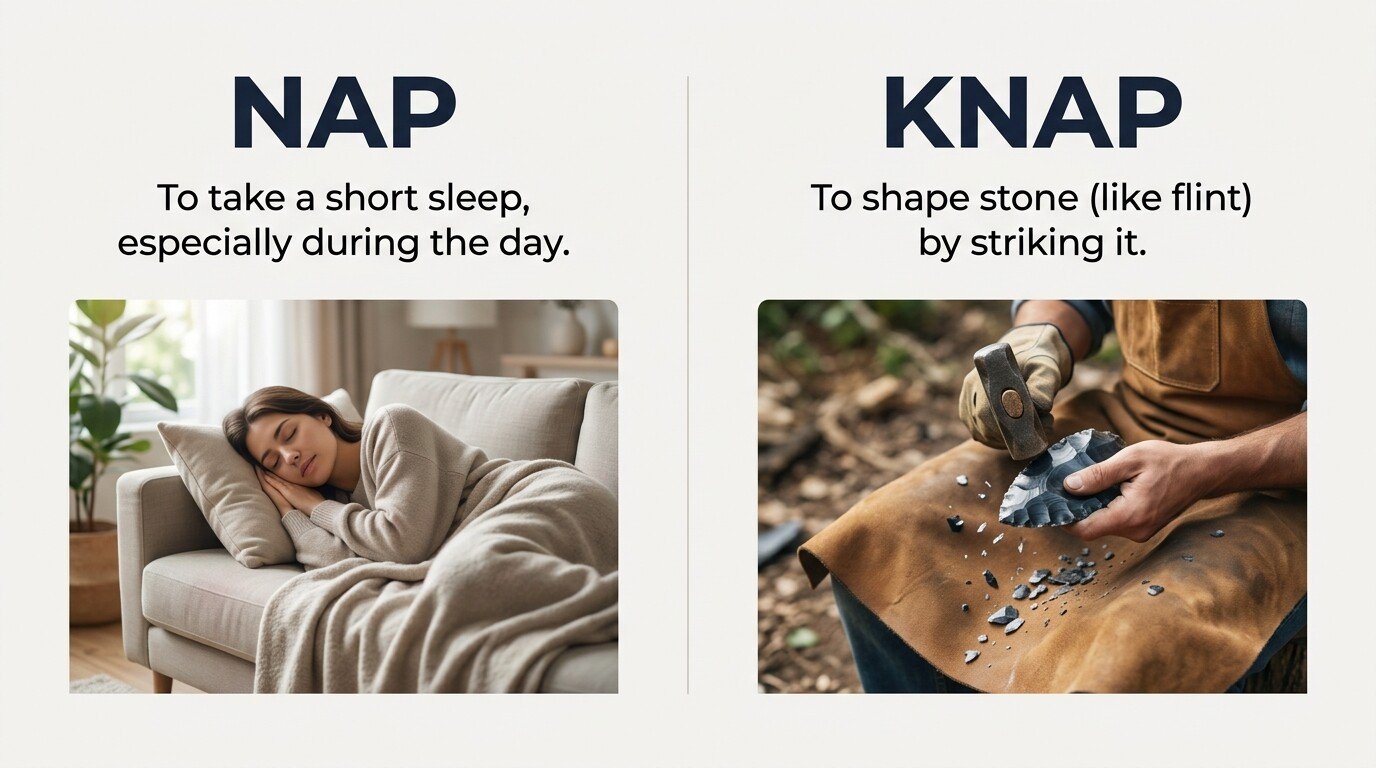
A nap is a short sleep, while knap is a much less common word with meanings linked to striking, shaping stone, or a hilltop.
Imagine you are tired after a long day at work. You sit on the sofa and close your eyes for twenty minutes. You have taken a nap. Now imagine reading an old book that says a small hill has a “knap.” You may stop and wonder if the writer meant “nap.” This is why people search for nap or knap when they are unsure about the spelling or meaning.
The two words look almost the same, but they are not normally used in the same way. Nap is a common English word. It usually means a short period of sleep. It can also describe the soft surface of cloth. Knap is rare in everyday English. It can mean to strike or break something sharply, especially stone, and it can also mean the top or crest of a hill in older or dialectal English.
Understanding nap or knap helps English learners avoid spelling mistakes and understand older texts, history, and specialist writing.
Pronunciation of Nap and Knap
US Pronunciation
- nap: /næp/
- knap: /næp/
UK Pronunciation
- nap: /næp/
- knap: /næp/
The two words are normally pronounced the same. The k in knap is silent.
Learn more abouthttps://personaor.com/proper-or-propper/
Difference Between Nap or Knap
1. Basic Meaning
Nap usually means a short period of sleep.
Knap has several rare meanings. It can mean to strike sharply, break or shape stone, or refer to the crest of a hill.
Examples:
- I need a quick nap.
- The baby had a nap after lunch.
For knap:
- Early people learned to knap stone.
- The old path crossed a small knap.
2. Frequency
Nap is common in modern English.
Knap is uncommon. It is more likely in historical, technical, dialect, or specialist writing.
Examples:
- I took a nap before dinner.
- Archaeologists study how people knapped stone tools.
3. Part of Speech
Nap can be a noun or a verb.
Knap can also be a noun or a verb, but its uses are much less common.
Examples:
- I took a nap.
- I will nap for ten minutes.
For knap:
- He learned to knap flint.
- The old knap stood above the valley.
4. Meaning Related to Sleep
Only nap commonly refers to sleeping.
Examples:
- She took a short nap.
- The child is napping now.
You should not write:
- ❌ I need a knap.
- ❌ The baby is knapping because it is sleeping.
Use nap instead.
5. Meaning Related to Stone
Knap can describe striking or shaping stone.
The related word knapping is used in archaeology and the study of stone tools.
Examples:
- The expert can knap flint.
- The tool was made by knapping stone.
6. Meaning Related to Hills
In older or dialectal English, knap can mean a hill, hilltop, or crest of rising ground.
Examples:
- The sheep stood on the knap.
- They reached the knap before sunset.
This meaning is not common in everyday modern English.
7. Silent Letter
Knap begins with kn, but the k is silent.
Examples:
- nap sounds like knap.
- knap does not have a spoken k sound.
8. Modern Everyday Use
Nap is useful in daily conversation.
Knap is rarely needed in normal conversation.
Examples:
- “I am tired. I need a nap.”
- “The archaeologist used knapping techniques.”
9. Writing Context
Use nap in casual, academic, business, and everyday writing when you mean a short sleep.
Use knap only when its special meaning is intended.
Examples:
- The patient took a short nap.
- The researcher studied ancient stone knapping.
10. Spelling Choice
If you mean short sleep, always choose nap.
If you mean striking or shaping stone, knap may be correct.
Examples:
- I had a nap after lunch.
- The hunter learned to knap flint.
Nature and Behaviour of Nap and Knap
Nature of Nap
Nap is a normal and useful everyday word. It describes a short period of sleep, often during the day. It can also describe the raised fibers on cloth. Oxford lists both the sleep meaning and the cloth meaning.
A nap is usually short.
Examples:
- Dad took a nap.
- I feel better after a nap.
Nature of Knap
Knap is a rare word with several historical meanings. As a verb, it can mean to strike sharply or shape stone by striking it. As a noun, it can refer to a hilltop or rising ground.
Examples:
- The craftsman knapped the flint.
- They walked over the knap.
Why People Get Confused About Nap and Knap
The main reason is simple: nap and knap sound the same.
The spelling is different, but the pronunciation is usually identical. The silent k makes knap especially confusing for learners.
People may also see knap in older books or specialist articles and assume it is a spelling mistake.
It is not always a mistake. Knap is a real English word. It simply has different and much less common meanings.
Comparison Table
| Feature | Nap | Knap |
| Common word? | Yes | No, usually uncommon |
| Pronunciation | /næp/ | /næp/ |
| Silent letter | No | Yes, k |
| Main meaning | Short sleep | Strike, shape stone, or hilltop |
| Used as a verb? | Yes | Yes |
| Used as a noun? | Yes | Yes |
| Everyday use | Very common | Rare |
| Stone-tool meaning | No | Yes |
| Hilltop meaning | No | Yes, in older/dialectal use |
| Best choice for sleep | Yes | No |
The Origin of Nap and Knap
The history of nap is old. The verb comes from Middle English nappen and Old English hnappian, meaning to doze, slumber, or sleep lightly.
The noun meaning a short sleep developed from this verb.
The history of knap is more complex. One branch comes from Old English cnæp/cnæpp, meaning a summit, top, knob, or similar raised point. Another verb sense developed around striking or making a sharp sound.
So, although nap and knap look related, they have separate histories and meanings.
British vs American English
There is no major British-American spelling difference between nap and knap.
Both varieties use nap for a short sleep.
Examples:
- British English: I had a nap after lunch.
- American English: I had a nap after lunch.
The word knap is also spelled the same way in both varieties when the rare word is needed.
The bigger difference is frequency. Modern speakers in both the UK and US are much more likely to use nap than knap.
Which One Should You Use?
If you are talking about sleep, use nap.
US English:
- I need a nap.
UK English:
- I need a nap.
For global English, nap is the safe and natural choice when you mean a short sleep.
Use knap only when you are talking about its specific meanings, such as stone shaping or an old word for a hilltop.
If you are unsure, check the context before choosing the spelling.
Common Mistakes
Mistake 1: Using knap for sleep
❌ I took a knap after work.
✅ I took a nap after work.
Mistake 2: Pronouncing the k
❌ Saying the k sound in knap.
✅ The k is silent.
Mistake 3: Thinking knap is always a spelling error
❌ “Knap is not a real word.”
✅ Knap is a real word, but it is uncommon.
Mistake 4: Using nap for stone shaping
❌ The expert napped the flint.
✅ The expert knapped the flint.
Mistake 5: Treating the words as synonyms
Nap and knap are not normal synonyms.
They may sound alike, but their meanings are different.
Everyday Usage Examples
In Emails
I may take a short nap during my lunch break.
This is natural and clear.
On Social Media
That twenty-minute nap saved my day!
This is a normal modern use.
In News
Archaeologists found evidence of ancient stone knapping.
This is suitable for a report about archaeology.
In Formal Writing
The study examines traditional methods of flint knapping.
Here, knapping has a specific technical meaning.
In Daily Conversation
I am really tired. I need a nap.
This is one of the most common uses of nap.
Usage Trends
Nap is a normal modern English word. Dictionaries list it as a common word for a short period of sleep.
Knap is far less common. Its stone-working sense still appears in archaeology, history, and survival writing. Its hilltop sense is mainly old, dialectal, or literary.
This means modern English learners will encounter nap much more often.
If you are writing general content, choose nap when you mean sleep.
Metaphors and Similes
Nap can appear in figurative expressions.
“Caught napping”
This means someone was not ready or alert.
Example:
The team was caught napping when the other side scored.
Oxford records catch somebody napping as an expression meaning to gain an advantage when someone is not ready.
“Like a cat taking a nap”
This can describe someone resting peacefully.
Example:
He slept like a cat taking a warm nap.
Knap has fewer common modern metaphors because the word itself is rare.
Connotative Meaning
Positive Meaning
Nap can have a positive feeling when it suggests rest and refreshment.
Example:
A short nap made me feel fresh.
Negative Meaning
A nap can sometimes suggest laziness or lost time, depending on the situation.
Example:
I wasted the afternoon by taking a long nap.
Neutral Meaning
Most uses of nap are neutral.
Example:
The baby took a nap.
Knap is usually neutral when used in technical or historical contexts.
Example:
The researcher studied stone knapping.
Idioms and Proverbs
There are a few useful expressions connected with nap.
Catch Someone Napping
This means to find someone unprepared.
Example:
The sudden question caught me napping.
Catnap
A catnap is a very short sleep.
Example:
I had a quick catnap before dinner.
Power Nap
A power nap is a short nap taken to regain energy.
Example:
She took a power nap before her meeting.
There are no widely used modern idioms based on knap.
Literature and Movies
The word nap appears naturally in English literature because sleep and rest are common themes. It is also common in modern stories, novels, and children’s books.
Knap is much less common in general literature. Its hilltop meaning belongs more to older English, dialect writing, and descriptions of landscapes. Its stone-working meaning is more common in historical and archaeological writing.
The related idea of stone knapping also appears in films about early human life and prehistoric technology. For example, Quest for Fire (1981), a French-Canadian film directed by Jean-Jacques Annaud, focuses on prehistoric humans and survival.
The key point is that nap belongs to normal everyday English, while knap often appears in specialized, historical, or dialect contexts.
Why This Difference Matters
Knowing the difference between nap and knap helps you write clearly.
If you use knap when you mean sleep, readers may think you made a spelling mistake.
If you use nap when discussing stone tools, you may change the meaning of your sentence.
The difference also teaches an important English lesson. Some words sound exactly alike but have different spellings and meanings. These are called homophones.
Learning them helps students improve spelling, reading, writing, and listening skills.
Usefulness in Daily Life
Nap is useful in everyday communication.
You can use it when talking about:
- Sleep
- Rest
- Babies
- Travel
- Work breaks
- Health and energy
- Daily routines
For example:
I will take a nap before the flight.
Knap is useful in more specific situations. You may see it in:
- Archaeology
- History
- Stone-tool studies
- Older literature
- Dialect writing
- Descriptions of hills
Most English learners will need nap much more often.
Situational Preference
Choose nap whenever you mean a short period of sleep. It is correct in conversations, emails, school writing, blogs, and formal writing. Use knap only when the context clearly calls for its special meaning. For example, an archaeologist may write about knapping flint, while a historical text may use knap for a hilltop. In modern global English, nap is the much safer choice for everyday use. If you see knap in a book, do not automatically assume it is a spelling error. Check the sentence first. The context will usually tell you which meaning the writer intends.
Possible short question
Is nap or knap correct for sleep?
Nap is correct when you mean a short period of sleep.
Is knap a real English word?
Yes. Knap is a real English word, but it is uncommon in everyday English.
Are nap and knap pronounced the same?
Yes. They are normally pronounced the same, with the k in knap silent.
What does knap mean?
Knap can mean to strike sharply, shape stone by striking it, or refer to the top or crest of a hill in older or dialectal English.
Can I write “I took a knap”?
No, not if you mean sleep. Write, “I took a nap.”
What is knapping?
Knapping is the process of striking stone to shape it, especially when making stone tools.
Which word is more common?
Nap is much more common in modern everyday English.
Conclusion
The difference between nap or knap is mainly a difference in meaning and use. Nap is the common word. It usually means a short period of sleep. It can also refer to the raised surface of cloth. Knap is a much rarer word. It can describe striking or shaping stone, and it can also mean a hilltop or raised piece of land in older or dialectal English. he two words are usually pronounced the same. This makes them easy to confuse, especially for English learners. The silent k in knap adds to the confusion. For everyday English, remember one simple rule: use “nap” when you mean sleep. Use knap only when the context involves its special historical, geographical, or stone-working meanings.

I’m Daim Abbas, an English language enthusiast, content writer, and SEO writer. I create clear and practical content about word meanings, synonyms, vocabulary, and commonly confused English words. I’m passionate about making English easy to understand while creating helpful, reader-friendly, and SEO-optimized content.