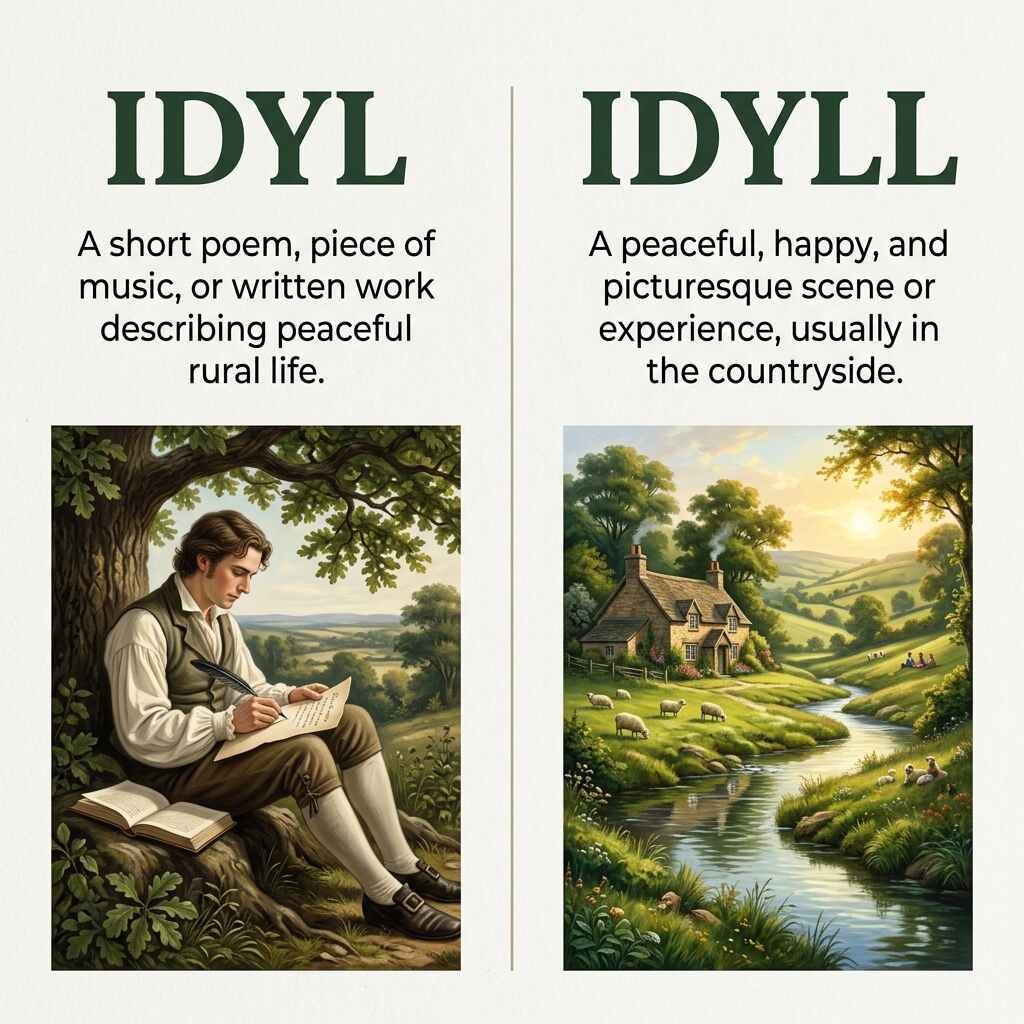
“Idyll” is the standard and more common spelling, while “idyl” is a less common variant with the same basic meaning.
Imagine spending a quiet afternoon in a small village. Birds are singing. The sun is warm. Children are playing near a green field. There is no noise or stress. You might call this peaceful scene an idyll. You may also see it written as idyl.
This is why people search for idyl or idyll. The two words look almost the same. They also have the same main meaning. This can make spelling and word choice confusing. English learners may wonder which form is correct. Writers may also want to know which spelling is better for formal writing.
In this guide, we will explain idyl or idyll in simple English. You will learn their meanings, pronunciation, history, differences, usage, and common mistakes. You will also see examples from daily and formal writing. By the end, you will know which form to choose and why idyll is usually the safest choice.
Pronunciation
Idyl — US English
Idyl is pronounced with two syllables. The stress falls on the first syllable.
Idyl — UK English
The British pronunciation is very similar to the American pronunciation.
Learn more abouthttps://personaor.com/england-or-uk/
Difference Between Idyl or Idyll
1. Spelling
The biggest difference is spelling.
Idyl has four letters.
Idyll has five letters and ends in -yll.
Examples:
- The poem describes a rural idyll.
- The old spelling idyl can also be found in some texts.
2. Standard Form
Idyll is the standard spelling in modern English.
Idyl is a recognized variant, but it is less common.
Examples:
- The village looked like an idyll.
- The novel presents country life as an idyll.
3. Meaning
Both words can describe a peaceful or happy scene.
They can also describe a simple and pleasant period of life.
Examples:
- Their summer holiday was an idyll.
- The painting shows a rural idyll.
4. Pronunciation
The two words are normally pronounced the same.
This means you cannot usually hear the difference between them.
Examples:
- She read about an idyll in the poem.
- He used the older spelling idyl in his essay.
5. Frequency
Idyll is much more common in present-day English.
Idyl is less common.
Examples:
- “An English country idyll” sounds natural in modern writing.
- “An English country idyl” is possible but less usual.
6. Formal Writing
For formal writing, idyll is usually the better choice.
It is familiar to more readers.
Examples:
- The book presents village life as an idyll.
- The report describes the area as a rural idyll.
7. Literature
The word idyll has a strong connection with literature.
An idyll can be a short poem or literary work about peaceful rural life.
Examples:
- The poet wrote an idyll about farm life.
- The collection contains several pastoral idylls.
8. Historical Spelling
Idyl is not simply a spelling mistake. It has been used as a variant spelling.
Older books and literary texts may use it.
Examples:
- The old book uses idyl.
- A modern edition may use idyll instead.
9. Word Choice
If you are unsure, choose idyll.
It is easier for modern readers to recognize.
Examples:
- The quiet island was a perfect idyll.
- The family wanted to return to their peaceful idyll.
10. SEO and Online Writing
For modern online writing, idyll is usually the stronger main form because it is the more familiar spelling.
However, idyl or idyll can be useful as a comparison keyword because people search for spelling differences.
Examples:
- Is idyl or idyll correct?
- Learn the difference between idyl or idyll.
Nature and Behaviour of Idyl or Idyll
Nature of Idyl
Idyl describes a peaceful or pleasant scene, time, or way of life. It often suggests beauty, simplicity, and calm.
The word can be used for a real place or an imagined situation.
Example:
- The small farm was an idyl of quiet country life.
Nature of Idyll
Idyll has the same core meaning. It is often used for a peaceful picture of life, especially rural life.
It can also describe a perfect or happy period.
Examples:
- Their childhood was a happy idyll.
- The village seemed like an idyll.
Why People Get Confused About Idyl or Idyll
People get confused because the two words:
- Look almost identical.
- Have the same basic meaning.
- Are pronounced almost the same.
- Can both appear in older and modern texts.
- Are connected with peaceful scenes and rural life.
The extra l in idyll is the main visual difference.
Many learners see idyl and think it is a spelling mistake. It is not. It is a real variant. However, idyll is the more common modern form.
Comparison Table
| Feature | Idyl | Idyll |
| Part of speech | Noun | Noun |
| Main meaning | Peaceful scene or period | Peaceful scene or period |
| Pronunciation | Similar to idyll | Similar to idyl |
| Spelling | Less common | More common |
| Modern usage | Less frequent | Standard choice |
| Literary use | Yes | Yes |
| Rural meaning | Yes | Yes |
| Formal writing | Possible | Preferred |
| Casual writing | Possible | Preferred |
| Safe modern choice | Usually no | Yes |
The Origin of Idyl or Idyll
The history of idyll goes back to ancient Greek.
The English word comes from the Greek word eidyllion, which meant a small picture, short poem, or little image. It is related to the idea of presenting a small and clear picture through words.
The word later became connected with short poems about peaceful country life.
One important early writer linked with idylls is Theocritus, an ancient Greek poet. His Idylls presented scenes of rural life, shepherds, nature, love, and simple human experiences.
The word later entered other European languages and eventually became part of English.
Idyl developed as a spelling variant. Today, both forms can be found, but idyll remains the more widely accepted modern spelling.
British vs American English
There is no major British-versus-American spelling difference between idyl and idyll.
Both forms can appear in English on both sides of the Atlantic.
The main difference is frequency and preference.
Idyll is the safer choice in both British and American English.
Examples:
- British: The village was a rural idyll.
- American: The village was a rural idyll.
You may find idyl in older literature or specialized writing. It should not be treated as an American-only or British-only word.
Which One Should You Use?
For most modern writing, use idyll.
If you are writing an article, school assignment, email, report, or professional document, idyll is the best choice.
For US English
Use idyll.
For UK English
Use idyll.
For Global English
Use idyll because it is easier for readers around the world to recognize.
You can use idyl when you are quoting an older text, discussing historical spelling, or following a source that uses that form.
Common Mistakes
Mistake 1: Thinking Idyl Is Always Wrong
Wrong idea: “Idyl is not a real word.”
Correction: Idyl is a real spelling variant.
Mistake 2: Using Idyl in Every Situation
Because idyl is valid, some writers may use it freely.
Better: Choose idyll for normal modern writing.
Mistake 3: Thinking They Have Different Meanings
They usually have the same core meaning.
Correct: Both can describe a peaceful or ideal scene.
Mistake 4: Assuming They Have Different Pronunciations
They are normally pronounced alike.
The spelling changes, but the spoken form does not usually change.
Mistake 5: Treating Idyl as a Typo
In an old book, idyl may be intentional.
Always consider the date and style of the source.
Everyday Usage Examples
In an Email
- “The quiet countryside was a welcome idyll after a busy month.”
On Social Media
- “Our weekend in the hills felt like a little idyll.”
In News Writing
- “The small coastal town was once seen as a peaceful idyll.”
Formal Writing
- “The author presents rural life as an idealized idyll.”
In a Story
- “For many years, the farm remained a peaceful idyll.”
In an Academic Essay
- “The poem creates an idyll of rural life.”
Usage Trends
Modern English strongly favors idyll.
You are more likely to see idyll in books, articles, dictionaries, essays, and online content.
Idyl still exists, but it has a much smaller role in current English.
This makes the choice simple for most writers. If you are creating new content, idyll is usually the best spelling.
The shorter form can still matter when researching historical texts. It may also appear in older editions, literary discussions, or works that prefer the variant spelling.
Metaphors and Similes
The word idyll is often used in a figurative way.
Metaphor
- The island was an idyll of peace.
- Their childhood became an idyll in her memory.
Here, idyll compares a situation to a perfect and peaceful world.
Simile
- The village was like an idyll in the middle of the busy city.
- Their holiday felt like an idyll.
These expressions show how the word can suggest more than simple quietness. It can create an image of beauty, peace, and happiness.
Connotative Meaning
Positive Meaning
Idyll usually has a positive feeling.
It can suggest:
- Peace
- Beauty
- Happiness
- Nature
- Simplicity
- Comfort
Example:
- The cottage offered a peaceful idyll away from city noise.
Negative Meaning
The word can sometimes have a negative or critical meaning.
A writer may suggest that an idyllic picture is too perfect or unrealistic.
Example:
- The novel challenges the idea of the countryside as a perfect idyll.
Neutral Meaning
The word can simply describe a peaceful scene without strong praise or criticism.
Example:
- The poem presents an idyll of village life.
Idioms and Proverbs
There is no major common English idiom that specifically contains idyl or idyll.
There is also no widely used traditional proverb built around the word.
However, English has many expressions about peace and simple living.
For example:
- “A peaceful life”
- “A quiet retreat”
- “A slice of heaven”
- “The simple life”
Example:
- The cabin gave them a taste of the simple life.
These expressions can sometimes communicate an idea similar to an idyll.
Literature and Movies
Literature
The word idyll has a strong literary history.
A famous example is Theocritus’s Idylls, a collection of pastoral poems from ancient Greece, generally dated to the 3rd century BCE. The poems often show shepherds, nature, love, music, and rural life.
Later writers also used the idea of the idyll. The form became important in pastoral and romantic literature.
An idyll does not always mean that the story is completely happy. Writers can use the peaceful setting to contrast with conflict or change.
Movies
Films often show idyllic settings even when they do not use the word in their titles.
For example, A Room with a View (1985), a British-American romantic drama, uses beautiful Italian and English settings to create a strong sense of beauty and escape. The peaceful scenes help create an idealized picture of life.
Another example is The Tree of Wooden Clogs (1978), an Italian historical drama. It presents rural life and everyday experiences in an older agricultural community. Its quiet countryside setting can be discussed through the idea of a rural idyll.
Why This Difference Matters
Understanding idyl or idyll matters because spelling affects clear communication.
If you use the standard modern spelling, readers can understand your meaning quickly.
This is especially important for:
- Students
- ESL learners
- Bloggers
- Content writers
- Journalists
- Authors
- Researchers
Knowing that idyl is a valid variant also helps you read older books without thinking you have found an error.
The lesson is simple: do not confuse a less common spelling with a wrong spelling. At the same time, choose the form that is most useful for your audience.
Usefulness in Daily Life
You may not use idyll every day. It is less common than words such as “peaceful,” “beautiful,” or “quiet.”
Still, it can be useful when you want to describe a whole scene or period of life.
For example, instead of saying:
- “The village was very peaceful.”
You can write:
- “The village was a rural idyll.”
The second sentence gives a stronger picture. It suggests not only peace but also beauty, simplicity, and an ideal way of life.
This makes idyll useful in creative writing, travel writing, literature, journalism, and descriptive content.
Situational Preference
When writing for modern readers, idyll is the better choice. Use it in school work, blogs, news articles, reports, and professional writing. If you are reading an older book and see idyl, do not assume it is wrong. It is a recognized variant. Use idyl when you need to preserve an original spelling or discuss historical language. For general global English, idyll is the clearest option. It is familiar, standard, and widely understood. In short, choose idyll unless you have a specific reason to use the less common form idyl.
Possible short question
Is idyl or idyll correct?
Both are correct. Idyll is the standard and more common modern spelling. Idyl is a less common variant.
Is idyl a real word?
Yes. Idyl is a real English word. It has the same basic meaning as idyll.
Is idyll more common than idyl?
Yes. Idyll is much more common in modern English.
Are idyl and idyll pronounced the same?
Yes. They are normally pronounced the same or very nearly the same.
What does idyll mean?
An idyll is a peaceful, happy, or ideal scene, period, or way of life. It can also mean a short literary work about peaceful rural life.
Should I use idyl in formal writing?
You can, but idyll is usually the better choice. It is more familiar to modern readers.
What is the plural of idyll?
The plural is idylls.
For example:
- “The poet wrote several idylls about country life.”
Conclusion
The choice between idyl or idyll is mainly a question of spelling and modern usage. Both words are valid, and both have the same basic meaning. They can describe a peaceful scene, a happy period, an ideal way of life, or a literary work about simple rural life. However, idyll is the standard and more common spelling in modern English. It is the best choice for most readers and most types of writing. This includes school work, websites, blogs, formal documents, and everyday written English. Idyl is still useful to know. You may see it in older books, historical texts, or sources that prefer the variant spelling. It is not automatically a mistake. If you are unsure which word to use, remember one simple rule: choose “idyll” for modern English.

I’m Daim Abbas, an English language enthusiast, content writer, and SEO writer. I create clear and practical content about word meanings, synonyms, vocabulary, and commonly confused English words. I’m passionate about making English easy to understand while creating helpful, reader-friendly, and SEO-optimized content.











1 thought on “Idyl or Idyll: Which Spelling Is Correct?”