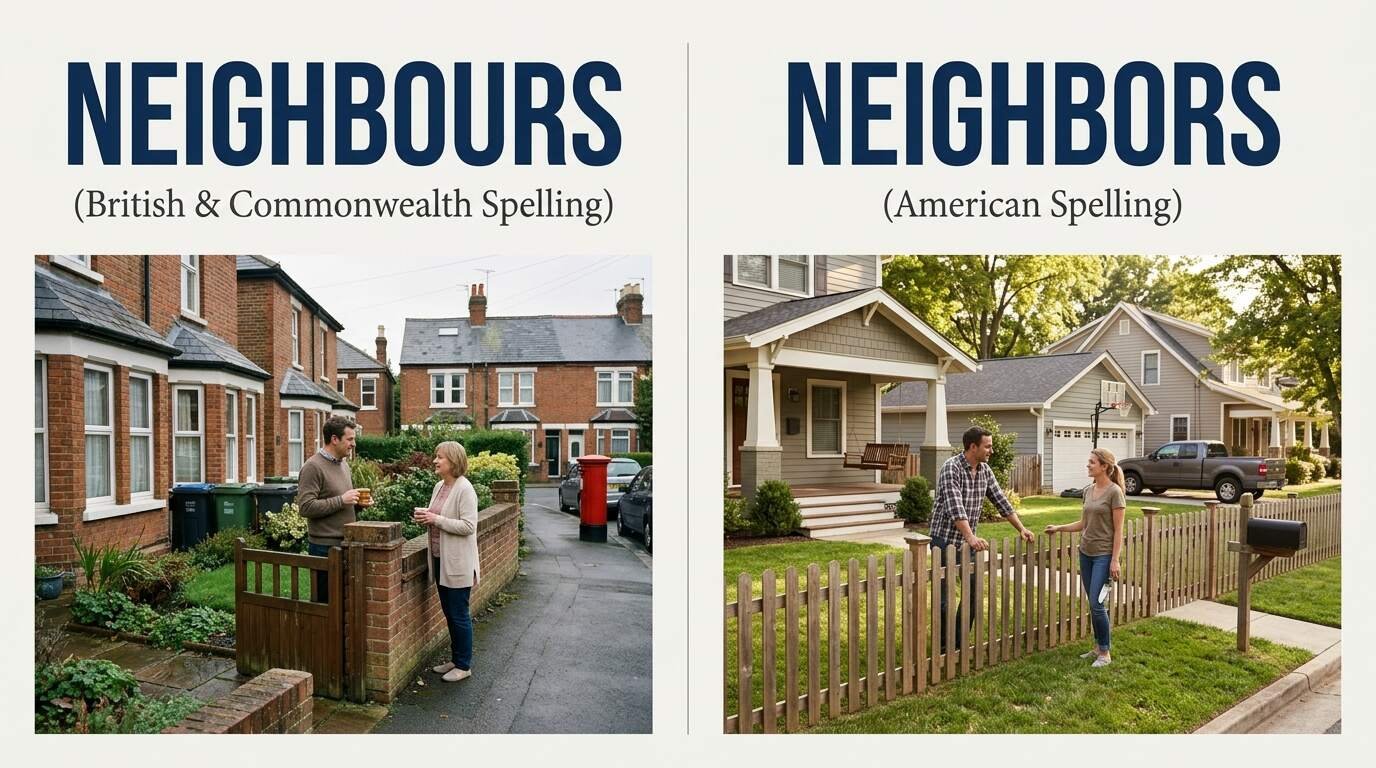
“Neighbours” is the British English spelling, while “neighbors” is the American English spelling. Both mean people who live near you.
Imagine you move into a new house. The people living next door smile, introduce themselves, and offer to help you. They are your neighbours if you use British English. In American English, they are your neighbors. The meaning does not change. Only the spelling is different.
The words neighbours or neighbors often confuse English learners because both forms are correct. People also search for neighbours or neighbors when writing school work, emails, websites, or social media posts. They want to know which spelling they should use.
This difference is mainly about British and American English. British English uses neighbours, while American English uses neighbors. Canadian, Australian, and other forms of English may also use spelling patterns closer to British English.
Pronunciation
UK pronunciation
neighbours: /ˈneɪ.bəz/
US pronunciation
neighbors: /ˈneɪ.bɚz/
The two words sound almost the same in normal speech. The main difference is the spelling.
Learn more about https://personaor.com/anterior-or-posterior/
Difference Between Neighbours or Neighbors
1. Spelling
The biggest difference is spelling.
British English writes neighbours with -our. American English writes neighbors with -or.
Examples:
- My neighbours are very friendly.
- My neighbors are very friendly.
2. British English
Neighbours is the standard British English spelling.
It is common in the United Kingdom and in many forms of English influenced by British spelling.
Examples:
- Our neighbours invited us for dinner.
- We know all our neighbours.
3. American English
Neighbors is the standard American English spelling.
It follows the American preference for -or in words such as color and favorite.
Examples:
- Our neighbors have a new car.
- I met my neighbors yesterday.
4. Meaning
Both words have the same basic meaning.
A neighbour or neighbor is a person who lives close to you.
Examples:
- Sarah is my neighbour.
- Tom is my neighbor.
5. Pronunciation
The pronunciation is very similar.
The spelling changes, but the spoken word is nearly the same.
Examples:
- British speakers say neighbours.
- American speakers say neighbors.
6. Singular Form
The singular form also changes in spelling.
British English uses neighbour. American English uses neighbor.
Examples:
- My neighbour has a dog.
- My neighbor has a dog.
7. Plural Form
The plural follows the same spelling rule.
British English: neighbours
American English: neighbors
Examples:
- The neighbours are outside.
- The neighbors are outside.
8. Formal Writing
Both forms are correct in formal writing.
The important point is consistency.
Examples:
- British report: “Local neighbours raised concerns.”
- American report: “Local neighbors raised concerns.”
9. SEO and Online Writing
Both spellings can appear in online searches.
A writer should choose the spelling used by the target audience.
Examples:
- A UK website may use neighbours.
- A US website may use neighbors.
10. Consistency
Do not switch between the two spellings without a reason.
Choose one style and use it throughout your text.
Examples:
- UK article: “Our neighbours are helpful.”
- US article: “Our neighbors are helpful.”
Nature and Behaviour of Neighbours or Neighbors
Neighbours
The word neighbours is a plural noun in British English. It describes people who live near one another.
Neighbours can be close friends, friendly families, or simply people living nearby.
Examples:
- Our neighbours help us often.
- The neighbours are having a party.
Neighbors
Neighbors has exactly the same meaning in American English.
It describes people who live close to another person, home, or place.
Examples:
- Our neighbors are kind.
- The neighbors brought us food.
Why People Get Confused About Neighbours or Neighbors
People get confused because the two words have the same meaning and almost the same pronunciation.
The only major difference is the spelling.
English has many British and American spelling differences. For example:
- colour → color
- favourite → favorite
- honour → honor
- neighbour → neighbor
These differences can make learners wonder which form is correct.
The answer is simple: both are correct, but they belong to different spelling systems.
Comparison Table
| Feature | Neighbours | Neighbors |
|---|---|---|
| English variety | British English | American English |
| Singular | neighbour | neighbor |
| Plural | neighbours | neighbors |
| Meaning | People living nearby | People living nearby |
| Pronunciation | Almost the same | Almost the same |
| Main difference | -our | -or |
| Common use | UK and British-style English | US English |
| Formal use | Correct | Correct |
| Informal use | Correct | Correct |
| Meaning change | No | No |
The Origin of Neighbours or Neighbors
The word comes from Old English nēahgebūr, which referred to a person who lived nearby.
The word developed over many centuries. Its parts were linked to ideas such as “near” and “dweller.”
The spelling later developed differently in British and American English.
American English often removed the u from words ending in -our. This helped create forms such as neighbor.
British English kept neighbour.
The spelling difference does not represent a difference in meaning.
British vs American English
British and American English are both forms of English. They share the same basic grammar and vocabulary, but spelling can differ.
British English
British English uses neighbour and neighbours.
Examples:
- My neighbour is a teacher.
- We invited our neighbours.
American English
American English uses neighbor and neighbors.
Examples:
- My neighbor is a teacher.
- We invited our neighbors.
Other examples include:
- colour → color
- labour → labor
- humour → humor
- behaviour → behavior
Which One Should You Use?
If you are writing for a UK audience, use neighbours.
If you are writing for a US audience, use neighbors.
For a global audience, either form can work. However, choose one spelling style and use it consistently.
If your website mainly targets American readers, neighbors is usually the better choice. If it targets British readers, choose neighbours.
For school, work, or professional writing, follow the English style required by your teacher, employer, publisher, or client.
Common Mistakes
Mistake 1: Mixing styles
Wrong style:
- Our neighbours love the color of our house.
This mixes British and American spelling.
Better British style:
- Our neighbours love the colour of our house.
Better American style:
- Our neighbors love the color of our house.
Mistake 2: Thinking one spelling is wrong
Both forms are correct.
The difference is regional.
Mistake 3: Using “neighbour” for an American audience
This is not grammatically wrong, but neighbor is the normal American spelling.
Mistake 4: Changing the pronunciation
The spelling difference does not create a major meaning or pronunciation difference.
Everyday Usage Examples
In emails
British:
Our neighbours have agreed to attend the meeting.
American:
Our neighbors have agreed to attend the meeting.
On social media
British:
Great barbecue with the neighbours today!
American:
Great barbecue with the neighbors today!
In news writing
British:
Local neighbours helped rescue the family.
American:
Local neighbors helped rescue the family.
In formal writing
British:
The council consulted nearby neighbours.
American:
The city consulted nearby neighbors.
Usage Trends
The spelling you see often depends on the country and the website’s target audience.
Neighbours is common in British English. It is also seen in other places that often follow British spelling.
Neighbors is especially common in American English.
Search engines can show both forms because both are valid. Writers should not change their spelling simply because another form appears in search results.
For SEO, the best approach is to write naturally for your intended audience. If your readers are mainly American, use neighbors. If they are mainly British, use neighbours.
Metaphors and Similes
The words can also appear in figurative expressions.
Metaphor
“The two countries are neighbors in the global community.”
Here, neighbors does not mean people living in houses. It means countries that are close or connected.
Simile
“The two villages stood like friendly neighbors.”
This compares the villages to people who live close together.
Examples:
- The two teams became like good neighbors.
- The nearby nations acted like peaceful neighbours.
Connotative Meaning
The words neighbours and neighbors are normally neutral.
Positive tone
They can suggest friendship, support, and community.
Example:
- Our neighbours helped us after the storm.
Negative tone
They can sometimes suggest conflict or disagreement.
Example:
- The neighbors complained about the loud music.
Neutral tone
They can simply describe people who live nearby.
Example:
- Our neighbors moved last week.
The spelling does not change the emotional meaning.
Idioms and Proverbs
The exact words neighbours and neighbors appear in some sayings and expressions.
One well-known proverb is:
“Love thy neighbour as thyself.”
This is a traditional moral teaching about treating people around you with care and respect.
Another useful expression is:
“Good fences make good neighbors.”
This saying suggests that clear boundaries can help people maintain peaceful relationships.
Example:
- We respect each other’s space because good fences make good neighbors.
Literature and Movies
The idea of neighbors appears often in literature because homes and communities create natural stories.
A famous example is The Neighbors, a short story by American writer Katherine Mansfield, published in 1920. It explores relationships, curiosity, and social life.
The idea also appears in movies.
Neighbors, released in 2014 in the United States, is a comedy film about a couple whose quiet life changes when a fraternity moves next door.
These examples show why people living close to one another can create both serious and funny stories.
Why This Difference Matters
This spelling difference matters because English is used around the world.
A student may read a British textbook but watch an American video. A writer may work with readers from both the UK and the US.
Knowing the difference helps learners understand what they read.
It also helps writers avoid accidental spelling changes.
For SEO writers, audience matters even more. A US audience is more likely to expect neighbors, while a UK audience is more likely to expect neighbours.
Neither spelling is better in every situation. The best spelling depends on your audience.
Usefulness in Daily Life
You may see these words in many places.
You can use them when talking about:
- People living next door
- Local communities
- Apartment buildings
- Housing problems
- Community events
- Local news
- Social relationships
- Neighborhood activities
Examples:
- I met my new neighbours today.
- We invited our neighbors for dinner.
- Our neighbours organized a street party.
- My neighbors helped clean the park.
Situational Preference
Use neighbours when writing in British English or for readers who normally use British spelling. Use neighbors when writing for an American audience. In school or professional work, follow the style guide you have been given. For websites, consider your main audience and keep your spelling consistent. If you are writing for a global audience, either form is acceptable, but mixing the two styles can look untidy. The key is not to choose the “better” word. Choose the spelling that matches your audience and your overall English style.
Possible short question
Are neighbours and neighbors the same word?
Yes. They have the same meaning. The difference is spelling.
Which is correct, neighbours or neighbors?
Both are correct. Neighbours is British English, while neighbors is American English.
Is “neighbours” British English?
Yes. Neighbour and neighbours are standard British English spellings.
Is “neighbors” American English?
Yes. Neighbor and neighbors are standard American English spellings.
Do neighbours and neighbors sound different?
They are pronounced almost the same. The main difference is written spelling.
Which spelling should I use for a US website?
Use neighbors if your website mainly targets American readers.
Which spelling should I use for a UK website?
Use neighbours for a British audience.
Conclusion
The difference between neighbours or neighbors is simple. Both words mean people who live near you. The main difference is the spelling used in different forms of English.Neighbours is the British English spelling. Neighbors is the American English spelling. Both are correct, and neither changes the meaning of the word.If you write for people in the UK, use neighbours. If you write for people in the US, use neighbors. For global writing, either form can work, but consistency is important.Understanding this small spelling difference can improve your English writing. It can also help you understand books, websites, news articles, emails, and social media from different English-speaking countries.

I’m Daim Abbas, an English language enthusiast, content writer, and SEO writer. I create clear and practical content about word meanings, synonyms, vocabulary, and commonly confused English words. I’m passionate about making English easy to understand while creating helpful, reader-friendly, and SEO-optimized content.