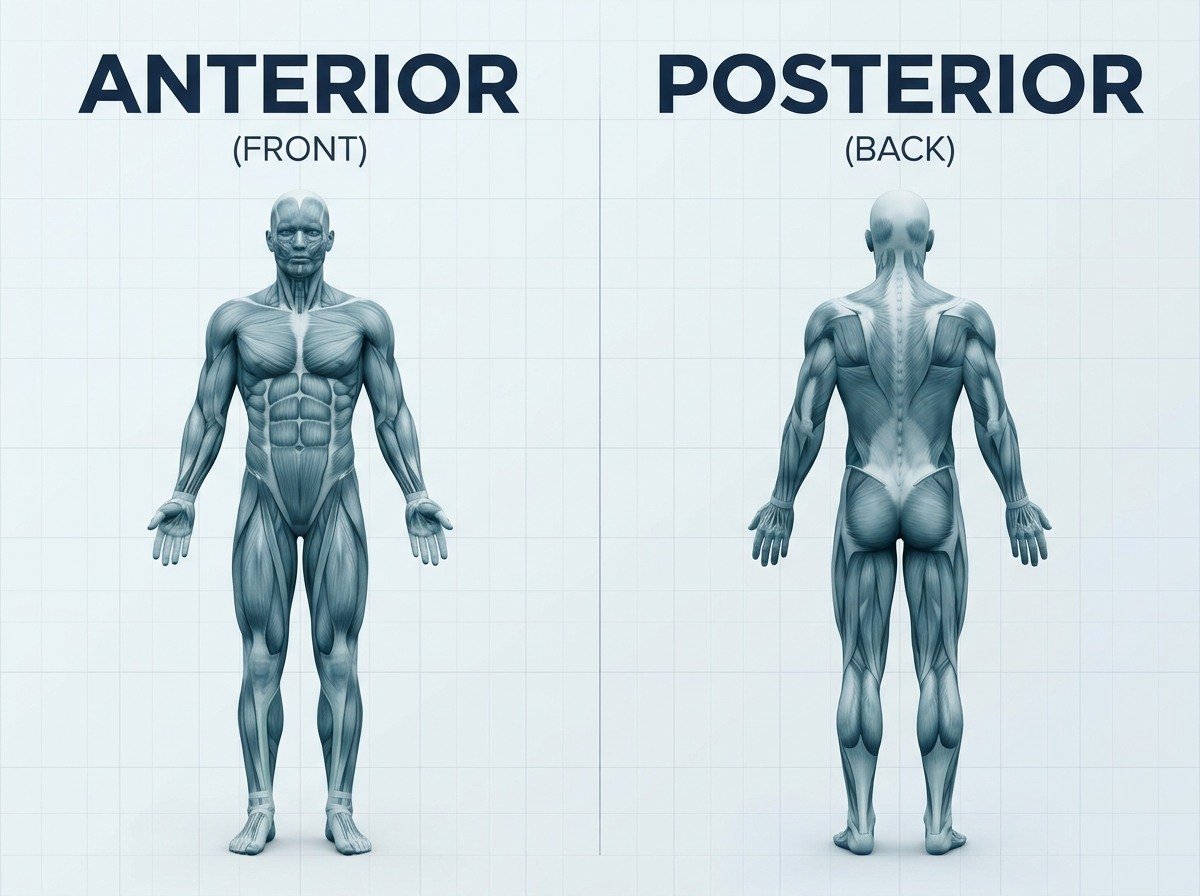
Anterior means toward the front of the body, while posterior means toward the back.
Imagine you are at a doctor’s office. The doctor points to the front of your knee and then the area behind it. You may hear words such as “anterior” and “posterior.” These words can sound hard at first, but their basic meanings are simple. Anterior describes something toward the front. Posterior describes something toward the back.
People often search for anterior or posterior because these terms appear in medical reports, anatomy lessons, fitness guides, and health information. The confusion usually comes from the formal language used in medicine. Someone may know what “front” and “back” mean but still wonder which technical word belongs to each direction.
Understanding anterior or posterior is useful because these words help describe exact body locations. They are also used in biology, dentistry, surgery, and other fields. Once you remember that anterior relates to the front and posterior relates to the back, the difference becomes much easier to understand.
Pronunciation
Anterior
US:
UK:
Posterior
US:
UK: pos-TEER-ee-uh
The stress usually falls on the -TEER- part of both words.
Let us now look at the difference in detail.
learn more abouthttps://personaor.com/schpiel-or-spiel/
Difference Between Anterior and Posterior
1. Basic Direction
Anterior means toward the front.
Posterior means toward the back.
Examples:
- The chest is anterior to the spine.
- The spine is posterior to the chest.
2. Front vs. Back
Anterior is used for the front side of a body or structure. Posterior is used for the back side.
Examples:
- The kneecap is on the anterior side of the knee.
- The back of the knee is on its posterior side.
3. Anatomy
Doctors use these words to describe body positions clearly.
Examples:
- The heart is anterior to the spine.
- The spinal cord is posterior to the heart.
4. Medical Reports
Medical reports often use anterior and posterior instead of “front” and “back.”
Examples:
- “Anterior knee pain” means pain toward the front of the knee.
- “Posterior shoulder pain” means pain toward the back of the shoulder.
5. Position
Anterior describes a position closer to the front. Posterior describes a position closer to the back.
Examples:
- The abdominal muscles are anterior to the spine.
- The back muscles are posterior to the abdominal muscles.
6. Dentistry
Dentists also use these terms when describing teeth and mouth structures.
Examples:
- Front teeth are called anterior teeth.
- Teeth farther back in the mouth are posterior teeth.
7. Biology
Biology uses these terms to explain the position of body parts in animals and humans.
Examples:
- A structure may be anterior to another structure.
- Another structure may be posterior to it.
8. Surgery
Surgeons need exact location words when discussing procedures.
Examples:
- The surgeon may describe an anterior incision.
- A posterior approach may involve the back side of the body.
9. Fitness and Exercise
Fitness articles may use these terms when discussing muscles and movement.
Examples:
- The anterior muscles of the leg are toward the front.
- Posterior muscles are found toward the back.
10. Opposite Meanings
Anterior and posterior are often used as opposites.
Examples:
- Anterior = front.
- Posterior = back.
This simple pair is the easiest way to remember them.
Nature and Behaviour of Anterior and Posterior
Anterior
Anterior is a directional term. It points toward the front of the body or a body structure. It is common in anatomy and medical writing.
For example, the chest is anterior to the spine. The front of the knee is also described as anterior.
Posterior
Posterior is also a directional term. It points toward the back of the body or a body structure.
For example, the spine is posterior to the chest. The back of the knee is posterior.
Neither word is “better.” The correct word depends on the location being described.
Why People Get Confused About Anterior or Posterior
The main problem is that these words are more formal than front and back.
A student may see “anterior” in a textbook and forget what it means. Another person may read “posterior” in a medical report and think it refers to a specific disease.
It does not.
These words mainly describe location and direction.
A simple memory trick is:
- Anterior → front
- Posterior → back
Think of your body facing forward. Your chest is on the anterior side. Your back is on the posterior side.
Comparison Table
| Feature | Anterior | Posterior |
| Basic meaning | Toward the front | Toward the back |
| Opposite | Posterior | Anterior |
| Main use | Anatomy and medicine | Anatomy and medicine |
| Body example | Chest | Back |
| Knee example | Front of knee | Back of knee |
| Tooth example | Front teeth | Back teeth |
| Style | Formal/technical | Formal/technical |
| Common everyday word | Front | Back |
| Used in reports | Yes | Yes |
| Used in biology | Yes | Yes |
Both words are technical terms. Both are useful for describing exact locations.
The Origin of Anterior and Posterior
Both words come from Latin.
Anterior comes from the Latin word anterior, meaning “former,” “earlier,” or “more forward.” Over time, it developed into a term for something located toward the front.
Posterior comes from the Latin posterior, meaning “later” or “following.” It developed into a term connected with the back or a position behind something.
These Latin roots are still visible in modern medical English.
That is why the words may look unusual compared with simple terms such as “front” and “back.”
British vs American English
There is no major spelling difference between American and British English for these words.
Both forms are normally written:
- anterior
- posterior
The meaning also stays the same.
American English example:
- The doctor noted anterior knee pain.
British English example:
- The doctor noted posterior shoulder pain.
The pronunciation can differ slightly between American and British speakers, but the spelling and core meaning remain the same.
Which One Should You Use?
Use anterior when you mean toward the front.
Use posterior when you mean toward the back.
For US English
Both terms are standard in medical and scientific writing.
For UK English
Both terms are also standard and widely used in medicine and science.
For Global English
These are safe terms in medical, academic, and scientific contexts. In casual writing, however, front and back are often easier to understand.
For example:
- Technical: “The injury is on the anterior surface.”
- Simple: “The injury is on the front surface.”
Common Mistakes
Mistake 1: Thinking anterior means back
Wrong: Anterior means toward the back.
Correct: Anterior means toward the front.
Mistake 2: Thinking posterior means front
Wrong: Posterior means toward the front.
Correct: Posterior means toward the back.
Mistake 3: Treating them as diseases
Wrong: “Posterior” is a disease.
Correct: Posterior is a location or direction term.
Mistake 4: Using them without context
These words describe position. The surrounding body part or structure usually gives the full meaning.
Mistake 5: Assuming they have different British and American spellings
They do not normally change spelling between the two varieties of English.
Everyday Usage Examples
In Emails
- “The report describes an anterior injury.”
- “Please review the posterior section of the scan.”
On Social Media
- “I finally understand anterior and posterior positions.”
- “Medical terms are easier when you learn the basic directions.”
In News
- “Doctors reported damage to the anterior part of the structure.”
In Formal Writing
- “The anterior region lies closer to the front of the body.”
- “The posterior region is located toward the back.”
Usage Trends
Anterior and posterior remain common in medical and scientific English.
They appear often in:
- Medical reports
- Anatomy textbooks
- Research papers
- Dental records
- Biology classes
- Physical therapy
- Fitness education
Everyday speakers usually prefer front and back. Technical professionals often choose anterior and posterior because these terms are more exact.
Metaphors and Similes
These words are mainly literal terms, so they are not common in everyday metaphors.
Still, they can sometimes be used creatively.
Example:
- “The old idea stood posterior to the new theory.”
Here, posterior is being used figuratively to suggest something that comes behind or follows another idea.
Another example:
- “His earlier belief was anterior to his new understanding.”
In normal English, however, simpler words such as before, behind, front, and back are usually better.
Connotative Meaning
Anterior
Anterior usually has a neutral meaning. It simply describes location.
Example:
“The anterior part of the knee was examined.”
Posterior
Posterior is also normally neutral.
Example:
“The posterior part of the shoulder was examined.”
Neither word is normally positive or negative. Any emotional meaning usually comes from the situation around the word.
For example, “posterior injury” may sound negative because an injury is negative, not because the word posterior is negative.
Idioms and Proverbs
There are no common English idioms that directly use anterior and posterior in their medical meanings.
English speakers usually use simpler expressions such as:
- “In front of”
- “Behind”
- “At the back”
- “At the front”
Example:
“The shop is in front of the hospital.”
This is more natural in everyday conversation than using a technical anatomical term.
Literature and Movies
Anterior and posterior are most common in medical, scientific, and academic writing rather than general literature.
They may appear in medical nonfiction, anatomy books, research writing, and science-based texts.
For example, anatomy textbooks and medical reference works regularly use both terms to explain body structures.
Movies can also use them when characters discuss medicine, surgery, injuries, or anatomy. Medical dramas from the United States and United Kingdom may use these words in hospital scenes.
However, most movie dialogue uses front and back when the audience does not need technical language.
Why This Difference Matters
Knowing the difference between anterior and posterior can make medical and scientific information much easier to understand.
A patient may see “anterior” in a scan report. A student may find “posterior” in an anatomy textbook. A fitness learner may read about anterior and posterior muscles.
Without knowing these terms, the information can seem difficult.
With the basic rule, the meaning becomes simple:
Anterior = front. Posterior = back.
This distinction also helps people communicate more accurately. Doctors, nurses, dentists, therapists, and scientists need clear location terms. A small change in location can matter when describing an injury or body structure.
For English learners, these words are also useful because they appear in many professional fields.
Usefulness in Daily Life
You may not use these words every day, but they are useful when reading health information.
You may see them in:
- Medical reports
- X-ray descriptions
- MRI reports
- Dental information
- Exercise guides
- Anatomy lessons
- Health websites
- Physical therapy notes
If you understand these two terms, many medical descriptions become easier to read.
For everyday conversation, however, front and back are usually more natural.
Situational Preference
Choose anterior when you are writing or speaking in a medical, scientific, dental, or academic setting and need a precise location. Choose posterior when describing a position toward the back. For casual conversation, use front and back because they are easier for most people to understand. In US and UK English, both technical terms are standard. Global readers also understand them in professional contexts. If your audience may not know medical terms, give the simple meaning too. For example, write “anterior, or front, part of the knee.” This keeps the writing clear and helpful.
POSSIBLE SHORT QUESTION
Is anterior the front or back?
Anterior means toward the front.
Is posterior the front or back?
Posterior means toward the back.
Are anterior and posterior opposites?
Yes. In basic anatomical use, anterior and posterior describe opposite directions: front and back.
Is anterior used in medical English?
Yes. It is very common in anatomy, medicine, dentistry, surgery, and physical therapy.
Is posterior a medical term?
Yes. Posterior is widely used as a medical and anatomical direction term.
Do British and American English spell these words differently?
No. Both varieties normally spell them anterior and posterior.
What is an easy way to remember the difference?
Remember: anterior = front and posterior = back.
Conclusion
Anterior and posterior are important words in anatomy, medicine, biology, and other technical fields. Their meanings are simple once you connect them with basic directions. Anterior means toward the front. Posterior means toward the back. For example, the chest is anterior to the spine, while the spine is posterior to the chest. The front of the knee can be called the anterior knee, while the back of the knee can be called the posterior knee. These terms are not mainly different because of American or British English. Both forms are used in both varieties. The main difference is their direction and position. In casual English, front and back are usually easier. In medical and academic writing, anterior and posterior are more precise. So, when you see anterior or posterior, think of one simple rule: anterior points forward or toward the front, while posterior points backward or toward the back. Once you remember this, these common technical terms become much easier to understand.

I’m Daim Abbas, an English language enthusiast, content writer, and SEO writer. I create clear and practical content about word meanings, synonyms, vocabulary, and commonly confused English words. I’m passionate about making English easy to understand while creating helpful, reader-friendly, and SEO-optimized content.












2 thoughts on “Anterior or Posterior: What Is the Difference?”