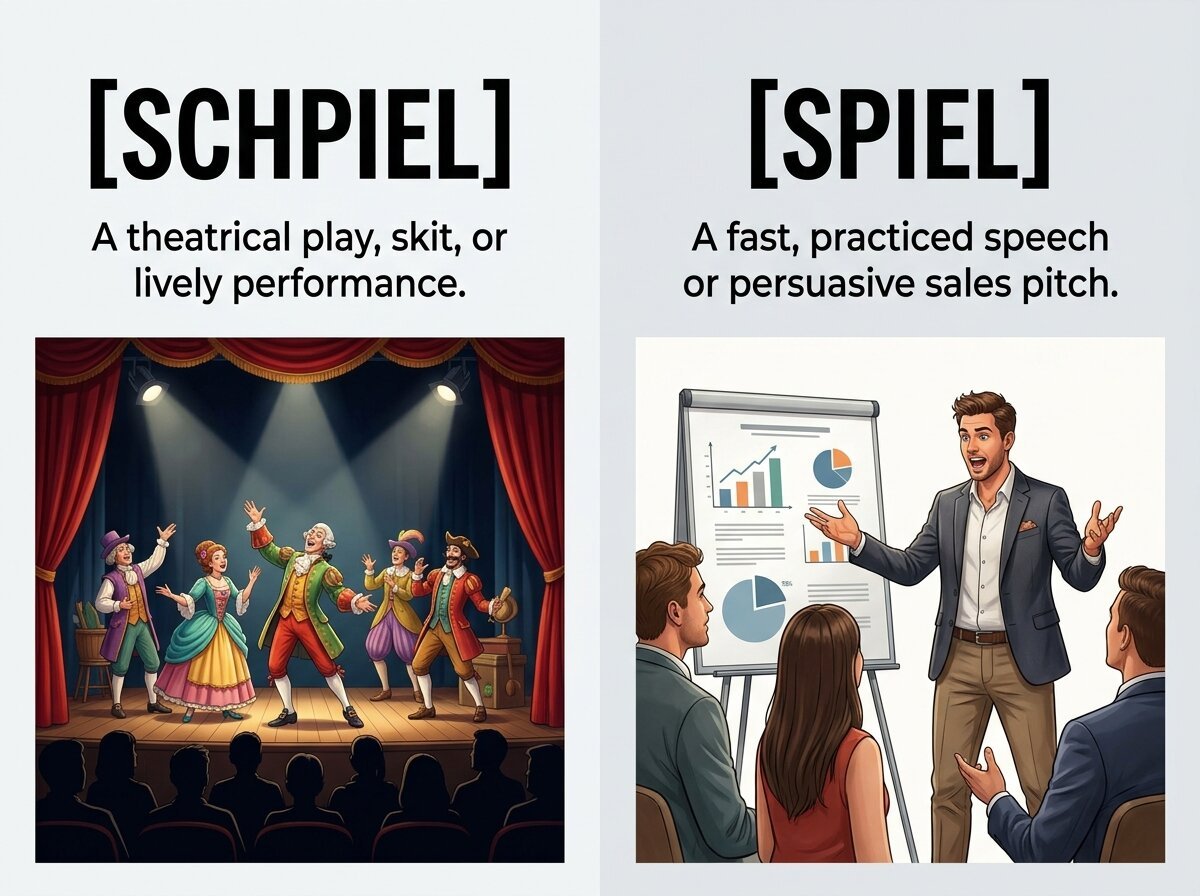
“Spiel” is the standard English spelling, while “schpiel” is a nonstandard variant spelling often influenced by the word’s Yiddish and German roots.
Have you ever heard someone say “spiel” and then wondered how to spell it? You may type schpiel because the word begins with a sound that feels like “sh.” This is a common mistake. Imagine a salesperson explaining a new phone to you. After five minutes, you may say, “I have heard this whole spiel before.” You would normally write spiel, not schpiel.
The word spiel means a long, practiced, persuasive, or sometimes exaggerated talk. It can describe a sales pitch, a familiar explanation, or a prepared speech. The spelling schpiel also appears, especially in informal or Yiddish-influenced writing, but spiel is the safer standard English form.
People search for schpiel or spiel because the pronunciation can make the spelling confusing. They want to know which form to use in an email, article, school paper, or conversation. This guide explains the difference between schpiel or spiel, their meanings, origins, pronunciation, and everyday use.
Pronunciation
Spiel
US: /ʃpiːl/ or /spiːl/
UK: /ʃpiːl/ or /spiːl/
Schpiel
US: usually /ʃpiːl/
UK: usually /ʃpiːl/
The first sound may be heard like sh. This helps explain why some people add ch when spelling the word.
The main point is simple: the spelling does not always show the exact sound.
Now let’s look at the key differences in a simple way.
learn more abouthttps://personaor.com/buffaloes-or-buffalos/
Difference Between Schpiel or Spiel
1. Standard English Spelling
Spiel is the standard spelling used in English.
Schpiel is much less common and is generally treated as a nonstandard or alternate spelling.
Examples:
- The salesman gave his usual spiel.
- I did not want to hear another spiel about the product.
2. Dictionary Use
Spiel is the normal dictionary headword for this English word.
Schpiel may appear as an alternative spelling in some references, but it is not the safest choice for standard English.
Examples:
- Check the dictionary for spiel.
- Use spiel in a school assignment.
3. Meaning
Both forms can refer to a long or rehearsed talk.
However, spiel is the normal English form for this meaning.
Examples:
- He gave a sales spiel.
- She repeated the same spiel again.
4. Spelling Pattern
Spiel has five letters.
Schpiel has seven letters.
The extra ch is what causes much of the confusion.
Examples:
- Correct: “His spiel was convincing.”
- Better standard spelling: “Her sales spiel was short.”
5. Pronunciation
The word can begin with an sh sound.
That sound may make people think the word should start with sch.
Examples:
- You may hear an sh sound at the start.
- The spelling still remains spiel in standard English.
6. Formal Writing
Spiel is the better choice when writing for school, work, or a general audience.
Schpiel can look unusual to many readers.
Examples:
- The report described the company’s marketing spiel.
- The article criticized the politician’s spiel.
7. Informal Writing
In casual writing, people may sometimes use schpiel.
It can show a more Yiddish-influenced style.
Examples:
- “Here comes his usual schpiel.”
- “I know that whole spiel already.”
8. Cultural Connection
Spiel has German and Yiddish connections.
The English word developed from German spielen, meaning “to play,” and German Spiel, meaning “play” or “game.”
Examples:
- The word has German roots.
- Yiddish usage also helped shape the modern word.
9. Tone
Spiel often has a slightly skeptical tone.
It may suggest that a person has repeated the same speech many times.
Examples:
- I heard his usual sales spiel.
- She gave me the same excuse-filled spiel.
10. Best Choice for Learners
For English learners, spiel is the easiest and safest choice.
Use it unless you have a clear reason to use a variant spelling.
Examples:
- Write: “He gave a long spiel.”
- Write: “The politician repeated his spiel.”
Nature and Behaviour of Schpiel or Spiel
Spiel
Spiel usually describes a practiced or extended piece of talk. It may be persuasive, entertaining, or explanatory.
A salesperson may give a product spiel. A parent may give a familiar speech about homework. A politician may deliver a campaign spiel.
The word often suggests that the listener has heard similar words before.
Schpiel
Schpiel generally carries the same basic meaning when it is used as a variant spelling. It can reflect the sound or the Yiddish connection.
However, it is less suitable when you want clear, standard English.
Why People Get Confused About Schpiel or Spiel
The main problem is sound.
Many speakers hear a beginning that sounds like sh. They then connect that sound with the spelling sch.
English also contains many words with sch, such as school and scholar. German and Yiddish words can add to this pattern.
That makes schpiel look natural even when spiel is the safer English spelling.
The confusion is therefore easy to understand. People often spell words from sound. But English spelling does not always work that way.
Comparison Table
| Feature | Spiel | Schpiel |
| Standard English choice | Yes | Usually no |
| Meaning | Long or rehearsed talk | Same basic meaning |
| Common in English | Very common | Much less common |
| Yiddish connection | Yes | Strongly visible |
| German connection | Yes | Yes |
| Formal writing | Recommended | Usually avoid |
| Casual writing | Common | Possible |
| Pronunciation | Often starts with an “sh” sound | Usually starts with an “sh” sound |
| Best for learners | Yes | No |
| Main issue | Unusual spelling | Nonstandard appearance |
The Origin of Schpiel or Spiel
The history of spiel is interesting.
The English word is linked to German spielen, meaning “to play.” It is also connected with German Spiel, meaning “play” or “game.” The English sense of a glib or persuasive speech appeared in American English in the late 19th century. Etymonline dates the noun sense to 1896 and the related verb use to the 1890s.
The word also has a strong Yiddish connection. The Yiddish form is commonly represented as shpil or shpiel. This helps explain spellings such as schpiel.
Over time, English settled mainly on the shorter spelling spiel.
British vs American English
There is no major British-versus-American spelling rule that changes spiel to schpiel.
Both varieties generally use spiel.
American English
- He gave his usual sales spiel.
- I have heard that spiel before.
British English
- The politician delivered the same spiel.
- We listened to his familiar spiel.
So this is not like colour/color or centre/center. The difference is not a normal British-American spelling difference.
For international English, spiel is the clearest choice.
Which One Should You Use?
For US English
Use spiel.
It is common in American conversation, journalism, business, and casual writing.
For UK English
Use spiel as well.
It is understood and works naturally in informal contexts.
For Global English
Choose spiel.
It is shorter, clearer, and more widely recognized.
If you are writing an essay, website, email, or business document, spiel is the safest choice.
Common Mistakes
Mistake 1: Adding “ch”
❌ He gave a long schpiel.
✅ He gave a long spiel.
Mistake 2: Writing “speal”
❌ The salesman started his speal.
✅ The salesman started his spiel.
Mistake 3: Using It as a Formal Synonym for Every Speech
A spiel often has a casual or skeptical tone.
For formal writing, speech, presentation, or address may be better.
Mistake 4: Assuming British English Uses “Schpiel”
It does not.
British writers normally use spiel too.
Mistake 5: Thinking Pronunciation Controls Spelling
A word can sound different from what its spelling suggests.
Do not add letters simply because you hear an “sh” sound.
Everyday Usage Examples
In Emails
The sales team gave us the usual product spiel.
This works in a casual business email.
On Social Media
I have heard this spiel a hundred times.
This sounds natural and informal.
In News Writing
The candidate repeated his campaign spiel during the interview.
News writers may use spiel to suggest a repeated or rehearsed message.
In Formal Writing
Use it carefully.
For example:
The company presented a detailed explanation of its new policy.
This may be better than:
The company gave a detailed spiel about its new policy.
The second sentence sounds more casual.
Usage Trends
Spiel is well established in modern English. It appears in conversation, journalism, business, entertainment, and online writing.
Schpiel is much less common. It may appear when writers want to reflect Yiddish usage or reproduce an informal spelling.
Digital communication can increase spelling variation. People often write words the way they hear them.
Still, the standard English form remains spiel.
For general readers, using spiel reduces confusion.
Metaphors and Similes
The word can also be used in figurative ways.
Metaphor
His apology was just another spiel.
Here, the apology is compared to a rehearsed speech.
Simile
Her explanation sounded like a rehearsed spiel.
This suggests that the explanation felt prepared and repeated.
More Examples
- His promises were nothing but a spiel.
- The advertisement was dressed up as a friendly spiel.
- Her opening talk was smooth as a practiced spiel.
These uses often carry a skeptical tone.
Connotative Meaning
The meaning of spiel depends on context.
Positive Meaning
Sometimes it can simply mean an engaging or effective talk.
Example:
The guide gave an entertaining spiel about the old building.
Here, the word is not strongly negative.
Negative Meaning
Often, spiel suggests empty, repeated, or overly persuasive talk.
Example:
I did not believe his sales spiel.
Neutral Meaning
It can also simply describe a prepared talk.
Example:
The presenter gave a short introductory spiel.
So spiel is not always negative. Context matters.
Idioms and Proverbs
There are no major traditional proverbs built around spiel.
However, several common expressions are used.
“Give someone the spiel”
This means to give someone a prepared explanation or pitch.
Example:
The agent gave me the whole spiel about the new service.
“The usual spiel”
This means a familiar or repeated speech.
Example:
He gave us the usual spiel about working harder.
“That’s just a spiel”
This suggests that the speaker does not fully trust what was said.
Example:
His promise sounds nice, but it may be just a spiel.
Literature and Movies
The word appears naturally in modern literature because it fits dialogue about persuasion, excuses, sales talk, and repeated explanations.
For film, The Big Lebowski (1998), an American comedy film by Joel and Ethan Coen, is a good example of the kind of informal American dialogue where words from Jewish and Yiddish-influenced speech can appear. The film is not a direct lesson in the word spiel, but it shows the broader cultural setting in which such informal vocabulary is heard.
These examples show how informal vocabulary can move between everyday speech, literature, and popular culture.
Why This Difference Matters
Knowing the difference matters because spelling affects how your writing looks.
If you use spiel, most English readers will understand you immediately.
If you use schpiel, some readers may think it is a spelling mistake. Others may recognize it as a variant influenced by Yiddish.
This matters most in school, work, blogging, journalism, and professional communication.
For English learners, the lesson is useful beyond this one word. English often keeps an older spelling even when pronunciation changes.
Learning the standard form helps you write with confidence.
Usefulness in Daily Life
Can use spiel in many everyday situations.
May hear a salesperson give a product spiel.
May describe a politician’s repeated message as a political spiel.
You may joke about a friend’s long explanation.
You may even describe your own prepared introduction as a spiel.
Examples:
- “I know the whole sales spiel.”
- “She gave me her usual spiel.”
- “That was quite a long spiel.”
- “The guide’s spiel was actually interesting.”
The word is especially useful when you want to show that someone has talked at length or repeated a familiar message.
Situational Preference
In most situations, spiel is the better choice. Use it in emails, articles, school work, websites, and professional writing when the informal meaning fits. Use schpiel only when you have a specific reason to show a variant or Yiddish-influenced spelling. In American and British English, spiel works well. For international readers, it is also the clearest option. If the setting is very formal, consider words such as speech, presentation, explanation, or address instead. The right choice depends on both spelling and tone.
Possible short question
Is spiel or schpiel correct?
Spiel is the standard English spelling. Schpiel is a less common variant spelling.
What does spiel mean?
A spiel is usually a long, practiced, persuasive, or familiar piece of talk.
Is schpiel a real word?
Schpiel is an attested alternative spelling of spiel, but it is not the standard form most writers should choose.
How do you pronounce spiel?
It is commonly pronounced with a long “ee” sound. The beginning may be pronounced with an “sh” sound, which helps explain the spelling confusion.
Is spiel a Yiddish word?
The English word has strong Yiddish connections, but its history also leads back to German Spiel and spielen.
Can spiel be used as a verb?
Yes. Informally, spiel can be used as a verb meaning to talk at length or deliver a rehearsed speech.
Is spiel formal or informal?
Spiel is mainly informal. In very formal writing, words such as speech, presentation, or explanation may be better.
Conclusion
The choice between schpiel or spiel is easier once you separate pronunciation from spelling. Spiel is the standard English form. Schpiel is a less common variant that reflects the word’s Yiddish or sound-based spelling. The word spiel usually means a long, practiced, persuasive, or familiar talk. You may hear it in sales, politics, business, entertainment, or everyday conversation. For example, a salesperson may give a product spiel, or a friend may give the same old spiel about why they were late. The word has an interesting history. It is connectedto German Spiel and spielen, while Yiddish forms such as shpil and shpiel help explain some alternative spellings.For most English writing, choose spiel. It works in both American and British English.

I’m Daim Abbas, an English language enthusiast, content writer, and SEO writer. I create clear and practical content about word meanings, synonyms, vocabulary, and commonly confused English words. I’m passionate about making English easy to understand while creating helpful, reader-friendly, and SEO-optimized content.












1 thought on “Schpiel or Spiel: Which Spelling Is Correct? Meaning,”