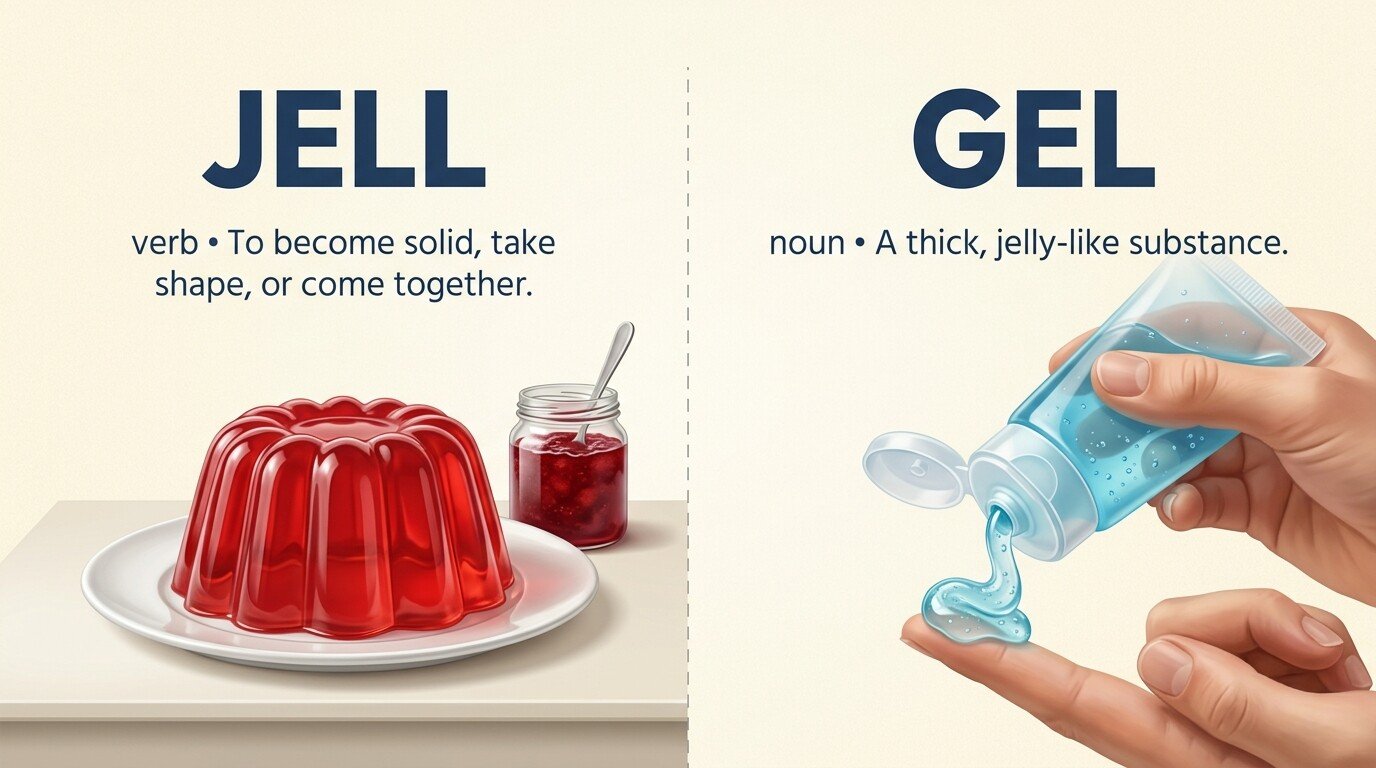
Jell and gel can sound the same, but they do not always mean the same thing.
Imagine you are writing a recipe. You want to say that the mixture will become firm. You type, “Let the mixture jell.” Then you wonder if “gel” would be better. This is a common English spelling problem. The two words look and sound very close, so many writers are unsure which one to choose.
Jell is mainly used as a verb meaning to become firm or to work well together. It is also common in American English when talking about gelatin or a substance becoming firm. Gel can be a noun or a verb. It often refers to a jelly-like substance or the process of becoming firm.
People search for jell or gel because both words are related to the idea of becoming firm. They also have similar sounds. Yet their uses are not always identical. Knowing the difference helps you write clear English.This guide explains jell or gel, their meanings, history, pronunciation, spelling, examples, and common mistakes.
Pronunciation
Both words have the same basic pronunciation in standard US and UK English.
- Jell: /dʒel/
- Gel: /dʒel/
The first sound is like the j in “job.” The vowel is like the vowel in “bell.”
Learn more about https://personaor.com/proper-or-propper/
Difference Between Jell or Gel
1. Jell is mainly a verb
Jell is usually used as a verb. It can mean to become firm or set.
Examples:
- The dessert will jell in the refrigerator.
- The mixture needs time to jell.
2. Gel can be a noun
Gel is often used as a noun. It describes a thick, jelly-like substance.
Examples:
- She applied hair gel.
- The medicine comes in gel form.
3. Gel can also be a verb
Gel can work as a verb. It can mean to become firm or to develop into a successful whole.
Examples:
- The mixture began to gel.
- Our team started to gel after a few weeks.
4. Jell can mean “work well together”
Jell has a special figurative use. People can jell when their ideas, personalities, or plans begin to work well together.
Examples:
- The new team quickly jelled.
- Their ideas did not jell at first.
5. Gel can describe physical substances
Gel is common when talking about physical materials.
Examples:
- The hair gel is on the shelf.
- The cooling gel feels cold.
6. Jell is common in American English
The spelling jell is especially familiar in American English. It is often used in phrases such as “things are starting to jell.”
Examples:
- The plan is starting to jell.
- Their partnership is beginning to jell.
7. Gel is common in science and products
The word gel is widely used in science, medicine, beauty products, and technology.
Examples:
- The scientist used a gel for the experiment.
- Apply a small amount of gel to your skin.
8. Gel has a wider range of uses
Gel can be a noun or verb. It is also used in many fields.
Examples:
- The gel cooled the injured area.
- The project finally gelled.
9. Jell is often figurative
Jell is frequently used when ideas or people begin to fit together.
Examples:
- The story finally jelled.
- The players jelled as a team.
10. Context decides the correct word
The best spelling depends on what you mean.
Use jell when you mean “become firm” or “come together.” Use gel for a jelly-like substance or when the context calls for the noun or verb gel.
Examples:
- The plan began to jell.
- The bottle contains hair gel.
Nature and Behaviour of Jell
Jell as a physical action
Jell can describe a substance becoming firm or set. It is closely linked to foods such as jelly and gelatin.
For example:
- The dessert will jell after it cools.
- Leave the mixture until it jells.
Jell as a figurative action
Jell can also describe ideas, people, or plans becoming organized and successful.
For example:
- The team’s strategy finally jelled.
- Her ideas began to jell into a clear plan.
This figurative meaning is very useful in everyday English.
Nature and Behaviour of Gel
Gel as a substance
A gel is a thick material. It can be soft, firm, sticky, or jelly-like.
Examples include:
- Hair gel
- Medical gel
- Cooling gel
- Food gel
Gel as a verb
As a verb, gel can mean to become firm.
It can also mean to fit together well.
For example:
- The mixture began to gel.
- The team members quickly gelled.
Why People Get Confused About Jell or Gel
The main reason is pronunciation. Jell and gel sound the same in standard English.
They also share a similar meaning in some situations. Both can relate to becoming firm or taking shape.
Another reason is that English has many words with different spellings but identical sounds. These words are called homophones.
For example:
- Jell and gel
- Sea and see
- Right and write
Comparison Table
| Feature | Jell | Gel |
| Part of speech | Mainly verb | Noun and verb |
| Pronunciation | /dʒel/ | /dʒel/ |
| Basic meaning | Become firm or come together | Jelly-like substance or become firm |
| Figurative use | Very common | Common |
| Physical substance | Less common | Very common |
| American English | Common | Common |
| British English | Used, but less common | Common |
| Product name | Rare | Very common |
| Team or idea use | “The team jelled” | “The team gelled” |
| Hair product | Not normally used | Common |
The Origin of Jell or Gel
The two spellings are closely related.
Jell developed as a variant related to gel and the word jelly. The idea behind these words is linked to a substance becoming thick or firm.
Gel comes from the same general family of words connected with gelatin and jelly-like substances. The modern noun became useful for describing substances that are thicker than liquids but softer than solids.
Over time, gel became especially important in science, medicine, cosmetics, food, and everyday products.
Jell developed a strong figurative use in American English. It can describe people, plans, or ideas coming together successfully.
British vs American English
Both British and American English use gel.
The word jell is also understood in both varieties, but it is more strongly associated with American usage, especially in the figurative sense.
American English
American writers often say:
- The team finally jelled.
- The plan is starting to jell.
British English
British English commonly uses gel in similar contexts:
- The team finally gelled.
- The plan is beginning to gel.
However, jell is not impossible in British English. It is simply less common.
Important spelling rule
The spelling does not change because of US or UK pronunciation. The key difference is usage and preference.
Which One Should You Use?
If you are talking about a physical jelly-like substance, gel is usually the safest choice.
If you mean that people, plans, or ideas are coming together, both jell and gel can work.
For US readers, jell is a natural choice in the figurative expression.
UK readers, gel may sound more natural.
For global writing, gel is often easier to understand because it is widely used as both a noun and a verb.
When in doubt, look at the meaning rather than the sound.
Common Mistakes
Mistake 1: Using “jell” for a product
Incorrect:
- I bought a bottle of hair jell.
Correct:
- I bought a bottle of hair gel.
Mistake 2: Thinking “gel” is always a noun
Incorrect idea:
- Gel can only name a substance.
Correct:
- The team gelled quickly.
Mistake 3: Choosing by pronunciation
Incorrect:
- They sound the same, so either spelling is correct.
Correct:
- The meaning and context decide the spelling.
Mistake 4: Using “jell” for every physical gel
Incorrect:
- Put the skin jell on the cut.
Correct:
- Put the skin gel on the cut.
Mistake 5: Forgetting the figurative meaning
Incorrect:
- The team members became better together.
Better:
- The team members gelled quickly.
Everyday Usage Examples
In Emails
- “I think the new project is finally starting to gel.”
- “Our ideas are beginning to jell.”
On Social Media
- “The team is really gelling this season.”
- “This recipe needs time to jell.”
News Writing
- “The new team has started to gel.”
- “The coalition’s plans are beginning to jell.”
Formal Writing
- “The research findings began to gel into a clear theory.”
- “The separate proposals gradually jelled into one plan.”
Daily Conversation
- “The group really gelled.”
- “Give the mixture time to gel.”
Usage Trends
Gel is more widely used today because it has many meanings.
It appears in:
- Food
- Medicine
- Beauty
- Science
- Sports
- Business
- Teamwork
- Casual speech
The figurative verb gel is also common. People often say that a team, group, idea, or plan is “gelling.”
Jell remains useful, especially in American English. It is often seen in the phrase “begin to jell” when talking about plans or groups.
For modern global English, gel has a broader practical range.
Metaphors and Similes
The words can also support figurative language.
Jell as a metaphor
- “The plan began to jell.”
- “Her thoughts finally jelled into a clear idea.”
Here, ideas are treated as if they were a substance becoming firm.
Gel as a metaphor
- “The team gelled like a well-oiled machine.”
- “Their ideas slowly gelled into one strong plan.”
These examples show how people use physical change to describe mental or social change.
Connotative Meaning
Positive meaning
Both words can have a positive sense when they describe successful teamwork.
Example:
- “The new players quickly gelled.”
This suggests good teamwork.
Negative meaning
A negative meaning can appear when something fails to come together.
Example:
- “The group’s ideas never gelled.”
This suggests that the ideas remained separate or unclear.
Neutral meaning
The words can also describe a simple physical process.
Example:
- “The mixture will gel when it cools.”
There is no strong positive or negative feeling here.
Idioms and Proverbs
There is no major traditional proverb built specifically around jell and gel.
However, the figurative use of gel is common.
“Things are starting to gel”
This means that a situation is becoming organized or successful.
Example:
- “After several meetings, things are starting to gel.”
“Gel as a team”
This means that team members begin to work well together.
Example:
- “The players needed time to gel as a team.”
“Ideas gel”
This means separate thoughts become one clear idea.
Example:
- “After more research, the ideas began to gel.”
Literature and Movies
The idea of substances becoming firm has appeared often in literature because food, jelly, and gelatin are familiar parts of daily life.
The figurative idea of people or plans coming together is also common in fiction. Writers often describe a group as “gelling” when characters begin to trust each other and work together.
In movies, this idea is especially common in team stories. Sports films, workplace dramas, and adventure films often show characters who slowly become a strong team.
For example, team-based films such as Remember the Titans (2000, United States) use the idea of people learning to work together. The language of teams “gelling” fits this type of story.
Comedy films also use similar expressions when a group of very different characters eventually begins to work well together.
Why This Difference Matters
Understanding jell or gel matters because correct spelling makes your writing clearer.
A spelling mistake may not change the sound, but it can change how professional your writing looks.
This matters for:
- Students
- Bloggers
- Teachers
- Business writers
- Journalists
- English learners
- Social media users
The difference also teaches an important English lesson. Words can sound exactly alike but have different spellings and uses.
Learning this difference helps readers understand context. It also helps writers avoid simple errors.
Usefulness in Daily Life
You may see gel almost every day.
It appears on:
- Hair products
- Skin products
- Medical products
- Food labels
- Science websites
- Product descriptions
- News articles
You may also hear gel when people talk about groups.
For example:
- “The team is starting to gel.”
- “Our new coworkers really gelled.”
Jell is useful when writing about something becoming firm or when using the American figurative form.
Situational Preference
Use gel when you are naming a physical substance, such as hair gel, medical gel, or food gel. It is also a strong choice when describing people or ideas that begin to work well together. Use jell when you want the verb meaning “become firm” or when using the American-style figurative expression. In British English, gel is often the more natural choice for the figurative meaning. In American English, jell is common in phrases about plans, ideas, and teams. For international writing, gel is usually the safest and most flexible option.
Possible short question
Is jell a real word?
Yes. Jell is a real English word. It can mean to become firm or to come together successfully.
Is gel a noun or a verb?
Gel can be both a noun and a verb. As a noun, it describes a jelly-like substance. As a verb, it can mean to become firm or work well together.
Are jell and gel pronounced the same?
Yes. In standard US and UK English, they are normally pronounced the same way: /dʒel/.
Which is more common, jell or gel?
Gel has a wider range of uses and is generally more common. It is used for many physical products and also as a verb.
Should I write “hair jell” or “hair gel”?
Write hair gel. The standard spelling for the hair product is gel.
Should I say “the team jelled” or “the team gelled”?
Both can be correct. The team jelled is especially familiar in American English. The team gelled is also widely used and may be preferred in British or international English.
Is jell more American than British?
Yes. Jell is more strongly associated with American English. British English commonly uses gel for the same figurative idea.
Conclusion
The difference between jell or gel is mainly about spelling, meaning, and context. Both words have the same basic pronunciation, so hearing them does not tell you which spelling to use.
Jell is mainly a verb. It can mean that something becomes firm. It can also mean that people, ideas, or plans come together successfully. This figurative use is especially common in American English. Gel is more flexible. It can be a noun for a jelly-like substance. Can also be a verb meaning to become firm or work well together. It is common in food, medicine, beauty, science, business, sports, and everyday speech.
For a physical substance such as hair gel or medical gel, use gel. When talking about a plan or group coming together, either jell or gel may work, depending on the variety of English.If you are writing for a global audience, gel is often the safest choice. Learning this small difference can make your English more accurate, natural, and professional.

I’m Daim Abbas, an English language enthusiast, content writer, and SEO writer. I create clear and practical content about word meanings, synonyms, vocabulary, and commonly confused English words. I’m passionate about making English easy to understand while creating helpful, reader-friendly, and SEO-optimized content.