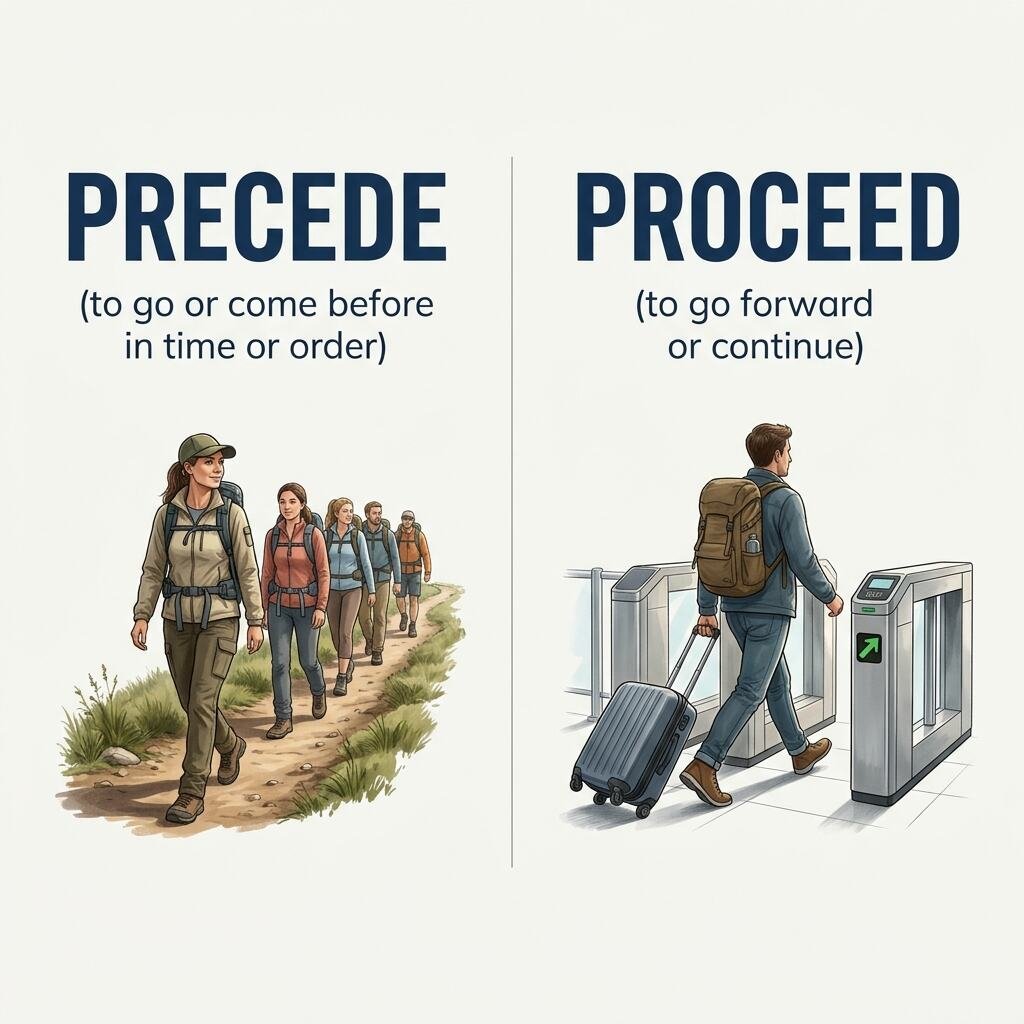
Proceed means to go forward. Precede means to come before.
Tom wrote an email to his boss. He typed, “Please precede with the plan.” His boss smiled and wrote back, “Do you mean proceed?” Tom felt shy. The two words look almost the same. They sound almost the same too. But they mean very different things.
Proceed means to move ahead or to keep going. Precede means to happen or come before something else. Many people search “proceed or precede” because they mix them up. They want to know which word fits their sentence. This guide clears up the confusion. You will learn the meaning, the sound, and the right use of proceed or precede. By the end, you will pick the right word each time. First, let us look at how to say them.
Pronunciation
Proceed
- US: proh-SEED (/proʊˈsiːd/)
- UK: pruh-SEED (/prəˈsiːd/)
Precede
- US: prih-SEED (/prɪˈsiːd/)
- UK: prih-SEED (/prɪˈsiːd/)
Both words end with the same “seed” sound. The start of each word is what sets them apart.
Learn more abouthttps://personaor.com/seek-or-seak/
Difference Between Proceed and Precede
1. Core Meaning
Proceed means to go forward. Precede means to come before.
- Example: Please proceed to gate five.
- Example: Breakfast precedes lunch.
2. Direction in Time
Proceed moves ahead in time. Precede looks back to what came first.
- Example: We will proceed after the break.
- Example: The trailer precedes the movie.
3. Prefix Meaning
“Pro” means forward. “Pre” means before.
- Example: Progress means moving forward. Proceed does too.
- Example: Preview means to see before. Precede means to come before.
4. Use of “With” and “To”
Proceed often takes “with” or “to.” Precede does not.
- Example: She will proceed with her plan.
- Example: Spring precedes summer.
5. Action or Order
Proceed is an action. Precede is about order.
- Example: The judge told the lawyer to proceed.
- Example: A short speech preceded the dinner.
6. Who Does the Thing
With proceed, a person usually acts. With precede, one thing comes before another thing.
- Example: The team proceeded to the field.
- Example: Thunder follows lightning. Lightning precedes thunder.
7. Related Nouns
Proceed gives us “proceeds” and “procedure.” Precede gives us “precedent” and “precedence.”
- Example: The proceeds go to charity.
- Example: That case set a precedent.
8. Tone
Proceed often sounds like a polite instruction. Precede sounds like a plain fact.
- Example: Please proceed to the counter.
- Example: A warning preceded the storm.
9. Use in Signs and Orders
Proceed shows up on signs and in orders. Precede shows up in lists and explanations.
- Example: “Proceed with caution.”
- Example: The title precedes the author’s name.
10. Sound at the Start
Proceed starts with “pro” (proh or pruh). Precede starts with “pre” (prih).
- Example: Say “pro-SEED” for go ahead.
- Example: Say “pre-SEED” for come before.
Nature and Behaviour of Proceed and Precede
Proceed
Proceed is an action word. It pushes things forward. You can proceed to a place. Can proceed with a task. You can also proceed to do something, as in “He proceeded to explain.” It is often used in formal talk, rules, and law. The noun “proceeds” means money earned from a sale.
Precede
Precede is a word about order. It shows what comes first. Things in a line, a list, or a timeline can precede each other. It is often used in writing, science, and grammar. A person can precede another person too, such as a king who preceded a queen.
Why People Get Confused About Proceed and Precede
Three things cause the mix-up.
First, the spelling is close. Only two letters near the start change.
Second, both words end in “-ceed” or “-cede” and sound the same at the end.
Third, both words deal with movement and order. Going forward and coming before feel like cousins.
Here is a trick. “Pro” is for progress. “Pre” is for previous. Think of that pair, and you will remember.
Comparison Table
| Feature | Proceed | Precede |
| Meaning | Go forward, continue | Come before |
| Prefix | Pro- (forward) | Pre- (before) |
| Type | Action | Order or time |
| Common partner | with, to | none needed |
| Related words | proceeds, procedure | precedent, precedence |
| Typical use | Orders, signs, law | Lists, history, science |
| Example | Please proceed. | Day precedes night. |
Similarities: Both are verbs. Both come from Latin. Each end with the “seed” sound. Both are spelled the same in US and UK English.
The Origin of Proceed and Precede
Both words come from the Latin word cedere. It means “to go” or “to move.”
Proceed comes from Latin procedere. “Pro” means forward, so it means “go forward.” It came into English through Old French in the 1300s.
Precede comes from Latin praecedere. “Prae” means before, so it means “go before.” It entered English in the 1400s.
So both words began as “go” words. Only the prefix changed the meaning.
British vs American English
The good news is that both words are spelled the same in both versions of English.
Spelling: It is “proceed” and “precede” everywhere. Never write “procede.”
A fun rule: Only three English words end in “-ceed”: exceed, proceed, and succeed. Most others end in “-cede,” like precede, recede, and concede.
Sound: The UK often says “pruh-SEED” for proceed. The US often says “proh-SEED.”
Usage: “Proceed” is slightly more formal in both. In the UK, “proceedings” is a common word in court and meetings. The US uses it too.
Example: “Please proceed with the meeting” works in both places.
Which One Should You Use?
In the US: Use proceed to tell someone to go on. Use precede to show order. Both are fine in formal and casual writing.
In the UK: The same rule applies. Proceed is common in notices and rules. Precede is common in books and reports.
Globally: Keep it simple. If you mean “go on,” write proceed. If you mean “came first,” write precede. Clear writing helps readers everywhere.
Common Mistakes
- Wrong: Please precede to the next step. Right: Please proceed to the next step.
- Wrong: Monday proceeds Tuesday. Right: Monday precedes Tuesday.
- Wrong: I will procede with the plan. Right: I will proceed with the plan.
- Wrong: The proceeds events were fun. Right: The preceding events were fun.
- Wrong: The precedes of the sale went to charity. Right: The proceeds of the sale went to charity.
Everyday Usage Examples
Emails:
- “If you agree, I will proceed with the order.”
- “The notes that precede this email explain the plan.”
Social media:
- “Proceed with caution. This pizza is hot!”
- “A bad dream preceded my good morning.”
News:
- “The trial will proceed next week.”
- “A loud bang preceded the fire.”
Formal writing:
- “Please proceed to the submission page.”
- “The introduction precedes the main chapters.”
Usage Trends
Around the world, “proceed” is used more often than “precede.” People see it on signs, in apps, and in business emails. Phrases like “proceed to checkout” are everywhere online.
“Precede” shows up more in books, school papers, and news stories. It is also used in grammar, science, and history.
Because the words look so close, many writers search for them to double-check. That makes the search “proceed or precede” a steady one.
Metaphors and Similes
These words work as figures of speech too.
- Proceed (metaphor): “Life proceeds like a river.” It means life keeps moving.
- Proceed (simile): “The line proceeded like a slow snake.”
- Precede (metaphor): “Rumors are the shadows that precede the truth.” They show up first.
- Precede (simile): “Her smile preceded her, like sunshine before a storm.”
Connotative Meaning
Proceed
- Positive: Moving ahead with hope. “We can finally proceed!”
- Negative: Pushing on when you should stop. “He proceeded despite the warning.”
- Neutral: A plain instruction. “Proceed to the next room.”
Precede
- Positive: Good things coming first. “A kind word preceded the gift.”
- Negative: A bad sign coming first. “Dark clouds preceded the flood.”
- Neutral: A fact about order. “Chapter one precedes chapter two.”
Idioms and Proverbs
- “Proceed with caution” means to go ahead, but carefully. Example: The road is icy, so proceed with caution.
- “Look before you leap” is about thinking first. Careful thought should precede action. Example: He looked before he leaped, so careful thought preceded his choice.
- “Put the cart before the horse” means doing things in the wrong order. Example: Buying curtains before the house puts the cart before the horse. The house should precede the curtains.
- “Ladies first” is a polite phrase. Example: Ladies first, so Anna preceded Tom through the door.
Literature and Movies
These works show the ideas behind the words. Many stories are about things that happen in order, or about people who press on.
Literature
- The Trial by Franz Kafka (novel, 1925, a story about a long legal process that keeps proceeding).
- Bleak House by Charles Dickens (novel, 1853, a tale about court cases that drag on).
- A Christmas Carol by Charles Dickens (novella, 1843, where each ghost precedes the next visit).
Movies
- Apollo 13 (1995, USA). Steps before launch precede a risky flight.
- Memento (2000, USA). The story shows what preceded events, in reverse order.
- Back to the Future (1985, USA). Past events precede and shape the future.
Why This Difference Matters
For learners: Using the right word makes your writing clear. It also builds trust. A wrong word can confuse the reader or change the meaning.
For society: Clear words matter in law, medicine, and safety signs. “Proceed” and “precede” can mean very different things in a rule or an order. Small words can carry big weight.
Usefulness in Daily Life
- At work: Write “Please proceed” in emails to move a task along.
- At school: Write “The cause precedes the effect” in essays.
- While driving: Read signs that say “Proceed with caution.”
- Online: Click “Proceed to payment” with confidence.
- At home: Tell kids that brushing teeth precedes bed.
Situational Preference
Use proceed when you give a command, a plan, or an update about action. It fits emails, signs, and speeches. Use precede when you explain order. It fits lists, history, science, and stories. In a formal paper, both are welcome, but each must match its meaning. In casual talk, many people say “go ahead” instead of proceed and “come before” instead of precede. That is fine too. If you are unsure, ask yourself: am I moving forward, or am I showing what came first? The answer tells you which word to pick.
Possible short question
1. Is proceed the same as precede?
No. Proceed means to go forward. Precede means to come before.
2. How do I remember the difference?
“Pro” matches progress, which is forward. “Pre” matches previous, which is before.
3. Is “procede” a correct spelling?
No. The right spelling is “proceed” with two e’s.
4. Are the spellings different in the US and UK?
No. Both words are spelled the same in all English.
5. What does “proceeds” mean?
It is a noun. It means the money you get from a sale or event.
6. Can I say “proceed to do”?
Yes. “She proceeded to open the door” means she then opened it.
7. What does “preceding” mean?
It means “coming before.” For example, “the preceding page” is the page just before this one.
Conclusion
Proceed and precede look alike, but they are not twins. Proceed means to go forward. Precede means to come before. One is about action. The other is about order.Both words come from the Latin word for “go.” The prefix is the key. “Pro” points forward. “Pre” points back. Think of “progress” and “previous,” and you will rarely go wrong.Remember the spelling too. It is never “procede.” Only exceed, proceed, and succeed end in “-ceed.” Also, the words are spelled the same in US and UK English, so you only need to learn them once.Use proceed in emails, signs, and plans. Use precede in lists, stories, and timelines. Check your sentence before you hit send. Ask if you are moving ahead or showing what came first.

I’m Daim Abbas, an English language enthusiast, content writer, and SEO writer. I create clear and practical content about word meanings, synonyms, vocabulary, and commonly confused English words. I’m passionate about making English easy to understand while creating helpful, reader-friendly, and SEO-optimized content.