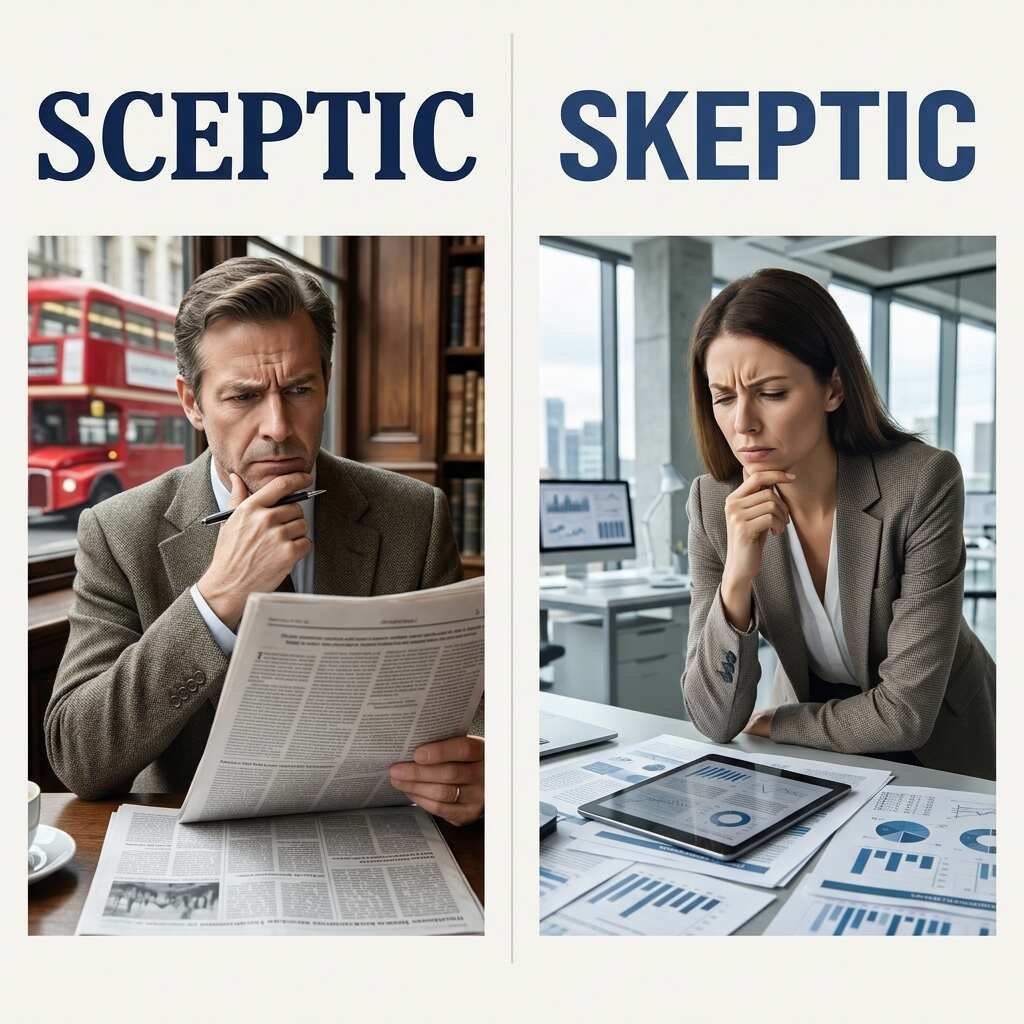
Sceptic and skeptic mean the same thing. The main difference is that sceptic is the usual British spelling, while skeptic is the usual American spelling.
Imagine your friend tells you that a new drink can help you lose weight in one day. You do not believe the claim right away. Instead, you ask for proof. You want to know if the drink really works. This makes you a sceptic or skeptic.
Both words describe someone who questions a claim before accepting it as true. Such a person may ask for facts, check sources, or look for evidence. Being a sceptic does not mean that you never believe anything. It means that you want good reasons before you believe a claim.
People often search for sceptic or skeptic because the words look different. They may wonder if one spelling is wrong or if the words have different meanings. The answer is simple: both are correct, but they are used in different spelling styles.
Pronunciation
Both words have the same standard pronunciation.
- Sceptic (UK): /ˈskep.tɪk/
- Sceptic (US): /ˈskep.tɪk/
- Skeptic (UK): /ˈskep.tɪk/
- Skeptic (US): /ˈskep.tɪk/
The stress falls on the first syllable. The spelling changes, but the sound and meaning remain the same.
Learn more abouthttps://personaor.com/taze-or-tase/
Difference Between Sceptic and Skeptic
Here are 10 important differences and similarities between these words.
1. Spelling
The main difference is the spelling. Sceptic uses the letter “c” after “s,” while skeptic uses “k.”
Examples:
- British: She is a sceptic.
- American: She is a skeptic.
2. British English
Sceptic is the usual spelling in British English. It appears in UK books, news reports, and formal writing.
Examples:
- The sceptic asked for proof.
- He is a sceptic about online claims.
3. American English
Skeptic is the usual spelling in American English. It is common in US schools, newspapers, and websites.
Examples:
- The skeptic checked the facts.
- My teacher is a skeptic about the idea.
4. Meaning
Both words mean a person who doubts a claim or wants evidence before believing it. Neither word has a separate basic meaning.
Examples:
- The sceptic did not trust the claim.
- The skeptic wanted to see the results.
5. Pronunciation
Both words are pronounced in the same way in standard British and American English. You cannot hear the spelling difference when someone says the word.
Examples:
- The British speaker called himself a sceptic.
- The American speaker called himself a skeptic.
6. Grammar
Both words are nouns. They name a person who questions something. Their related adjectives are sceptical and skeptical.
Examples:
- She is a sceptic.
- He is skeptical about the news.
7. Related Words
The same spelling pattern appears in other forms of the word.
- British: sceptical, scepticism
- American: skeptical, skepticism
Examples:
- Her scepticism grew after the test.
- His skepticism led him to check the facts.
8. Formal Writing
Both spellings are correct in formal writing. The right choice depends on the English style used by your school, company, or publication.
Examples:
- A UK report may use “sceptic.”
- A US report may use “skeptic.”
9. Global Usage
Both forms appear around the world. British spelling is common in the UK and many other countries. American spelling is widely used in the United States and online.
Examples:
- A British website may use “sceptic.”
- An American website may use “skeptic.”
10. SEO and Online Searches
People search for both spellings online. Writers should consider their readers and use the right spelling style throughout the article.
Examples:
- A UK blog may target “sceptic meaning.”
- A US blog may target “skeptic meaning.”
Nature and Behaviour of Sceptic and Skeptic
A sceptic or skeptic usually asks questions before accepting a claim. This person may check facts, read reports, or ask for evidence.
For example, a sceptic may question a product that promises fast results. A skeptic may also check a news story before sharing it.
This attitude can help people avoid false claims. However, healthy doubt does not mean rejecting every idea. A fair-minded person should also accept reliable evidence.
Why People Get Confused About Sceptic or Skeptic
People often confuse these words because they look different but have the same meaning and pronunciation. English has many spelling differences between British and American forms.
For example, British English uses “colour,” while American English uses “color.” In the same way, British English usually uses “sceptic,” while American English uses “skeptic.”
Some learners think one spelling must be wrong. That is not true. Both spellings are accepted. The key is to know which style your audience expects.
Comparison Table
| Feature | Sceptic | Skeptic |
|---|---|---|
| Meaning | A person who doubts | A person who doubts |
| Main spelling style | British English | American English |
| First letters | Sc | Sk |
| Pronunciation | /ˈskep.tɪk/ | /ˈskep.tɪk/ |
| Part of speech | Noun | Noun |
| Adjective | Sceptical | Skeptical |
| Related noun | Scepticism | Skepticism |
| Correct spelling | Yes | Yes |
| Formal use | Correct | Correct |
| Best audience | Mainly UK readers | Mainly US readers |
The Origin of Sceptic and Skeptic
Both words share the same history. They come from the Greek word skeptikos, which referred to someone who examines or considers things carefully.
The word entered English through older forms influenced by Greek, Latin, and French. Over time, spelling styles developed on both sides of the Atlantic.
Sceptic became the usual British form, while skeptic became the standard American form. The same pattern appears in sceptical/skeptical and scepticism/skepticism.
This history explains why both spellings are correct today. They are not different words with different meanings. They are two regional forms of the same word.
British vs American English
British and American English share most words, but some spellings differ.
| British English | American English |
|---|---|
| Sceptic | Skeptic |
| Sceptical | Skeptical |
| Scepticism | Skepticism |
| Colour | Color |
| Centre | Center |
| Realise | Realize |
Examples:
- British: “The sceptic asked for more evidence.”
- American: “The skeptic asked for more evidence.”
Both sentences are correct. The choice depends on the spelling style you follow.
Which One Should You Use?
Use sceptic when writing for a British audience or following British English rules. Use skeptic when writing for an American audience or following American English rules.
For a global website, either form can work. Check the spelling style used in your other articles and stay consistent. If your website follows British English, use sceptic and sceptical. If it follows American English, use skeptic and skeptical.
Common Mistakes
Here are common mistakes to avoid:
- Mistake: Thinking “sceptic” is wrong.
Correct: It is the usual British spelling. - Mistake: Thinking “skeptic” is wrong.
Correct: It is the usual American spelling. - Mistake: Using both forms without a reason.
Correct: Choose one spelling style and keep it consistent. - Mistake: Confusing the noun and adjective.
Correct: Use sceptic/skeptic for a person and sceptical/skeptical to describe an attitude. - Mistake: Writing “skeptick” or “sceptick.”
Correct: Write skeptic or sceptic.
Everyday Usage Examples
Both words can be used in emails, social media, news, and formal writing.
In Emails
- British: “I am a sceptic about this proposal and would like more evidence.”
- American: “I am a skeptic about this proposal and would like more evidence.”
On Social Media
- British: “I am a sceptic when I see claims that sound too good to be true.”
- American: “I am a skeptic when I see claims that sound too good to be true.”
In News
- British: “The sceptic questioned the report.”
- American: “The skeptic questioned the report.”
In Formal Writing
- British: “The sceptic requested further evidence.”
- American: “The skeptic requested further evidence.”
The meaning stays the same in every example.
Usage Trends
Both spellings remain in use today. Their use often depends on the country, publication, or audience.
Sceptic is common in British English writing. Skeptic is common in American English books, news reports, and websites. Online searches include both forms because people use different spelling styles.
If you write for a website, choose the spelling that matches your target readers. You can mention the other spelling when explaining the difference. This helps readers understand both forms without making your article confusing.
Metaphors and Similes
A metaphor describes one thing as another. A simile compares two things using words such as “like” or “as.”
Examples of metaphors:
- “A sceptic is a gatekeeper of truth.”
- “A skeptic is a filter for false claims.”
Examples of similes:
- “The sceptic was like a detective looking for proof.”
- “The skeptic was as careful as a scientist testing an idea.”
These are creative comparisons. They show how a person may question claims before accepting them.
Connotative Meaning
The words sceptic and skeptic can have positive, negative, or neutral meanings, depending on the situation.
Positive Meaning
A sceptic may be seen as careful and wise when they check facts.
Example: “The skeptic stopped the team from sharing false information.”
Negative Meaning
The word may sound negative when a person refuses to listen to any evidence.
Example: “The sceptic rejected every idea without thinking.”
Neutral Meaning
The word can simply describe someone who wants proof.
Example: “The skeptic asked for evidence before making a choice.”
The words themselves are not always positive or negative. The situation gives them their tone.
Idioms and Proverbs
There are no common idioms that depend only on the spelling sceptic or skeptic. However, some sayings express a similar idea.
- Seeing is believing: People often want proof before accepting a claim.
Example: “She tested the product herself. Seeing is believing.” - Take something with a grain of salt: Do not accept something as completely true without checking it.
Example: “Take that online claim with a grain of salt.” - Trust, but verify: Trust can be useful, but checking facts is also important.
Example: “He checked the report before sharing it. Trust, but verify.”
These sayings support careful thinking, but they do not mean that every claim is false.
Literature and Movies
Scepticism is a common theme in books and films. Characters often question claims, examine evidence, and search for truth.
Literature
- The Adventures of Sherlock Holmes (1892), by Arthur Conan Doyle: Sherlock Holmes studies clues and checks facts before reaching a conclusion.
- The Demon-Haunted World (1995), by Carl Sagan: This nonfiction book explains why critical thinking and scientific evidence matter.
Movies
- 12 Angry Men (1957, United States): A juror questions the evidence and asks others to examine the case carefully.
- The Matrix (1999, United States): The main character questions the world around him and searches for the truth.
These works show how doubt and careful thinking can help people understand the world.
Why This Difference Matters
Knowing the difference between sceptic and skeptic helps you write correct English. It also helps you understand books, articles, and websites from different countries.
The difference can also p with online searches. Someone searching for “sceptic meaning” may want the same information as someone searching for “skeptic meaning.”
Most importantly, the two spellings do not describe different beliefs. Both words refer to people who question claims and look for evidence.
Usefulness in Daily Life
These words are useful when discussing news, science, products, or online claims.
Examples:
- “I am a sceptic about promises of quick results.”
- “My friend is a skeptic who checks news sources.”
- “The sceptic asked for proof before buying the product.”
- “The skeptic changed his mind after seeing the evidence.”
Learning both spellings also helps you read British and American English with confidence. When writing, choose the form that fits your audience.
Situational Preference
The best spelling depends on where and why you are writing. Use sceptic for British school work, UK news, and websites that follow British English. Use skeptic for American school work, US publications, and websites that follow American English. For international readers, check your style guide or choose one form and use it throughout your text. Both spellings are correct, so there is no need to change the meaning of your sentence. Consistency is the most important rule.
Possible short question
1. What is the difference between sceptic and skeptic?
Both words mean a person who doubts a claim or asks for proof. Sceptic is the usual British spelling, while skeptic is the usual American spelling.
2. Is sceptic a correct English word?
Yes. Sceptic is a correct spelling used in British English and many publications that follow British spelling rules.
3. Is skeptic a correct English word?
Yes. Skeptic is the standard American spelling and is correct in formal and informal writing.
4. Do sceptic and skeptic sound the same?
Yes. Both have the same standard pronunciation. The difference is in spelling, not sound.
5. What is the difference between sceptical and skeptical?
Both mean doubtful or unwilling to accept a claim without proof. Sceptical is common in British English, while skeptical is common in American English.
6. Which spelling should I use for SEO?
Use sceptic if your main audience is British and skeptic if your main audience is American. Explain both forms naturally if the spelling difference is the topic of your article.
7. Does a sceptic never believe anything?
No. A sceptic questions claims and looks for evidence. A fair-minded sceptic can accept an idea when reliable proof supports it.
Conclusion
Sceptic and skeptic have the same meaning. Both words describe a person who questions claims and looks for evidence before accepting them. The main difference is their spelling.Sceptic is the usual British form, while skeptic is the usual American form. Both are correct, and both sound the same. The related forms also follow this pattern: British English uses sceptical and scepticism, while American English uses skeptical and skepticism.When writing for a British audience, choose sceptic. When writing for an American audience, choose skeptic. If you write for readers around the world, follow your website’s spelling style and use it consistently.Remember, being a sceptic or skeptic does not mean rejecting every idea. It means asking questions, checking facts, and thinking carefully. This habit can help you avoid false claims and make better choices.

I’m Daim Abbas, an English language enthusiast, content writer, and SEO writer. I create clear and practical content about word meanings, synonyms, vocabulary, and commonly confused English words. I’m passionate about making English easy to understand while creating helpful, reader-friendly, and SEO-optimized content.