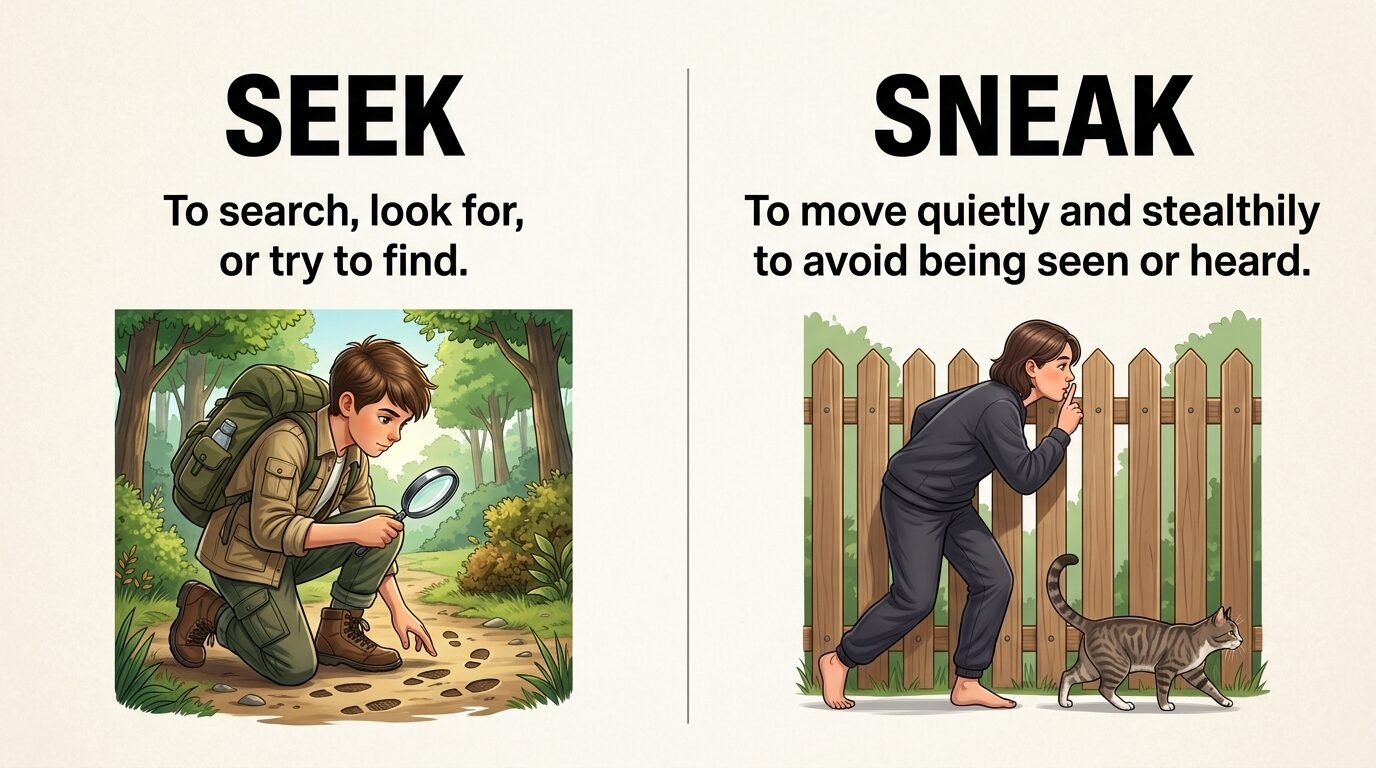
“Seek” is the correct English word. “Seak” is usually a misspelling of “seek.”
Imagine you are writing an email to your teacher. You want to say that you want to seek help with a difficult lesson. You type, “I want to seak help.” The sentence looks almost right, but one letter makes the spelling incorrect. This is why many English learners search for seek or seak. The two words sound similar, but only one is a standard English word.
Seek is a verb. It means to look for, try to find, or ask for something. For example, “She went to seek advice.” Seak, on the other hand, is not the standard spelling of this common verb. People often type it because the pronunciation can make the spelling confusing. Knowing the difference between seek or seak helps you avoid spelling mistakes in schoolwork, emails, social media posts, and formal writing. It also makes your English clearer and more professional.
Pronunciation
Seek
- US: /siːk/
- UK: /siːk/
Seak
“Seak” is not normally used as the standard spelling of the verb seek, so it does not have a standard pronunciation in this context.
seek
seek
Learn more abouthttps://personaor.com/ark-or-arc/
Difference Between Seek or Seak
1. Correct Spelling
Seek is the correct spelling.
Seak is generally an incorrect spelling when you mean “look for” or “try to find.”
Examples:
- I will seek help.
- They seek a better solution.
2. Meaning
Seek means to look for something or try to get something.
Seak does not have this standard meaning in everyday English.
Examples:
- We should seek advice.
- She went to seek information.
3. Part of Speech
Seek is mainly used as a verb.
It describes an action.
Examples:
- He seeks knowledge.
- They seek answers.
4. Use in Formal English
Seek is common in formal English.
You may see it in business, education, law, and official writing.
Examples:
- We seek your approval.
- The company seeks new workers.
5. Use in Everyday English
Seek can also be used in normal conversation.
However, words like “look for” are often more casual.
Examples:
- I am seeking a new job.
- She sought help from her friend.
6. Verb Forms
Seek has unusual past forms.
Its main forms are:
- Seek
- Sought
- Sought
Examples:
- I seek advice.
- I sought advice yesterday.
7. Common Spelling Error
Some people write seak because it sounds close to seek.
The correct spelling is seek.
Examples:
- Incorrect: I will seak help.
- Correct: I will seek help.
8. Similar Words
Several words have meanings close to seek.
These include:
- Look for
- Search
- Find
- Pursue
- Request
Examples:
- I will seek an answer.
- I will search for an answer.
9. Search Engines and Writing
People often type seek or seak because they are unsure about the spelling.
For correct English writing, choose seek.
Examples:
- Seek professional advice.
- Seek more information.
10. Professional Communication
Use seek in emails, reports, applications, and official documents.
Examples:
- I am writing to seek your advice.
- We seek your support for this project.
Nature and Behaviour of Seek or Seak
Nature of Seek
Seek is an action word. It shows that someone is trying to find, obtain, or ask for something.
It can describe both physical and abstract searches.
For example:
- She seeks a new house.
- He seeks peace.
- They seek advice.
Nature of Seak
Seak is not the normal spelling of the English verb meaning “look for.” In most cases, writing seak is simply a spelling error.
If your intended meaning is “look for,” use seek.
Why People Get Confused About Seek or Seak
The confusion comes mainly from pronunciation.
Seek has a long “ee” sound. When people hear the word, they may not know which letters to use.
English also has many words where pronunciation does not clearly show spelling.
For example:
- See
- Sea
- Seek
- Seem
Learners may therefore write seak by mistake.
The key rule is simple:
If you mean “look for,” spell it S-E-E-K: seek.
Comparison Table
| Feature | Seek | Seak |
| Correct standard spelling | Yes | No, in this meaning |
| Part of speech | Verb | Not standard as this verb |
| Meaning | Look for or try to get | Usually a misspelling |
| Formal writing | Common | Avoid |
| Everyday writing | Common | Avoid |
| Past tense | Sought | — |
| Example | Seek help | Seak help ❌ |
| Pronunciation | /siːk/ | No standard form for this meaning |
| Common online confusion | Yes | Often typed by mistake |
| Recommended use | Yes | No |
The Origin of Seek
The word seek is very old. It comes from Old English sēcan, meaning “to seek, look for, search for, or visit.”
It is related to similar words in other Germanic languages.
Over time, its spelling changed as English developed. The modern form seek became standard.
The past form is different: sought. This is an example of an irregular English verb.
So, although seek may look simple, it has a long history in the English language.
British vs American English
There is no major British-American spelling difference here.
Both British English and American English use:
seek
Both use the same basic forms:
- seek
- seeks
- seeking
- sought
British English:
- I will seek advice.
American English:
- I will seek advice.
The spelling seak is not the normal American or British spelling for this verb.
Which One Should You Use?
Use seek when you mean:
- look for something
- search for something
- try to obtain something
- ask for something
US English, use seek.
UK English, use seek.
For international English, use seek.
You should avoid seak when writing standard English.
A simple memory trick is:
Seek has two E’s: S-E-E-K.
Common Mistakes
Mistake 1: Writing “seak”
❌ I want to seak help.
✅ I want to seek help.
Mistake 2: Using the wrong past tense
❌ Yesterday, I seeked advice.
✅ Yesterday, I sought advice.
Mistake 3: Adding an unnecessary word
❌ We seek for a solution.
✅ We seek a solution.
However, “search for a solution” is also correct.
Mistake 4: Confusing seek with find
Seek means trying to find something.
Find means successfully discovering it.
Example:
- I seek a job.
- I found a job.
Everyday Usage Examples
In Emails
- I am writing to seek your advice.
- We would like to seek your approval.
On Social Media
- Sometimes you need to seek help.
- Seek knowledge every day.
In News
- Officials are seeking more information.
- Police are seeking witnesses.
In Formal Writing
- The organization seeks to improve education.
- Students should seek reliable sources.
Usage Trends
Seek remains a common English word.
It appears often in formal writing, news reports, business documents, job advertisements, and academic writing.
In casual speech, people often use look for instead.
For example:
- Formal: “We are seeking new employees.”
- Casual: “We are looking for new employees.”
The misspelling seak can appear in informal online writing, but it is not recommended in standard English.
Metaphors and Similes
Seek can be used in figurative language.
Metaphor
- She seeks the light in difficult times.
Here, “light” can represent hope or happiness.
Another Example
- He seeks the truth.
Truth is not a physical object. The sentence means that he wants to discover what is true.
Simile
A person can be described as seeking something like a traveler seeking a new path.
Example:
- He searched for answers like a traveler seeking a new path.
Connotative Meaning
Positive Meaning
Seek can suggest effort, curiosity, growth, and wisdom.
Example:
- She seeks knowledge every day.
Negative Meaning
In some situations, seek can suggest a strong or selfish desire.
Example:
- He constantly seeks attention.
Neutral Meaning
Seek can simply describe looking for something.
Example:
- The team seeks a solution.
Idioms and Proverbs
The word seek appears in many well-known expressions.
Seek and You Shall Find
This phrase suggests that effort can lead to discovery.
Example:
- Keep learning. Seek and you shall find.
Seek Out
Seek out means deliberately look for someone or something.
Example:
- She sought out an expert for advice.
Seek Refuge
Seek refuge means look for safety or protection.
Example:
- The family sought refuge from the storm.
Literature and Movies
The idea of seeking something is common in literature because stories often involve a character searching for truth, love, freedom, or a better life.
In The Odyssey, an ancient Greek epic traditionally linked to Homer, the hero’s journey involves searching, struggle, and a return home.
The theme also appears in modern films.
For example, The Pursuit of Happyness (2006, United States) follows a man seeking a better life for himself and his son.
The idea of seeking is powerful because many stories are built around a goal.
Why This Difference Matters
Knowing the difference between seek and seak matters because spelling affects clear communication.
A spelling error can make schoolwork look careless. It can also make a professional email less polished.
English learners often face words that sound similar but have different spellings. Learning the correct form helps build confidence.
The difference also matters in digital communication. Search engines, applications, emails, and social media all depend on written language.
If you remember only one rule, remember this:
Seek = look for.
Seak = avoid when you mean “look for.”
Usefulness in Daily Life
You can use seek in many real-life situations.
Education
- Students seek knowledge.
- Students seek help from teachers.
Work
- Workers seek new opportunities.
- Companies seek skilled employees.
Health and Safety
- People may seek medical advice.
- People may seek shelter during danger.
Personal Life
- We seek happiness.
- We seek good friendships.
Online
- Users seek information.
- Customers seek support.
Situational Preference
In almost every standard English situation, seek is the better choice when you mean “look for” or “try to obtain.” Use it in school assignments, work emails, formal reports, applications, websites, and everyday writing. British, American, and international English all use seek. The spelling seak should normally be avoided. If you are speaking casually, “look for” may sound more natural. For example, “I am looking for a job” is very common. In formal writing, “I am seeking a job” may sound more polished. Choose the word based on the situation, but always spell the verb seek.
Possible short question
Is seek the correct spelling?
Yes. Seek is the correct standard spelling when you mean “look for” or “try to obtain.”
Is seak a word?
Seak is not the standard spelling of the common English verb meaning “look for.” In most cases, it is a spelling mistake.
What does seek mean?
Seek means to look for, search for, ask for, or try to obtain something.
What is the past tense of seek?
The past tense of seek is sought.
Example:
- She sought help.
Is seek used in British English?
Yes. British English uses seek.
Is seek used in American English?
Yes. American English also uses seek.
What is the difference between seek and find?
Seek means to try to find something. Find means to discover or locate it.
Example:
- I seek a solution.
- I found a solution.
How can I remember the spelling?
Remember:
Seek = S-E-E-K.
It has two E’s in the middle.
Conclusion
The correct spelling is seek, not seak, when you mean “look for,” “search for,” or “try to obtain.” This small spelling difference is important because seek is a common English verb used in everyday, academic, professional, and formal writing.The word seek can describe many actions. You can seek help, seek advice, seek knowledge, seek information, seek a job, or seek a solution. Its past tense is sought, which is an important irregular verb form to remember.There is no standard British or American spelling difference. Both varieties use seek. The spelling seak is usually an error caused by the similar sound of the word.If you are ever unsure, use this simple rule: S-E-E-K means to look for something. Learning this rule will help you write better emails, assignments, posts, and professional documents. Once you remember the two E’s, choosing seek becomes easy.

I’m Daim Abbas, an English language enthusiast, content writer, and SEO writer. I create clear and practical content about word meanings, synonyms, vocabulary, and commonly confused English words. I’m passionate about making English easy to understand while creating helpful, reader-friendly, and SEO-optimized content.












3 thoughts on “Seek or Seak: Which Spelling Is Correct?”