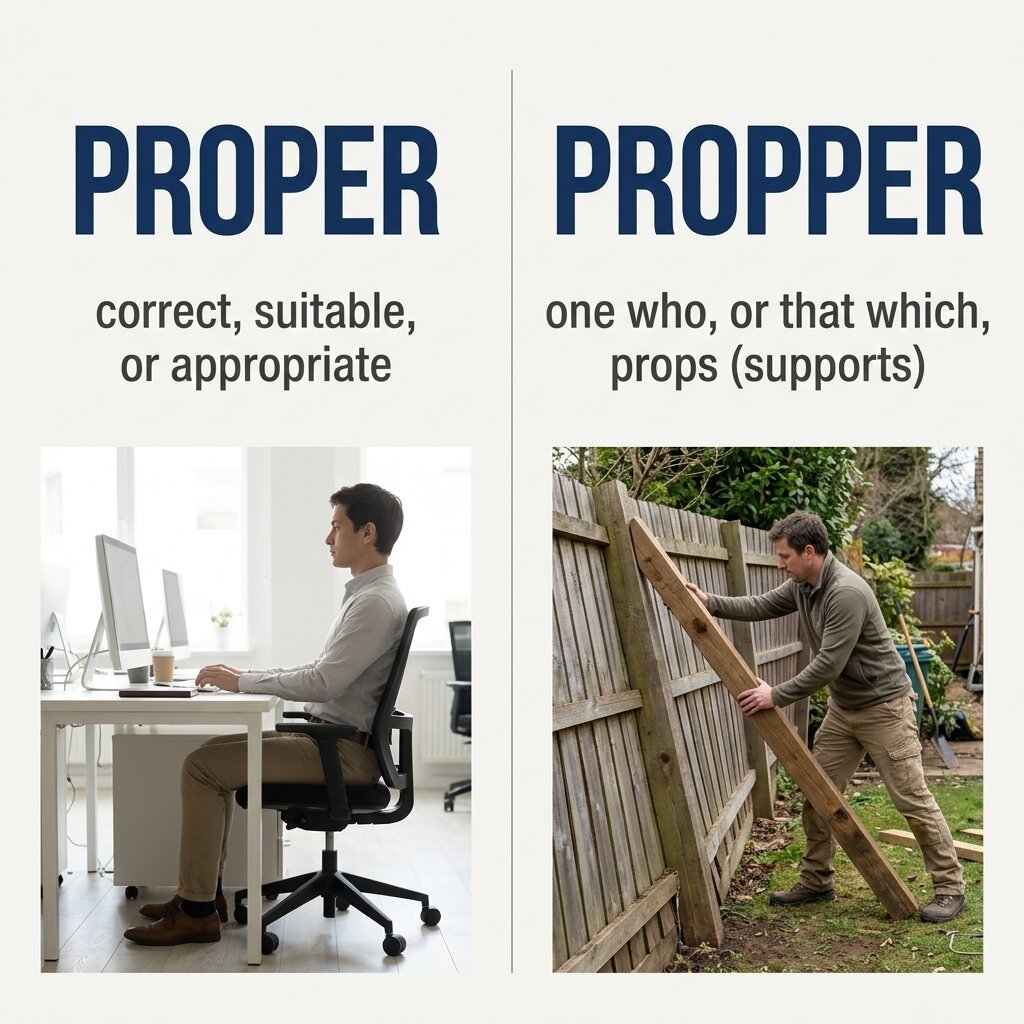
“Proper” is the correct English spelling; “propper” is usually a misspelling. Have you ever typed a word and then stopped because two spellings looked almost right? This happens often with proper or propper. For example, someone may write, “Please use the propper format,” and then wonder if the word should have two p letters. The correct form is proper, with only one p in the middle.
Proper is a common English word. It can mean correct, suitable, appropriate, or well-behaved. It can also describe something that follows accepted rules or standards. Propper, on the other hand, is not the standard spelling of this word in modern English.
People search for proper or propper because the word is pronounced in a way that can make the spelling less obvious. The double p sound may also lead writers to add another letter. This guide explains the difference between proper or propper, shows the correct spelling, and gives easy examples. By the end, you will know when to use proper and why propper should normally be avoided.
Pronunciation
Proper
- US: /ˈprɑː.pɚ/
- UK: /ˈprɒp.ə/
Propper
- It is not the standard spelling of the word proper. If it appears as a name or special term, its pronunciation may depend on that specific use.
Learn more abouthttps://personaor.com/peon-or-pion/
Difference Between Proper or Propper
1. Correct spelling
Proper is the correct standard spelling.
Propper is normally incorrect.
- Example 1: Please use the proper form.
- Example 2: We need a proper plan.
2. Standard English
Proper appears in standard English dictionaries and normal writing.
Propper is not the normal spelling of the adjective.
- Example 1: She gave a proper answer.
- Example 2: He did not use the proper method.
3. Meaning
Proper has several meanings. It can mean correct, suitable, or appropriate.
Propper does not have these standard meanings.
- Example 1: Wear proper shoes for hiking.
- Example 2: We need proper training.
4. Grammar
Proper is commonly used as an adjective.
Propper is generally not used as a standard English adjective.
- Example 1: That is the proper way.
- Example 2: She needs proper support.
5. Spelling pattern
The word is spelled p-r-o-p-e-r.
It does not need another p after the first syllable.
- Example 1: Use the proper spelling.
- Example 2: Write proper in your report.
6. Formal writing
Proper is safe in formal writing.
Propper should normally be corrected.
- Example 1: The document needs a proper title.
- Example 2: Please provide a proper explanation.
7. School writing
Students should always use proper when they mean correct or suitable.
- Example 1: Use a proper sentence.
- Example 2: Give a proper answer.
8. Professional communication
In work emails, reports, and messages, proper is the correct choice.
- Example 1: Please follow the proper process.
- Example 2: We need proper approval.
9. Pronunciation can cause confusion
The sound of proper can make some people think there should be another p.
However, spelling is not always a direct copy of pronunciation.
- Example 1: Use the proper word.
- Example 2: Check the proper spelling.
10. Names and special uses
Propper can appear as a surname, brand name, or other proper name. In such cases, it may be correct because names can have unusual spellings.
- Example 1: Propper may be a person’s surname.
- Example 2: A company may choose Propper as its name.
Nature and Behaviour of Proper or Propper
Proper
Proper is a normal English adjective. It describes something that is correct, suitable, acceptable, or appropriate.
It can also describe good behavior.
For example:
- Please wear proper clothing.
- He showed proper respect.
- We need the proper tools.
Propper
Propper is not normally a standard English word with the same meaning. Most of the time, it is simply a spelling mistake for proper.
Why People Get Confused About Proper or Propper
The main reason is pronunciation.
The first syllable of proper contains a strong p sound. Some writers think that a strong sound should have two letters. But English spelling does not work that way.
Another reason is that English has many words with double consonants. Words such as happy, running, and bigger contain doubled letters for different spelling reasons.
This can make proper or propper confusing for new English learners.
The simple rule is:
If you mean correct, suitable, or appropriate, use “proper.”
Comparison Table
| Feature | Propr | Propper | |
| Standard English spelling | Yes | No | |
| Common adjective | Yes | No | |
| Means correct/suitable | Yes | No | |
| Used in formal writing | Yes | Normally no | |
| Used in school writing | Yes | No | |
| Common dictionary word | Yes | Not as the normal spelling | |
| Can be a surname | Yes | Yes, potentially | |
| Can be a brand name | Yes | Yes, potentially | |
| Common spelling mistake | No | Yes | |
| Recommended for normal English | Yes | No |
The Origin of Proper or Propper
Proper has a long history in English.
It comes from Old French and Latin roots. The English word developed from forms related to the Latin proprius, meaning one’s own, special, or particular.
Over time, proper gained several meanings. It could describe something belonging to a person or thing. It later developed meanings such as correct, suitable, appropriate, and acceptable.
The spelling proper became established in English.
Propper is not the standard historical spelling of this word. When it appears in ordinary English, it is usually a misspelling. However, it can exist independently as a surname, name, or brand.
British vs American English
There is no major British-American spelling difference between these two forms.
Both British and American English use:
proper
Examples:
- British English: Please use the proper form.
- American English: Please use the proper form.
The meaning is also very similar in both varieties.
British English may use proper in some informal expressions where American English may choose another phrase.
For example:
- British: Have a proper look.
- American: Take a good look.
But the spelling remains proper in both forms.
Which One Should You Use?
If you are writing normal English, choose proper.
For US English
Use proper.
Example:
Please follow the proper procedure.
For UK English
Use proper.
Example:
We need the proper equipment.
For global English
Use proper because it is the widely accepted standard spelling.
Use Propper only when you are referring to a specific name, brand, surname, or title that officially uses that spelling.
Common Mistakes
Mistake 1: Adding an extra p
Incorrect:
Please use the propper format.
Correct:
Please use the proper format.
Mistake 2: Using “propper” in formal writing
Incorrect:
We need a propper explanation.
Correct:
We need a proper explanation.
Mistake 3: Assuming strong sounds need double letters
A strong consonant sound does not always require a double letter.
Correct:
proper
Not:
propper
Mistake 4: Correcting a name
yIf Propper is someone’s official surname, do not automatically change it.
Example:
Mr. Propper attended the meeting.
Here, Propper may be a name rather than a spelling error.
Everyday Usage Examples
In emails
Please send the proper document before Friday.
On social media
Finally, I had a proper day off!
In news writing
Officials called for a proper review of the policy.
In formal writing
Every applicant must follow the proper procedure.
In school
Use proper grammar in your essay.
In conversation
Let’s have a proper discussion.
Usage Trends
Proper is a common word in both British and American English.
It appears in everyday speech, school work, business writing, news articles, books, and online content.
Propper is much less common as an ordinary English word. Most appearances are likely to come from names, brands, usernames, or spelling mistakes.
Searches for proper or propper are often made by people checking whether the word needs one p or two.
For standard English, the answer is simple: proper.
Metaphors and Similes
Proper can appear in figurative expressions.
Metaphor
He finally got a proper grip on the problem.
Here, “grip” means understanding.
Simile
She worked like a proper machine.
This suggests that she worked hard and steadily.
Another example
The team finally found its proper rhythm.
This does not mean physical rhythm only. It means the team started working well together.
Connotative Meaning
Proper can have different feelings depending on context.
Positive meaning
It can suggest care, quality, and good standards.
She gave me a proper explanation.
This suggests a complete and useful explanation.
Negative meaning
It can sometimes sound strict or critical.
You need to learn proper behavior.
This may sound like a correction.
Neutral meaning
It can simply mean correct or suitable.
Use the proper form.
There is no strong emotional meaning here.
Idioms and Proverbs
There are several common expressions that use proper.
“Properly speaking”
This means when using the correct or exact meaning.
Properly speaking, the two terms are not the same.
“Proper noun”
This is a grammar term for a specific name.
“London” is a proper noun.
“Properly done”
This means done correctly or well.
The work should be properly done before submission.
Literature and Movies
The word proper appears widely in English literature because it is a common everyday word.
In classic English literature, writers such as Jane Austen used words like proper to describe manners, behavior, social rules, and suitable conduct. Austen’s novel Pride and Prejudice, published in 1813, is a strong example of writing from a period when ideas about proper behavior were important.
In movies, the word also appears often in dialogue.
For example, British films and television dramas frequently use proper in expressions related to manners, behavior, food, work, and social life. This reflects the broad everyday use of the word in British English.
Why This Difference Matters
Correct spelling matters because small errors can affect how readers understand your writing.
Using proper shows that you know the standard spelling.
Using propper in a normal sentence may make the reader think it is a typing or spelling error.
This is especially important in:
- School assignments
- Job applications
- Business emails
- Websites
- Reports
- Professional documents
For English learners, remembering one simple spelling rule can prevent many mistakes:
Correct, suitable, or appropriate = proper.
Usefulness in Daily Life
You can use proper in many daily situations.
You may talk about:
- proper food
- proper clothing
- proper grammar
- proper training
- proper manners
- proper care
- proper planning
- proper equipment
- proper procedure
- proper behavior
For example:
You need proper shoes for the trip.
Or:
Please give the machine proper care.
Situational Preference
In almost every normal English situation, proper is the better choice. Use it in school, work, emails, reports, websites, and everyday conversation when you mean correct, suitable, or appropriate. British and American English both accept proper, so you do not need a different spelling based on your audience. Use Propper only when it is an official name, surname, brand, username, or title. If you are unsure whether Propper is a special name, check the original source before changing it. For ordinary English writing, choose proper.
Possible short question
Is “proper” the correct spelling?
Yes. Proper is the standard spelling when you mean correct, suitable, or appropriate.
Is “propper” a word?
Propper is not normally the standard spelling of the adjective proper. It can appear as a name or special term.
Why do people spell proper as propper?
The strong p sound can make some people think the word needs two p letters.
Is proper used in British English?
Yes. Proper is very common in British English.
Is proper used in American English?
Yes. Americans also use proper.
Can Propper be a name?
Yes. Propper may be used as a surname, brand name, or other proper name.
How can I remember the spelling?
Remember this simple form:
P-R-O-P-E-R
There is no extra p after the first syllable.
Conclusion
The difference between proper or propper is simple once you know the standard spelling. Proper is the correct English word when you mean correct, suitable, appropriate, or acceptable. It is used in both British and American English. It works in casual speech, formal writing, school assignments, business emails, and many other situations.Propper is normally not the correct spelling for these meanings. If you see it in ordinary writing, it is usually a spelling mistake. However, Propper can still be correct when it is an official surname, brand, username, or other name.The best rule is easy to remember: use “proper” for standard English. Do not add another p simply because the sound may seem strong.

I’m Daim Abbas, an English language enthusiast, content writer, and SEO writer. I create clear and practical content about word meanings, synonyms, vocabulary, and commonly confused English words. I’m passionate about making English easy to understand while creating helpful, reader-friendly, and SEO-optimized content.











2 thoughts on “Proper or Propper: Which Spelling Is Correct?”