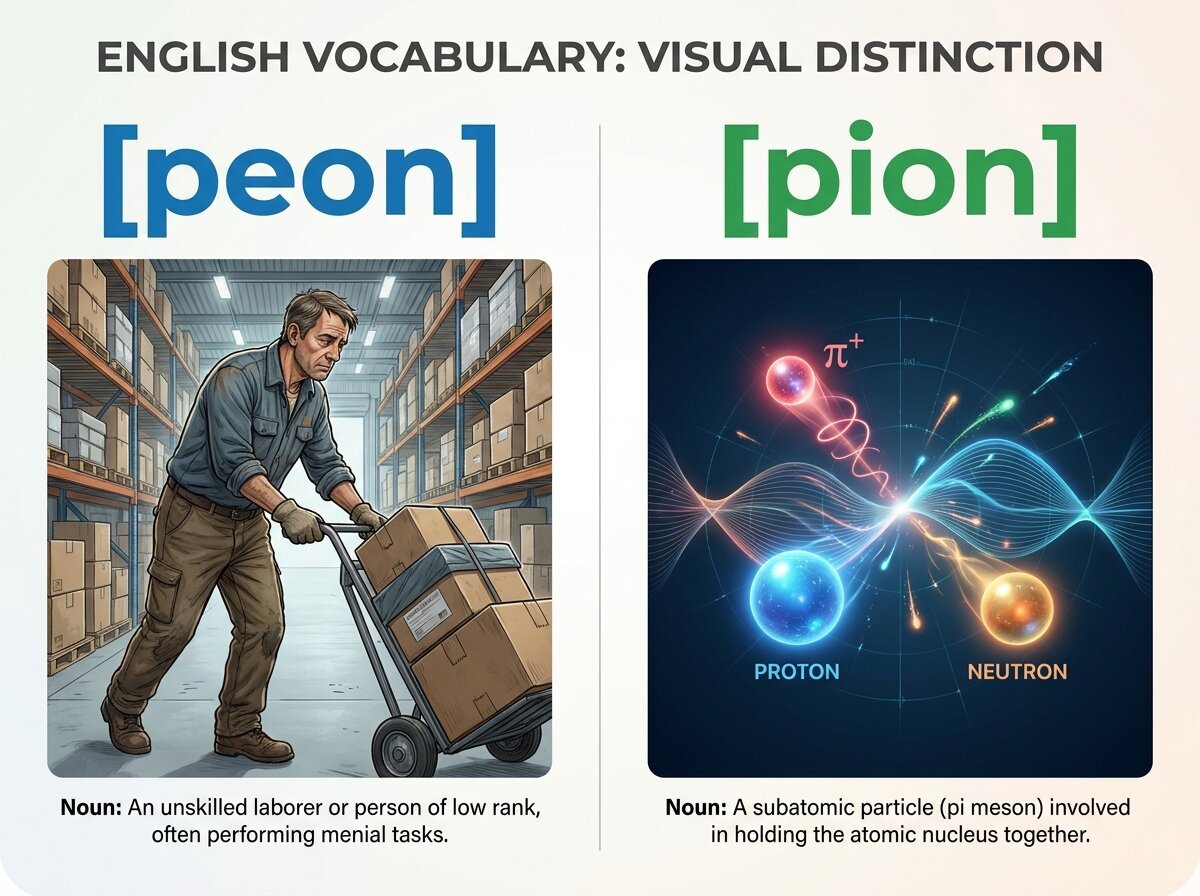
Peon is a word for a low-level worker or in older use a servant while pion is a scientific word for a type of subatomic particle.
Imagine you are writing an English sentence about a worker in an office. You want to say that someone works in a basic support role. You type “pion,” but something looks wrong. Then you search for peon or pion. This is a common spelling problem because both words look and sound somewhat similar.
The word peon has been used for a person who performs basic or low-status work. In modern English, it can also describe someone with little power or authority. The word pion, on the other hand, belongs mainly to physics. A pion is a type of meson involved in strong nuclear interactions.
Pronunciation
Peon
- US: /ˈpiːən/
- UK: /ˈpiːən/
Pion
- US: /ˈpaɪ.ɑːn/ or /ˈpaɪ.ɒn/
- UK: /ˈpaɪ.ɒn/
The pronunciation of pion can vary slightly, especially between scientific speakers and regions. The main point is that peon begins with a long “ee” sound, while pion usually begins with a sound like “pie.”
Now let us look at the differences in a simple way.
Difference Between Peon or Pion
1. Basic Meaning
Peon refers to a low-level worker or, in older usage, a servant.
Pion refers to a subatomic particle in physics.
Example 1:
The peon carried the files to the office.
Example 2:
The scientist studied the behavior of a pion.
2. Field of Use
Peon is mainly used in everyday English, history, social discussions, and descriptions of work.
Pion is mainly used in physics and science.
Example 1:
The manager asked the peon to bring some papers.
Example 2:
The experiment produced several pions.
3. Part of Speech
Both words are nouns.
A peon is a person.
A pion is a particle.
Example 1:
The peon cleaned the room.
Example 2:
A pion can be positively or negatively charged.
4. Meaning in Modern English
Today, peon can describe someone who has a low-ranking job or little power.
Pion does not describe a person. It has a technical scientific meaning.
Example 1:
He felt like a peon in the large company.
Example 2:
The physicist measured the energy of a pion.
5. Meaning in History
Peon has a long social and historical background. It has been used for workers and people in dependent positions.
Pion has a modern scientific history connected to particle physics.
Example 1:
Historical records used the word peon for certain workers.
Example 2:
Scientists discovered the pion in the twentieth century.
6. Connection With Work
Peon can be connected with low-level work.
Pion has no connection with jobs or workers.
Example 1:
The peon delivered documents.
Example 2:
The pion moved through the detector.
7. Connection With Science
Peon is not normally a scientific term.
Pion is an important term in particle physics.
Example 1:
The word peon appears in discussions about social class.
Example 2:
The word pion appears in physics textbooks.
8. Spelling
The spelling is different even though the words look similar.
Peon: P-E-O-N
Pion: P-I-O-N
Example 1:
Correct: The peon opened the gate.
Example 2:
Correct: The pion has a short lifetime.
9. Pronunciation
Peon normally starts with an “ee” sound.
Pion normally starts with a sound like “pie.”
Example 1:
Peon has a sound beginning like the word “pea.”
Example 2:
Pion has a sound beginning like the word “pie.”
10. Correct Context
The context makes the choice easy.
Use peon when you mean a worker or person in a low position.
Use pion when you mean the particle.
Example 1:
The peon worked in the office.
Example 2:
The pion was detected by the research team.
Nature and Behaviour of Peon and Pion
Peon
A peon is a person. The word can describe a worker with low status or authority. In some contexts, it may sound insulting or old-fashioned. It is better to choose a more respectful job title when one is available.
For example, instead of calling someone a peon, you may say office assistant, worker, or another accurate job title.
Pion
A pion is a subatomic particle. It is a type of meson. Pions come in three charge states: positive, negative, and neutral.
Pions are important in nuclear and particle physics. They play a role in the interaction between protons and neutrons.
Why People Get Confused About Peon and Pion
The main reason is spelling.
Both words have four letters. Both contain the letters P, O, and N. They also have similar sounds in some accents.
But their meanings are completely different.
Think of it this way:
Peon = person or worker
Pion = particle
This simple rule can help you remember the difference.
Comparison Table
| Feature | Peon | Pion |
| Meaning | Low-level worker or servant | Subatomic particle |
| Type | Person | Particle |
| Field | General English | Physics |
| Part of speech | Noun | Noun |
| First letter | P | P |
| Spelling | P-E-O-N | P-I-O-N |
| Common context | Work and history | Science |
| Modern use | Sometimes used | Common in physics |
| Can describe a person? | Yes | No |
| Can describe a particle? | No | Yes |
The Origin of Peon and Pion
Origin of Peon
The word peon has roots in Spanish and entered English through historical contact with Spanish-speaking regions. The Spanish word peón referred to a foot soldier, laborer, or person who worked in a subordinate position.
Over time, English adopted peon. Its meaning developed around workers with low status or limited power.
Today, the word can still be found in English, but it may sound negative when used to describe a person.
Origin of Pion
The word pion belongs to modern particle physics. The particle was proposed as part of the search for the particle responsible for nuclear forces.
Pions were discovered experimentally in 1947. They became an important part of the study of subatomic particles.
The word is therefore strongly linked with modern physics.
British vs American English
There is little difference between British and American English in the spelling of these two words.
Peon is spelled the same in both varieties.
Pion is also spelled the same in both varieties.
The main difference may appear in pronunciation.
British English
A British speaker may pronounce pion with a slightly different final vowel than an American speaker.
Example:
The physicist observed a pion.
American English
American speakers may use a pronunciation with a more noticeable final “on” sound.
Example:
The laboratory detected a pion.
For peon, the spelling and basic meaning remain the same in both forms of English.
Which One Should You Use?
Use peon when your sentence is about a worker, servant, or person in a low-level position.
Use pion when your sentence is about particle physics.
US English:
- Use peon for the worker-related meaning.
- Use pion for the physics meaning.
UK English:
- Use peon for the worker-related meaning.
- Use pion for the physics meaning.
For global English, the same rule works well.
If you are writing about a person, peon may be correct, but consider whether a more respectful word is better.
If you are writing about science, use pion.
Common Mistakes
Mistake 1: Using pion for a worker
Wrong:
The pion brought the documents.
Correct:
The peon brought the documents.
Mistake 2: Using peon for a particle
Wrong:
The scientist discovered a new peon.
Correct:
The scientist studied a new pion.
Mistake 3: Treating both words as synonyms
They are not synonyms.
Peon and pion have different meanings.
Mistake 4: Spelling peon as pion
If you mean a worker, remember:
P-E-O-N = peon
Mistake 5: Spelling pion as peon
If you mean the particle, remember:
P-I-O-N = pion
Everyday Usage Examples
In an Email
Peon:
“The peon will deliver the documents to your office.”
This use is possible, but a modern workplace may prefer office assistant or another job title.
On Social Media
Peon:
“He started as a peon and worked his way up.”
This can be used in an informal or figurative way.
In News Writing
Peon:
“The old system gave little power to the peons who worked under senior officials.”
In Scientific Writing
Pion:
“The researchers measured the energy of the pion.”
In a Physics Textbook
Pion:
“A pion is a meson made from a quark and an antiquark.”
Usage Trends
Peon is still understood in English, but it is less common in polite modern workplace language. It can sound old-fashioned, dismissive, or insulting.
Modern writers often choose words such as:
- Worker
- Assistant
- Employee
- Laborer
- Staff member
The word pion is different. It remains a normal technical term in physics.
Students, researchers, and science writers use it when discussing particle physics.
So the two words have very different usage patterns.
Metaphors and Similes
Peon as a Metaphor
The word peon can be used figuratively for someone who feels powerless.
Example:
“He felt like a peon in the huge company.”
Here, the word does not necessarily describe his official job. It describes his low position.
Pion in Figurative Language
Pion is rarely used as a metaphor in normal English. It is mainly a technical science word.
Example:
“The pion moved through the detector.”
This is a literal scientific statement.
Connotative Meaning
Peon
The word peon can have a negative meaning.
It may suggest:
- Low status
- Little power
- Hard work
- Poor treatment
- A lower position
Example:
“She hated being treated like a peon.”
The word can sound disrespectful when used about a real person.
Pion
Pion has a neutral scientific meaning.
It does not normally express praise or criticism.
Example:
“The experiment produced a neutral pion.”
The meaning is scientific and factual.
Idioms and Proverbs
There are no major common English proverbs built around pion.
The word peon, however, can appear in informal expressions.
“Just a peon”
This phrase means someone who has little power.
Example:
“I am just a peon here, so I cannot approve the request.”
“Corporate peon”
This informal phrase describes a low-level office worker.
Example:
“He started as a corporate peon and later became a manager.”
These expressions can sound negative, so use them with care.
Literature and Movies
Literature
The word peon appears in historical and literary writing, especially in works dealing with class, labor, colonial history, and social status. Its meaning can change with the historical setting.
The word pion is more likely to appear in science writing, popular science books, and physics textbooks than in ordinary literature.
Movies
Peon may appear in movies that explore historical societies, workers, class systems, or social inequality.
Pion is more likely to appear in documentaries and films that discuss particle physics or scientific research.
Because these words have different meanings, they usually belong to very different kinds of stories and subjects.
Why This Difference Matters
Knowing the difference between peon and pion matters because one spelling mistake can change the meaning of a sentence completely.
A reader may understand a typo from context, but the mistake can still make writing look careless.
students, correct spelling is important in exams and assignments.
bloggers, correct word choice improves trust.
scientists, correct terminology is essential.
For workers and professionals, using peon can also create a tone problem. The word may sound insulting when used about a real employee.
The safest rule is simple:
Person or worker → peon
Physics particle → pion
Usefulness in Daily Life
You may see peon in older books, historical writing, or informal descriptions of low-level workers.
You may see pion in:
- Physics classes
- Science articles
- Research papers
- Particle experiments
- Educational videos
- Science textbooks
Knowing both words helps you understand what you read.
It also helps you avoid spelling errors.
Situational Preference
Choose peon when the subject is a worker, servant, or person with little authority. However, avoid it in polite workplace writing if a better job title is available. Choose pion when discussing particle physics, nuclear forces, mesons, or subatomic particles. In an office email, peon may sound rude or outdated. In a physics report, pion is the correct technical term. When you are unsure, look at the subject of your sentence. If you are talking about a person, think peon. If you are talking about a particle, think pion.
Possible short question.
1. Is peon or pion correct for a worker?
Peon is correct when referring to a low-level worker or servant.
2. Is pion a person?
No. A pion is a subatomic particle used in particle physics.
3. What is the difference between peon and pion?
A peon is a person in a low-level or subordinate position. A pion is a type of subatomic particle.
4. How do you spell the worker word?
The spelling is peon: P-E-O-N.
5. How do you spell the physics word?
The spelling is pion: P-I-O-N.
6. Is peon a rude word?
It can be. In modern English, calling someone a peon may sound insulting or dismissive. A neutral job title is often better.
7. Is pion only used in science?
Almost always. Pion is mainly a technical term used in particle and nuclear physics.
Conclusion
The difference between peon or pion is simple once you know what each word means. Peon refers to a low-level worker, servant, or person with little authority. Pion is a scientific term for a type of subatomic particle. The two words look similar, but they belong to very different areas of English. Peon is linked with work, social position, and history. Pion is linked with physics, particles, and scientific research.

I’m Daim Abbas, an English language enthusiast, content writer, and SEO writer. I create clear and practical content about word meanings, synonyms, vocabulary, and commonly confused English words. I’m passionate about making English easy to understand while creating helpful, reader-friendly, and SEO-optimized content.












1 thought on “Peon or Pion: What Is the Difference”