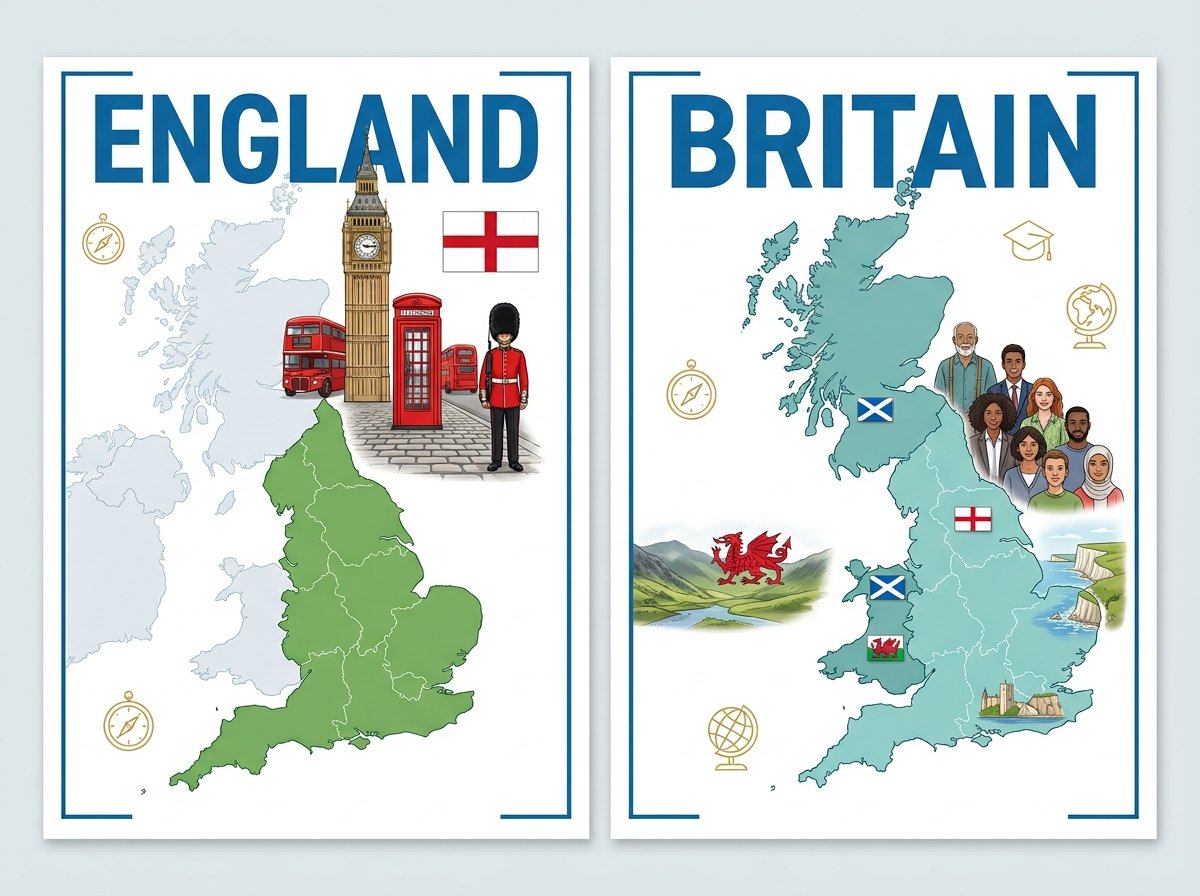
England is one country within the United Kingdom, while Britain usually means the island that contains England, Scotland, and Wales.
Imagine you are planning a trip to the UK. A friend asks, “Are you going to England?” You say yes because you are visiting London. But another friend says, “So, you are going to Britain?” That can also be correct. The two words are closely related, but they do not mean exactly the same thing.
England or Britain is a common search because many English learners and travelers are unsure when to use each term. England is a country. Britain, in its usual geographic sense, is the island called Great Britain. It includes England, Scotland, and Wales. Northern Ireland is not part of Great Britain, although it is part of the United Kingdom.
Pronunciation
England
- US: /ˈɪŋɡlənd/
- UK: /ˈɪŋɡlənd/
Britain
- US: /ˈbrɪtən/
- UK: /ˈbrɪtən/
England
ING-glənd
Give feedback
Britain
BRIT-ən
Give feedback
Now, let us look at the key differences step by step.
Difference Between England or Britain
1. England Is a Country
England is one of the four countries that make up the United Kingdom.
Examples:
- London is the capital of England.
- Manchester is a city in England.
2. Britain Is a Geographic Name
Britain usually refers to Great Britain, the large island containing England, Scotland, and Wales.
Examples:
- Great Britain has three countries.
- Scotland is part of Great Britain.
3. England Is Smaller
England covers only part of Great Britain.
Examples:
- England is south of Scotland.
- Wales borders England.
4. Britain Includes Scotland
Scotland is not part of England, but it is part of Great Britain.
Examples:
- Edinburgh is in Scotland, not England.
- Scotland is part of Britain.
5. Britain Includes Wales
Wales is also part of Great Britain.
Examples:
- Cardiff is in Wales.
- Wales is on the island of Great Britain.
6. Northern Ireland Is Different
Northern Ireland is part of the United Kingdom, but it is not part of Great Britain.
Examples:
- Belfast is in Northern Ireland.
- Northern Ireland is not on Great Britain.
7. England Has London
London is the capital of England and also the capital of the United Kingdom.
Examples:
- London is in England.
- The UK government is based in London.
8. Britain Is Not the Same as the UK
Great Britain and the United Kingdom are different terms.
Examples:
- Great Britain = England + Scotland + Wales.
- United Kingdom = Great Britain + Northern Ireland.
9. England Refers to English Identity
The word England can describe English culture, places, and people.
Examples:
- She lives in England.
- He is learning about English history.
10. Britain Can Have a Wider Cultural Meaning
Britain can be used in broader cultural, political, and historical contexts.
Examples:
- British history is taught in many schools.
- British music is popular around the world.
Nature and Behaviour of England or Britain
England
England is a country with its own history, culture, traditions, cities, and regional identities. It is the largest country in the UK by population.
People from England are generally called English.
For example:
- She is English.
- He lives in England.
Britain
Britain, when used for Great Britain, is a geographic term. It brings together England, Scotland, and Wales.
People from these countries can be called British, although they may also prefer more specific identities such as English, Scottish, or Welsh.
For example:
- She is British.
- He is Scottish and British.
Why People Get Confused About England or Britain
The confusion comes from the fact that the terms are connected.
England is part of Britain. Britain is part of the United Kingdom in geographic terms, but Britain itself does not include Northern Ireland.
There is also a long history behind these names. In everyday speech, people sometimes use “Britain,” “Great Britain,” and “UK” loosely. This can make the difference harder to understand.
The easiest rule is:
England = one country.
Great Britain = England + Scotland + Wales.
United Kingdom = Great Britain + Northern Ireland.
Comparison Table
| Feature | England | Britain / Great Britain |
| Type | Country | Geographic island |
| Includes England | Yes | Yes |
| Includes Scotland | No | Yes |
| Includes Wales | No | Yes |
| Includes Northern Ireland | No | No |
| Capital associated with it | London | No separate capital |
| People | English | British can refer to people from Great Britain |
| Location | Part of Great Britain | Island in the British Isles |
| Common adjective | English | British |
| Example | England has London | Britain includes Scotland |
The Origin of England or Britain
The name England comes from Old English Engla land, meaning “land of the Angles.” The Angles were a Germanic people who settled in parts of Britain after the Roman period.
The name Britain has much older roots. It is linked to the name used for the island and its ancient Celtic inhabitants. The Roman name Britannia became strongly connected with the island.
Over time, the political map changed. Different kingdoms developed in Britain. England became a powerful kingdom, while Scotland and Wales developed their own political histories.
Later, England and Scotland joined politically in stages. The Kingdom of Great Britain was created in 1707. The political union with Ireland followed in 1801. After most of Ireland became independent in the 20th century, the modern United Kingdom became the United Kingdom of Great Britain and Northern Ireland.
British vs American English
The words England and Britain have the same basic meanings in both British and American English.
The main difference is often pronunciation, accent, and surrounding vocabulary.
British English
British speakers may use:
- Britain
- Great Britain
- the UK
- England
Example:
- “Scotland is part of Great Britain.”
American English
American speakers also use these terms, but “England” is sometimes used informally when the speaker means the UK.
Example:
- “She moved to England.”
If she actually moved to Scotland, the sentence would be incorrect.
Important Usage Rule
Do not use England when you mean all four countries of the UK.
Instead, use the UK or the United Kingdom when Northern Ireland is included.
Which One Should You Use?
England when you are talking specifically about the country of England.
Great Britain when you mean England, Scotland, and Wales.
Use the United Kingdom when you mean England, Scotland, Wales, and Northern Ireland.
For US readers, the same rule applies. American English does not change the geographic meaning.
For global writing, the safest choice is to be specific. You mean London, Manchester, or Liverpool, say England. If you mean Scotland and Wales too, Great Britain may be suitable. If you mean all four UK countries, use the United Kingdom.
Common Mistakes
Mistake 1: Calling Scotland England
Wrong: Scotland is in England.
Correct: Scotland is in Great Britain and the UK.
Mistake 2: Saying Britain Means Only England
Wrong: Britain means England.
Correct: Great Britain includes England, Scotland, and Wales.
Mistake 3: Including Northern Ireland in Great Britain
Wrong: Great Britain includes Northern Ireland.
Correct: Northern Ireland is part of the UK, not Great Britain.
Mistake 4: Calling Every UK Person English
Wrong: A Scottish person is English.
Correct: A Scottish person is Scottish and may also be British.
Mistake 5: Treating Britain and UK as Exact Synonyms
Wrong: Britain and the UK always mean exactly the same thing.
Correct: Great Britain and the UK have different geographic meanings.
Everyday Usage Examples
In Emails
- “I will be traveling to England next month.”
- “Our company has offices across Britain.”
On Social Media
- “London is one of my favorite cities in England.”
- “I want to visit Scotland and Wales in Britain.”
In News
- “The British government announced a new policy.”
- “England’s football team won the match.”
In Formal Writing
- “England is the largest country in the United Kingdom by population.”
- “Great Britain consists of England, Scotland, and Wales.”
Usage Trends
The words England, Britain, British, and UK are all common around the world.
“England” is especially common when people talk about English cities, sports teams, history, or culture.
“British” is widely used for things connected with the UK, such as British English, British history, and British culture.
“UK” is common in news, business, travel, education, and official writing because it clearly refers to the United Kingdom.
Online searches often mix these terms. This is one reason people search for questions such as “England or Britain” and “Britain vs UK.”
Metaphors and Similes
These words are not usually used as metaphors. However, writers sometimes use them in figurative descriptions.
England as a Symbol
England can represent English culture or history.
Example:
“London felt like the heart of England.”
Here, “heart” is a metaphor for something central or important.
Britain as a Symbol
Britain can represent British society or culture.
Example:
“Music became a bridge across Britain.”
The “bridge” means something that connects people.
Connotative Meaning
Positive Meaning
Both terms can have positive meanings when linked with culture, history, travel, or national pride.
Example:
“Britain has a rich literary tradition.”
Negative Meaning
The words themselves are not normally negative. However, historical or political discussions can give them a negative tone depending on context.
Example:
“The debate raised difficult questions about Britain’s past.”
Neutral Meaning
In most factual writing, these words are neutral.
Example:
“England is part of the United Kingdom.”
Idioms and Proverbs
There are no major common English idioms that depend on the exact contrast between England and Britain.
However, “Britannia” appears in historical and cultural expressions.
Example:
“Britannia has long been used as a symbol of Britain.”
Another familiar phrase is “British weather,” often used humorously for changeable weather.
Example:
“We planned a picnic, but British weather changed our plans.”
Literature and Movies
England and Britain appear often in literature.
Literature
Pride and Prejudice by Jane Austen was published in 1813. It is a classic English novel about society, family, marriage, and class.
Oliver Twist by Charles Dickens was published in book form in 1838. It presents life in Victorian England.
British literature also includes major Scottish and Welsh writers, so “British literature” can cover a wider range than “English literature.”
Movies
The King’s Speech (2010) is a British historical drama about King George VI. It was produced in the United Kingdom.
Paddington (2014) is a British family comedy film. It follows the adventures of a bear who comes to London.
These examples show why knowing the difference between England and Britain can help when discussing culture and history.
Why This Difference Matters
This difference matters because geography and identity are important.
If you call a Scottish person English, they may correct you. The same can happen with Welsh or Northern Irish people.
Correct word choice also makes writing clearer. In school essays, travel guides, news articles, and business writing, accurate names show care and respect.
For English learners, the distinction is especially useful. It helps you understand maps, sports, history, politics, and international news.
A simple geographic mistake can change the meaning of a sentence. Learning these terms now can prevent many mistakes later.
Usefulness in Daily Life
Knowing these terms can help when you:
- Plan a trip.
- Book a flight.
- Read a map.
- Talk about sports.
- Discuss history.
- Write about culture.
- Read international news.
- Talk with people from the UK.
- Complete school assignments.
- Write professional content.
Possible short question
Is England the same as Britain?
No. England is one country within Great Britain. Great Britain includes England, Scotland, and Wales.
Is Britain the same as the UK?
No. Great Britain includes England, Scotland, and Wales. The UK also includes Northern Ireland.
Is Scotland part of England?
No. Scotland is a separate country within the United Kingdom. It is also part of Great Britain.
Is Wales part of Britain?
Yes. Wales is part of Great Britain and the United Kingdom.
Is Northern Ireland part of Britain?
Northern Ireland is not part of Great Britain. It is part of the United Kingdom.
Are English and British the same?
No. English usually means something related to England. British can refer to something related to the United Kingdom or its people.
Which term should English learners use?
Use the most specific term. Say England for England, Great Britain for England + Scotland + Wales, and the UK for all four countries.
Conclusion
England or Britain is important because the two terms have related but different meanings. England is a country. Great Britain is the island that contains England, Scotland, and Wales. United Kingdom is a political state made up of England, Scotland, Wales, and Northern Ireland. The easiest way to remember the difference is to think about size and geography. England is one part of Great Britain. Great Britain is one part of the United Kingdom’s name and geography. Northern Ireland belongs to the UK but not to Great Britain. Using these words correctly can make your English more accurate. It can also help you avoid mistakes when talking about travel, history, sports, culture, or politics. Whether you are an English learner, student, or writer, this small distinction is worth learning. When in doubt, be specific. England means England. Great Britain means England, Scotland, and Wales. The UK includes all four countries.

I’m Daim Abbas, an English language enthusiast, content writer, and SEO writer. I create clear and practical content about word meanings, synonyms, vocabulary, and commonly confused English words. I’m passionate about making English easy to understand while creating helpful, reader-friendly, and SEO-optimized content.








1 thought on “England or Britain: What Is the Difference?”