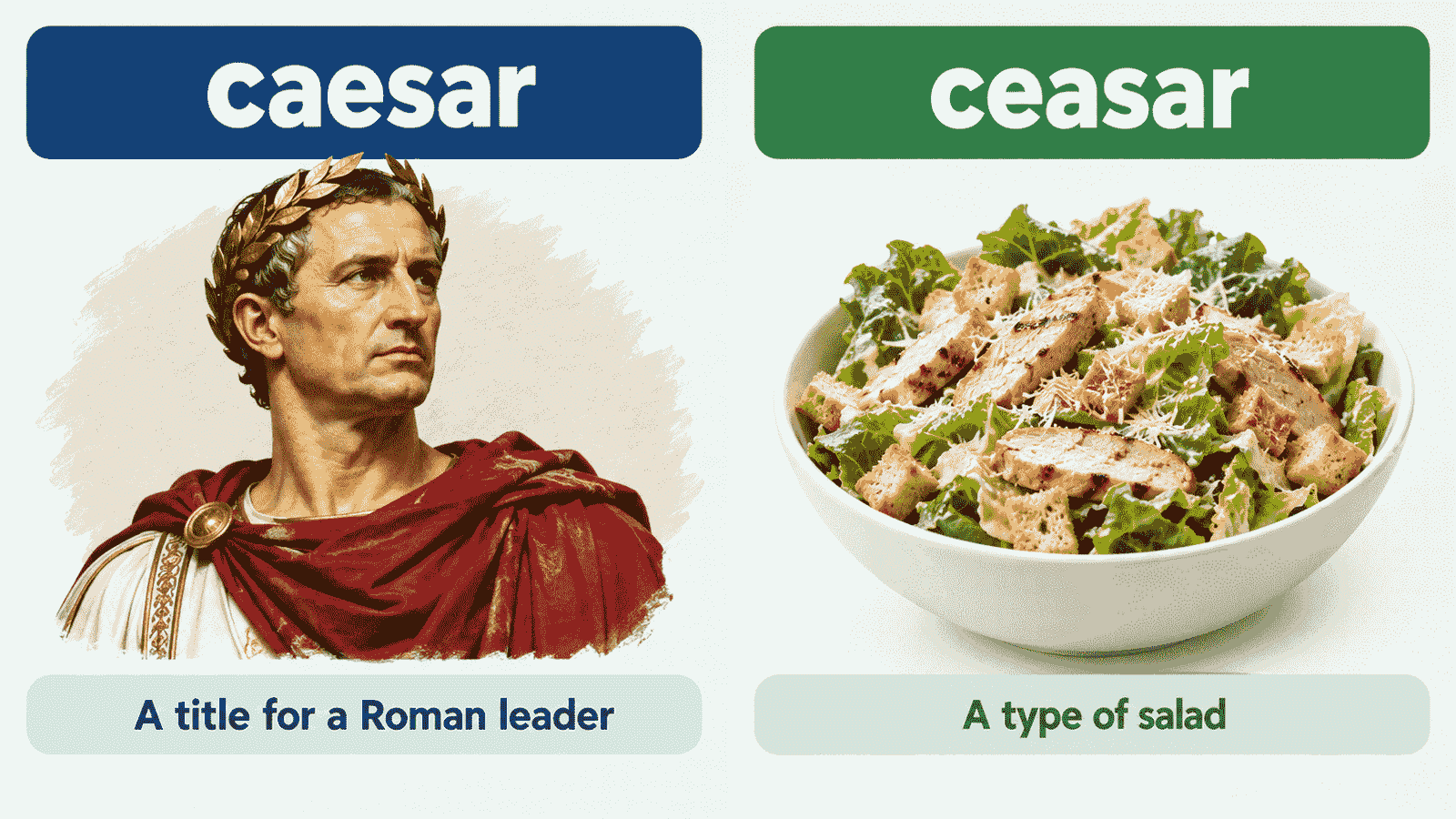
“Caesar” is the correct spelling, while “Ceasar” is a common misspelling.
Imagine you are writing about the famous Roman leader Julius Caesar. You type his name quickly and write “Julius Ceasar.” The sentence looks fine at first. Then you stop and wonder, “Is it Caesar or Ceasar?” This is a common spelling problem. The two forms look almost the same, but only Caesar is the standard English spelling for the Roman name and title.
The word Caesar can refer to Julius Caesar, the famous Roman general and statesman. It can also refer to a title used by Roman emperors. Cambridge Dictionary lists Caesar as the standard English form and gives it the meanings of Julius Caesar and a title used by ancient Roman emperors.
People search for caesar or ceasar because the letters are easy to mix up. The unusual vowel order makes the spelling hard to remember. This guide explains caesar or ceasar, their meaning, pronunciation, history, and correct usage in simple English.
Pronunciation of Caesar and Ceasar
Caesar
- US: /ˈsiː.zɚ/
- UK: /ˈsiː.zə r/
Cambridge Dictionary gives these pronunciations for Caesar.
Ceasar
“Ceasar” is a misspelling, so it does not have a separate standard dictionary pronunciation. When someone writes Ceasar but means Caesar, they normally intend the same pronunciation as Caesar.
The main point is simple: the correct spelling is Caesar.
Now let us look at the difference in more detail.
Difference Between Caesar or Ceasar
1. Correct spelling
Caesar is the correct spelling.
Ceasar is normally an incorrect spelling of the same word.
Examples:
- Julius Caesar was a Roman leader.
- The word Caesar appears in many history books.
2. Dictionary use
Caesar appears as a standard English dictionary word.
Ceasar is not the standard spelling for the Roman name or title.
Examples:
- You can find Caesar in an English dictionary.
- You should not use Ceasar in a school paper.
3. Historical name
Caesar is the spelling used for the famous Roman leader Julius Caesar.
Ceasar is an error when referring to him.
Examples:
- Julius Caesar was born in 100 BC.
- Caesar was assassinated in 44 BC.
4. Roman title
After Julius Caesar, Caesar also became a title linked with Roman emperors.
Ceasar is not the standard form of this title.
Examples:
- Augustus Caesar became an important Roman ruler.
- A Roman emperor could be called a Caesar.
5. Spelling order
The main problem is the order of the vowels.
The correct form is:
C-A-E-S-A-R
The common error is:
C-E-A-S-A-R
Examples:
- Correct: Caesar
- Incorrect: Ceasar
6. Formal writing
Use Caesar in formal writing.
This includes school work, history essays, reports, and articles.
Examples:
- Caesar played an important role in Roman history.
- The essay discusses Julius Caesar.
7. Search engines
People often type ceasar when they are unsure about the spelling.
Search engines may still understand what they mean.
However, writers should use Caesar in the final text.
Examples:
- Search query: “caesar or ceasar”
- Correct article text: “Caesar is the correct spelling.”
8. Names and titles
Caesar is used in names such as Julius Caesar and Augustus Caesar.
Ceasar should not replace the correct spelling.
Examples:
- Julius Caesar was a Roman general.
- Augustus Caesar became Rome’s first emperor.
9. Academic work
Students should always write Caesar in history assignments.
Using Ceasar may be marked as a spelling error.
Examples:
- Correct: “Caesar crossed the Rubicon.”
- Incorrect: “Ceasar crossed the Rubicon.”
10. Online writing
The same rule applies online.
Blogs, social posts, websites, and news articles should use Caesar.
Examples:
- “Who was Julius Caesar?”
- “Five facts about Caesar.”
Nature and Behaviour of Caesar or Ceasar
Caesar
Caesar is a proper name and a historical title. It is strongly connected with ancient Rome. The word can point to Julius Caesar or to the imperial title that later developed from his name. Cambridge Dictionary also lists Caesar as a noun for a title used by ancient Roman emperors.
The word can also appear in modern expressions and names. For example, Caesar salad is a famous food name. However, Caesar salad is named after restaurateur Caesar Cardini, not directly after Julius Caesar.
Ceasar
Ceasar does not have a separate historical meaning in standard English when it is used as a spelling of the Roman name.
In most cases, it is simply a spelling mistake.
For example:
- Wrong: “Julius Ceasar”
- Correct: “Julius Caesar”
Why People Get Confused About Caesar or Ceasar
The confusion comes from the unusual spelling.
Many English words do not make the vowel order easy to predict. Caesar contains “ae,” which can look strange to modern English readers.
People may remember the sound but forget the exact letters. As a result, they write Ceasar instead of Caesar.
Another reason is typing speed. A person may know the correct name but type the letters in the wrong order.
The best memory trick is simple:
Caesar has “CAE” at the beginning.
Think:
C-A-E-S-A-R
Not:
C-E-A-S-A-R
Comparison Table
| Feature | Caesar | Ceasar |
| Standard spelling | Yes | No |
| Historical name | Yes | No |
| Julius Caesar | Correct | Incorrect |
| Roman title | Correct | Incorrect |
| Dictionary form | Yes | No standard form |
| Formal writing | Recommended | Avoid |
| Academic writing | Recommended | Avoid |
| Common online error | Sometimes | Yes |
| Pronunciation | /ˈsiː.zɚ/ US | Usually intended as Caesar |
| Meaning | Roman name/title | Usually a misspelling |
Both forms may appear in online searches, but they do not have equal status. Caesar is the standard form.
The Origin of the Keyword
The word Caesar comes from the family name of Julius Caesar. Over time, the name became linked with Roman imperial power.
Julius Caesar was a major Roman general and statesman. He played a key role in the political changes that ended the Roman Republic and helped lead toward the Roman Empire. Cambridge Dictionary identifies Julius Caesar as a famous Roman emperor and general and records his birth in 100 BC and assassination on March 15, 44 BC.
After his death, the name Caesar gained a wider meaning. It became associated with Roman rulers and imperial authority.
This historical development is why Caesar is more than just a personal name.
British vs American English
There is no major British-American spelling difference between Caesar and Caesar.
Both British and American English use:
Caesar
The pronunciation has a small difference.
- UK: /ˈsiː.zə r/
- US: /ˈsiː.zɚ/
The spelling stays the same.
Examples:
British English:
- “Julius Caesar was a Roman general.”
American English:
- “Julius Caesar was a Roman general.”
In both forms of English, Ceasar is normally treated as a misspelling.
Which One Should You Use?
Use Caesar in almost every standard English situation.
For US English
Use Caesar.
Example:
- “I am reading about Julius Caesar.”
For UK English
Use Caesar.
Example:
- “Shakespeare wrote a play about Julius Caesar.”
For global English
Use Caesar.
It is the safest and most widely recognized spelling.
If you see Ceasar, treat it as a likely spelling error unless it is part of a specific person’s name or another proper name.
Common Mistakes
Here are some common mistakes and corrections:
- Ceasar → Caesar
- Julius Ceasar → Julius Caesar
- Ceasar salad → Caesar salad
- Ceasar was a Roman leader → Caesar was a Roman leader
- Augustus Ceasar → Augustus Caesar
- Caeser → Caesar
- Cesar → Caesar when referring to the English form of the Roman name
Remember the vowel order:
CAESAR
Everyday Usage Examples
In emails
Formal:
“I am writing a report about Julius Caesar.”
Informal:
“Did you finish the Caesar section?”
On social media
- “Julius Caesar changed Roman history.”
- “I just watched a documentary about Caesar.”
In news writing
- “Historians continue to study Caesar’s role in Roman politics.”
Formal writing
- “Caesar’s political career had a major effect on Roman history.”
School writing
- “Julius Caesar was assassinated in Rome in 44 BC.”
In all these cases, use Caesar, not Ceasar.
Usage Trends
The correct form Caesar has been used for centuries because it is tied to Roman history and later imperial titles.
The misspelling Ceasar appears mainly because people reverse the “a” and “e.” It can be found in searches, informal writing, social posts, and user-generated content.
This does not make Ceasar a second accepted spelling of the historical name.
For professional writing, the rule is simple:
Choose Caesar.
Metaphors and Similes
Caesar can sometimes be used in a figurative way because the name is linked with power and leadership.
Metaphor
- “He became a Caesar in the company.”
Here, Caesar suggests a very powerful leader.
Simile
- “He ruled the team like a Caesar.”
This compares the person’s leadership with the power of a Roman ruler.
Another example
- “The manager acted like a modern Caesar.”
This suggests that the manager wanted strong control.
These are figurative uses. They do not change the spelling.
Connotative Meaning
The word Caesar can carry different feelings depending on the context.
Positive meaning
It may suggest:
- Power
- Leadership
- Success
- Authority
Example:
“He was a Caesar-like leader who united his people.”
Negative meaning
It can also suggest:
- Too much power
- Pride
- Control
- Dictatorship
Example:
“The ruler behaved like a Caesar and ignored everyone around him.”
Neutral meaning
In history, Caesar may simply identify a person or title.
Example:
“Caesar was a major figure in Roman history.”
Idioms and Proverbs
There is no common English proverb based directly on the spelling Caesar or Ceasar.
However, several famous expressions are connected with Julius Caesar and Roman history.
Cross the Rubicon
This means to make a decision that cannot easily be reversed.
Example:
“Once she signed the contract, she had crossed the Rubicon.”
Et tu, Brute?
This famous phrase is strongly associated with the assassination of Caesar. It is often used to express shock at betrayal.
Example:
“You took my project? Et tu, Brute?”
These expressions are linked to Caesar’s story, not to the misspelling Ceasar.
Literature and Movies
Literature
One of the best-known literary works connected with Caesar is Julius Caesar, a tragedy by William Shakespeare. It was written around 1599 and focuses on Caesar’s assassination and the political conflict that follows.
The play remains one of Shakespeare’s best-known historical tragedies.
Another major literary connection is Shakespeare’s use of Roman history in his drama. The story has helped keep the name Caesar familiar for English readers for centuries.
Movies
Julius Caesar (1953) is an American historical drama based on Shakespeare’s play. It features the story of Caesar, Brutus, and the political conflict in ancient Rome.
Another famous Roman-era film is Cleopatra (1963), a historical epic produced in the United States and the United Kingdom. Julius Caesar is an important character in the story.
Why This Difference Matters
The difference matters because correct spelling makes writing clear and trustworthy.
A spelling error can change how professional a sentence looks. This is especially important in history, education, journalism, and academic writing.
For English learners, Caesar is also a useful example of why English spelling can be difficult. The letters do not always appear in the order that learners expect.
Knowing the correct form helps you:
- Write better essays.
- Search for historical information.
- Avoid spelling errors.
- Write names correctly.
- Create professional content.
- Improve your English vocabulary.
A small spelling difference can make a big difference in formal writing.
Usefulness in Daily Life
You may need the word Caesar in many situations.
You might write a school essay about Rome. And might read a book about ancient history. You might search for Julius Caesar online. Might watch a historical movie.
You may also see the word in Caesar salad, books, museums, documentaries, and history websites.
Situational Preference
In school, work, websites, emails, and formal documents, always choose Caesar. British English and American English both use this spelling. If you are writing about Julius Caesar, Roman emperors, or a historical event, Caesar is the correct choice. If you see Ceasar in an informal post, it is usually a spelling error. The only time you should keep a different spelling is when it is an exact spelling of a specific person’s name, brand, or title that intentionally uses that form. For normal English usage, there is no reason to replace Caesar with Ceasar.
Possible short question
Is Caesar or Ceasar correct?
Caesar is correct. Ceasar is normally a misspelling.
How do you spell Julius Caesar?
The correct spelling is Julius Caesar.
Is Ceasar an English word?
Ceasar is not the standard English spelling of the Roman name or title. It is usually a misspelling of Caesar.
How is Caesar pronounced?
In US English, it is /ˈsiː.zɚ/. In UK English, it is /ˈsiː.zə r/.
Why is Caesar spelled with AE?
The spelling comes from the historical Latin name Caesar. The unusual letter order has remained in the English form.
Is Caesar a name or a title?
It can be both. It is the family name of Julius Caesar and later became a title associated with Roman emperors.
Is Caesar salad named after Julius Caesar?
No. The famous salad is associated with restaurateur Caesar Cardini, not Julius Caesar.
Conclusion
The answer to caesar or ceasar is simple: Caesar is the correct spelling. Ceasar is normally a spelling mistake.The word Caesar has a long history. It comes from the name of Julius Caesar, one of the most famous figures in ancient Rome. Later, the name became a title linked with Roman emperors. Today, the word still appears in history books, literature, movies, news articles, school essays, and everyday writing. Cambridge Dictionary recognizes Caesar as the standard English form and gives both US and UK pronunciations.
Correct: Caesar
Incorrect: Ceasar

I’m Daim Abbas, an English language enthusiast, content writer, and SEO writer. I create clear and practical content about word meanings, synonyms, vocabulary, and commonly confused English words. I’m passionate about making English easy to understand while creating helpful, reader-friendly, and SEO-optimized content.