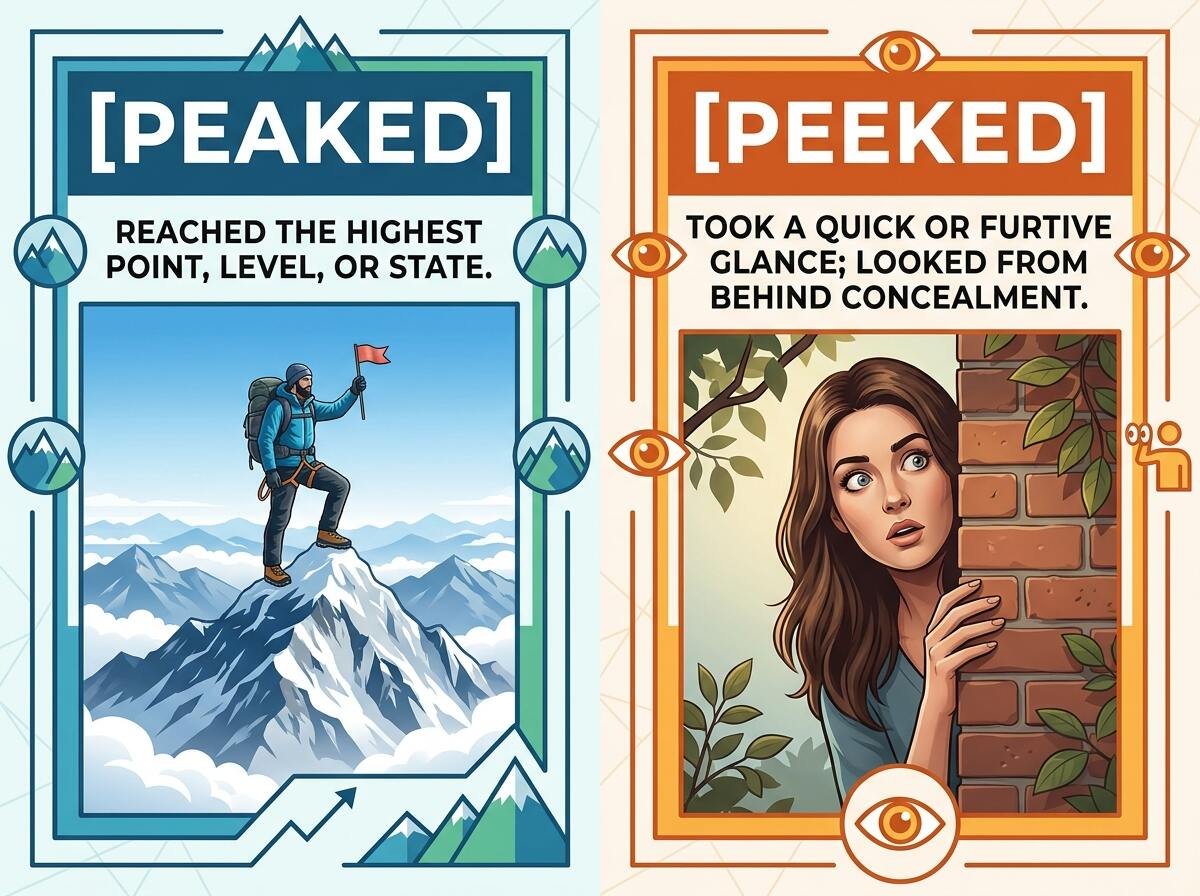
Peaked means reached the highest point, while peeked means looked quickly or secretly.
Imagine you are watching a football match. Your team plays very well in the first half, and its performance reaches its best level. You might say, “The team peaked in the first half.” Now imagine you want to see a surprise gift before your birthday. You open the box for a quick look. You peeked at the gift.
These two words sound almost the same, but they have very different meanings. Peaked or peeked is a common spelling question because both words contain the same long “ee” sound. Writers and English learners may confuse them when typing quickly. The word peaked is linked to a peak, or the highest point. The word peeked comes from peek, which means to look quickly, often when you should not. Knowing the difference between peaked or peeked can help you avoid simple spelling mistakes in emails, schoolwork, social media posts, and professional writing. This guide explains peaked or peeked with clear examples and easy rules.
Pronunciation
| Word | US Pronunciation | UK Pronunciation |
| peaked | /piːkt/ | /piːkt/ |
| peeked | /piːkt/ | /piːkt/ |
Both words are pronounced the same. They are homophones.
peaked or peeked
/piːkt ɔːr piːkt/
Give feedback
Now let us look at the meaning, grammar, and correct use of each word.
Difference Between Peaked or Peeked
1. Basic Meaning
Peaked means reached the highest point or level.
Peeked means looked quickly or secretly.
- Her career peaked in 2019.
- She peeked inside the box.
2. Word Root
Peaked comes from the noun peak.
A peak is the highest point of something.
Peeked comes from the verb peek.
Peek means to take a quick look.
- The mountain peaked above the clouds.
- Tom peeked through the door.
3. Action vs. Highest Point
Peaked often describes a rise that reaches a maximum.
Peeked describes a person’s action of looking.
- Sales peaked in December.
- I peeked at the answer.
4. Grammar
Both words are past-tense verbs.
Peak → peaked
Peek → peeked
- The temperature peaked at 40°C.
- She peeked at her phone.
5. Common Context
Peaked is common in discussions about:
- Sports
- Careers
- Sales
- Performance
- Numbers
- Health
- Trends
Peeked is common when talking about:
- Looking
- Secrets
- Surprises
- Doors
- Boxes
- Notes
6. Emotional Meaning
Peaked can describe the best stage of something.
- His performance peaked during the final.
- Her popularity peaked last year.
Peeked has no such meaning.
- She peeked at the surprise.
- He peeked through the window.
7. Can You See Something?
With peeked, someone looks at something.
With peaked, someone does not necessarily look at anything.
- I peeked inside the room.
- The team’s form peaked in June.
8. Common Objects
You can peek at something.
You do not normally peek a number or performance.
- He peeked at the letter.
- The company’s profits peaked in July.
9. Physical and Abstract Use
Peaked can describe physical or abstract highs.
- The road peaked near the hill.
- Interest in the show peaked last week.
Peeked normally involves sight.
- The child peeked behind the curtain.
- I peeked into the bag.
10. Easy Memory Rule
Think:
Peak = highest point
Peek = quick look
Examples:
- The graph peaked at 90%.
- She peeked at the graph.
Nature and Behaviour of Peaked or Peeked
Peaked
Peaked describes something that reached its highest level.
It is often followed by information about time, place, or amount.
- Prices peaked in June.
- His popularity peaked at age 25.
It can also describe reaching a physical high point.
- The mountain road peaked near the top.
Peeked
Peeked describes a quick or secret look.
It usually involves a person looking at something.
- She peeked through the window.
- He peeked inside the bag.
The action may be curious, playful, or secret.
Why People Get Confused About Peaked or Peeked
The main reason is pronunciation.
Peaked and peeked sound exactly alike in standard English. They are homophones.
Their spelling and meanings are different, but their sound is the same.
For example:
The sales peaked in July.
and
She peeked inside the room.
When speaking, listeners use context to understand the meaning. When writing, you must choose the correct spelling.
A useful trick is to remember:
Peak = top
Peek = look
Comparison Table
| Feature | Peaked | Peeked |
| Root word | Peak | Peek |
| Meaning | Reached the highest point | Looked quickly |
| Part of speech | Verb | Verb |
| Past tense | Yes | Yes |
| Pronunciation | /piːkt/ | /piːkt/ |
| Main idea | Highest level | Quick look |
| Common with numbers | Yes | No |
| Common with secrets | No | Yes |
| Example | Sales peaked in June. | She peeked inside. |
Similarities
Both words:
- Are verbs.
- Are past-tense forms.
- Sound the same.
- End in -ed.
- Can appear in simple past sentences.
The Origin of Peaked or Peeked
The word peak comes from an old English word connected with a pointed top or summit. Over time, its meaning expanded beyond mountains. Today, a peak can mean the highest point of almost anything.
For example, we can talk about the peak of a career, season, or trend.
The verb peek has a different history. It developed from words related to looking or peering briefly. Its modern meaning is to take a quick or secret look.
The two words developed separately. Their similar pronunciation is what makes them easy to confuse.
British vs American English
There is no major spelling difference between peaked and peeked in British and American English.
Both varieties use:
- peaked
- peeked
Examples:
American English:
- Sales peaked last summer.
- She peeked through the door.
British English:
- Sales peaked last summer.
- She peeked through the door.
The pronunciation is also essentially the same.
The important point is not British versus American spelling. It is choosing the word that matches your meaning.
Which One Should You Use?
Use peaked when you mean reached the highest point.
- The temperature peaked at 35°C.
- His career peaked in 2020.
Use peeked when you mean looked quickly.
- She peeked inside the room.
- He peeked at the answer.
For US, UK, and global English, the same rule applies.
When you are unsure, replace the word mentally:
Did it reach a high point? → peaked
Did someone take a quick look? → peeked
Common Mistakes
Mistake 1: Using “peeked” for a high point
Incorrect:
- Sales peeked in December.
Correct:
- Sales peaked in December.
Mistake 2: Using “peaked” for looking
Incorrect:
- She peaked through the window.
Correct:
- She peeked through the window.
Mistake 3: Confusing “peak” and “peek”
Incorrect:
- I want to peak inside the box.
Correct:
- I want to peek inside the box.
Mistake 4: Forgetting the context
Always ask what the sentence means.
If it is about a top level, use peaked.
If it is about a quick look, use peeked.
Everyday Usage Examples
In Emails
- Our website traffic peaked last month.
- I peeked at the document before the meeting.
On Social Media
- My excitement peaked during the final scene.
- I peeked at the surprise gift!
In News
- Temperatures peaked at 42°C.
- The reporter peeked through the damaged doorway.
In Formal Writing
- Demand peaked during the holiday season.
- The researcher peeked through the viewing window.
Usage Trends
Both words are common in modern English, but they appear in very different contexts.
Peaked is common in news, business, sports, science, and data reports. Writers often use it to describe a maximum level.
Peeked is common in stories and everyday conversations. It describes someone taking a quick look.
Online writing can increase confusion because people often type quickly and rely on spell-check tools. Since both words are real English words, an automatic spell-checker may not always detect the mistake.
Context remains important.
Metaphors and Similes
Peaked is often used figuratively.
- Her career peaked after the award.
- His confidence peaked before the final match.
Here, peaked does not mean standing on a mountain. It means reaching the highest level.
Peeked can also appear in playful descriptions.
- She peeked like a curious cat through the door.
- The sun peeked through the clouds.
In these examples, peeked describes a brief appearance or look.
Connotative Meaning
Positive Tone
Peaked can suggest success or a high level.
- His career peaked with that award.
Peeked can suggest curiosity.
- The child peeked into the gift box.
Negative Tone
Peaked can sometimes suggest decline after reaching a high point.
- The team’s performance peaked early in the season.
Peeked may suggest secret or unwanted behavior.
- He peeked at my test answers.
Neutral Tone
Both can be neutral.
- Prices peaked in May.
- She peeked through the window.
Idioms and Proverbs
There is no major common proverb that specifically pairs peaked and peeked.
However, peak appears in common expressions.
Peak Season
This means the busiest or most popular time.
- Hotels are expensive during peak season.
Peak Performance
This means the highest level of performance.
- The athlete reached peak performance.
Peak Time
This means the busiest period.
- Traffic is heavy during peak time.
The word peek is also used in the phrase:
Take a Peek
This means to have a quick look.
- Take a peek inside the box.
Literature and Movies
The idea of a peak is common in literature. Writers often describe the highest point of a character’s success, power, or emotional journey. It is especially common in biographies, sports writing, drama, and coming-of-age stories.
The idea of peeking is also common in fiction. A character may peek through a keyhole, around a corner, or inside a secret room. It is often used to create curiosity or suspense.
In movies, these actions are easy to show visually. A character may peek before entering a room, while a story may show a character reaching the peak of success.
These words are therefore useful in both factual and creative writing.
Why This Difference Matters
Knowing the difference between peaked and peeked makes your writing clearer.
A wrong spelling can change the meaning of a sentence.
Compare:
- The company’s sales peaked in June.
- The company peeked in June.
The first sentence says sales reached their highest level. The second sentence sounds as if the company looked quickly.
For English learners, this is a useful lesson in homophones. Many English words sound alike but have different meanings and spellings.
Correct word choice also helps in school, work, emails, articles, and professional communication.
Usefulness in Daily Life
You may use peaked when talking about:
- Weather
- Prices
- Sales
- Sports
- Careers
- Popularity
- Performance
- Trends
You may use peeked when talking about:
- Gifts
- Rooms
- Bags
- Letters
- Phones
- Surprises
- Secrets
- Windows
Remember the simple rule:
Peaked = reached the top.
Peeked = took a quick look.
Situational Preference
Use peaked when your sentence describes a maximum point. It works well for numbers, performance, popularity, prices, careers, and trends. Use peeked when someone takes a short look at something. It is useful in everyday speech, stories, emails, and casual writing. In business reports, peaked is much more likely. In a story about a child opening a surprise box, peeked is the natural choice. Neither word is more correct in general. The situation decides which one you need. Always focus on the meaning before choosing the spelling.
POSSIBLE SHORT QUESTION
Is “peaked” a real word?
Yes. Peaked is the past tense of peak. It means reached the highest point or level.
Is “peeked” a real word?
Yes. Peeked is the past tense of peek. It means looked quickly or secretly.
Do peaked and peeked sound the same?
Yes. They are homophones in standard English. Both are normally pronounced /piːkt/.
Is it “peaked through the window” or “peeked through the window”?
The correct phrase is peeked through the window because it describes looking.
Is it “sales peeked” or “sales peaked”?
The correct form is sales peaked because sales can reach their highest level.
Can peaked describe a career?
Yes.
- Her career peaked in the early 2000s.
How can I remember the difference?
Think of peak as the top of a mountain. Think of peek as taking a quick look.
Conclusion
Peaked and peeked sound the same, but they have different meanings and spellings. Peaked comes from peak and means reached the highest point or level. Peeked comes from peek and means looked quickly or secretly. This difference is easy to remember once you connect each word with its root. Use peaked for things such as sales, prices, careers, sports performance, temperatures, and popularity. Peeked when someone takes a quick look at a person, place, object, or secret. Both words are used in American and British English, and neither has a special regional spelling. The key rule is simple: peak means the top, while peek means a quick look. When you write peaked or peeked, think about the action or idea in your sentence first. If something reached its highest point, choose peaked. If someone looked quickly, choose peeked. This small distinction can make your English more accurate, clear, and professional.

I’m Daim Abbas, an English language enthusiast, content writer, and SEO writer. I create clear and practical content about word meanings, synonyms, vocabulary, and commonly confused English words. I’m passionate about making English easy to understand while creating helpful, reader-friendly, and SEO-optimized content.












1 thought on “Peaked or Peeked: What Is the Difference?”