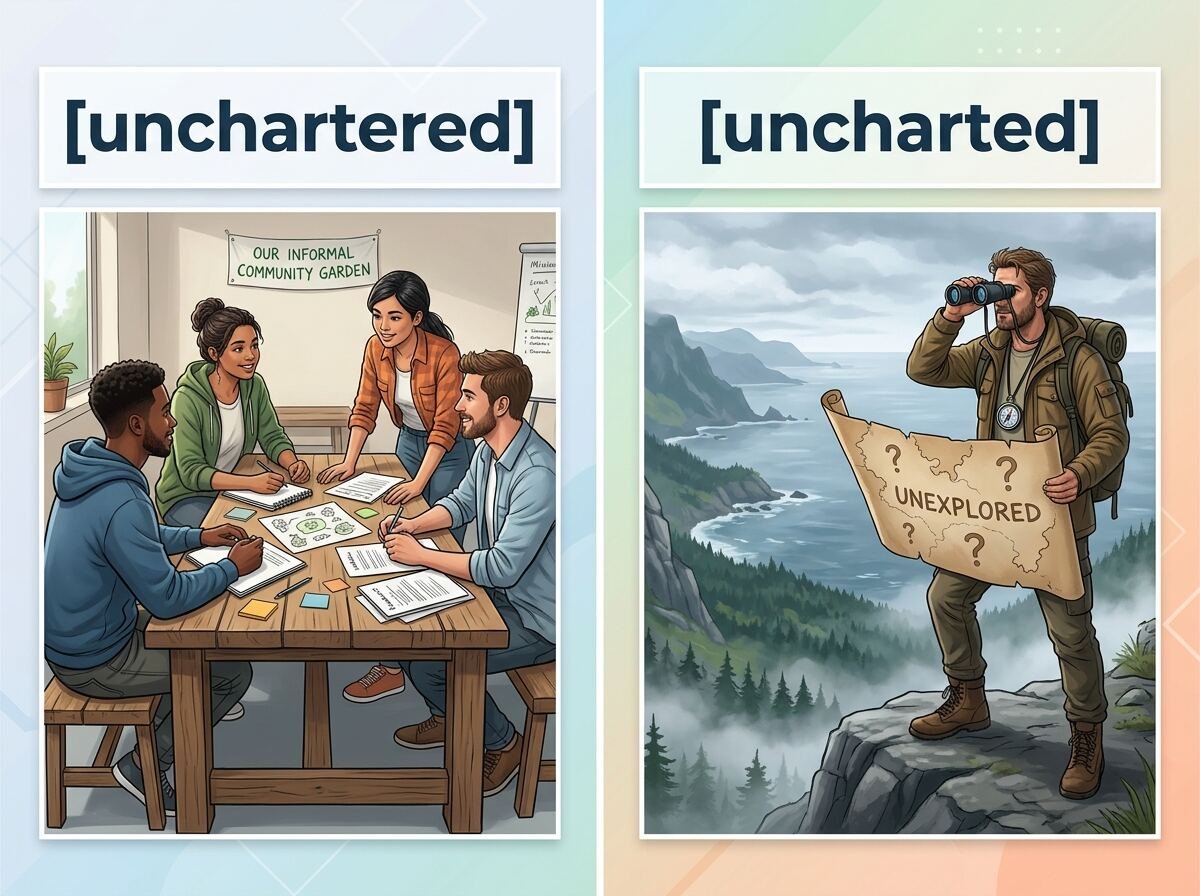
Uncharted means unknown, unexplored, or not yet mapped, while unchartered means not given or covered by a charter.
Imagine you are planning a trip to a remote place. You open a map and see a large area with no roads, names, or clear paths. You might say, “This is uncharted territory.” The word uncharted fits because the area is unknown or not fully explored. Now imagine a business that has not been given an official charter. In that rare case, unchartered may be the right word.
People often search for unchartered or uncharted because the two spellings look almost the same. They also sound very similar. However, they have different meanings and uses. Uncharted is the common word. It is used for unknown places, new ideas, fresh experiences, and difficult situations. Unchartered is much less common and relates to a charter or official authorization.
Pronunciation
Uncharted
- US: /ʌnˈtʃɑːrtɪd/
- UK: /ʌnˈtʃɑːtɪd/
Unchartered
- US: /ʌnˈtʃɑːrtərd/
- UK: /ʌnˈtʃɑːtəd/
The main difference is easy to notice in careful speech. Unchartered has an extra syllable because of the word chartered.
Now let us look at the difference in detail.
Difference Between Unchartered or Uncharted
1. Basic Meaning
Uncharted means unknown, unexplored, or not mapped.
Unchartered means not covered by a charter or not officially chartered. It is uncommon in modern English.
Examples of uncharted:
- The explorers entered an uncharted area.
- We are moving into uncharted territory.
Examples of unchartered:
- The group was described as unchartered.
- The organization remained unchartered for many years.
2. Common Usage
Uncharted is widely used in everyday and formal English.
Unchartered is rare. Most writers do not need it.
Examples of uncharted:
- The team faced uncharted challenges.
- Scientists entered uncharted waters.
Examples of unchartered:
- The small group was still unchartered.
- The club operated as an unchartered body.
3. Meaning of “Chart”
The word uncharted comes from the idea of something not being placed on a chart or map.
A chart can show a place, route, or area.
Examples:
- The sailors traveled through uncharted waters.
- The map showed several uncharted islands.
Here, uncharted means not recorded or mapped.
4. Meaning of “Charter”
Unchartered is connected with the word charter.
A charter is an official document that gives rights, powers, or permission to an organization.
Examples:
- The organization was not yet chartered.
- The school received its official charter.
Therefore, unchartered relates to the absence of a charter.
5. Geographic Use
Uncharted is common when talking about places.
It can describe land, seas, caves, mountains, or space.
Examples:
- The sailors crossed uncharted waters.
- The explorers reached an uncharted island.
Unchartered is normally not used to describe unknown places.
Examples:
- Incorrect for meaning “unknown”: We entered an unchartered forest.
- Better: We entered an uncharted forest.
6. Figurative Use
Uncharted is often used in a figurative way.
It can describe a new experience or situation.
Examples:
- Starting a new career can feel like uncharted territory.
- The scientists entered uncharted territory with their research.
Unchartered usually does not carry this figurative meaning.
Examples:
- Avoid using “unchartered territory” when you mean something new.
- Use “uncharted territory” instead.
7. Grammar
Both words can work as adjectives.
Uncharted usually comes before a noun.
Examples:
- uncharted territory
- uncharted waters
Unchartered can also work as an adjective, but its use is limited.
Examples:
- an unchartered organization
- an unchartered group
8. Frequency
Uncharted is far more common.
You will see it in books, news reports, business writing, science, travel writing, and entertainment.
Examples:
- The company entered uncharted markets.
- The researchers explored uncharted areas.
Unchartered appears much less often.
Examples:
- The association was unchartered.
- The organization had no official charter.
9. Meaning in Modern English
Modern English speakers usually understand uncharted as “unknown” or “unexplored.”
Examples:
- The future is uncharted.
- The team faced an uncharted challenge.
Unchartered keeps its connection to legal or official chartering.
Examples:
- The organization was unchartered.
- The group had not received a charter.
10. Which One Is Usually Correct?
If you mean unknown, unexplored, or not mapped, choose uncharted.
If you truly mean not officially chartered, unchartered can be correct.
Examples:
- We entered uncharted territory. ✓
- She explored uncharted waters. ✓
Examples with unchartered:
- The association was unchartered. ✓
- The organization had remained unchartered. ✓
For most normal writing, uncharted is the word you need.
Nature and Behaviour of Uncharted and Unchartered
Uncharted
Uncharted describes something that is unknown, unexplored, or not recorded on a map or chart.
It often creates a sense of discovery. It can also describe new situations.
For example, a new business market can be called uncharted territory. A scientist may enter an uncharted field of research.
Unchartered
Unchartered describes something that does not have an official charter.
Its meaning is more specific. It is not normally used to mean “unknown.”
For example, an organization may be unchartered if it has not received a formal charter.
Why People Get Confused About Unchartered or Uncharted
The confusion comes from their similar spelling.
Both words begin with un- and contain chart. They also sound similar in many accents.
The main problem is that uncharted is very common, while unchartered is rare. People may see the longer form and assume it means “not explored.”
That is usually wrong.
A simple memory trick is:
Uncharted = unknown or unexplored.
Unchartered = without a charter.
If you are talking about a new path, new idea, unknown place, or difficult new experience, uncharted is almost certainly the word you want.
Comparison Table
| Feature | Uncharted | Unchartered |
| Main meaning | Unknown or unexplored | Without an official charter |
| Commonness | Very common | Rare |
| Related word | Chart | Charter |
| Maps | Common | Usually no |
| New experiences | Common | Usually no |
| Organizations | Sometimes, but not usually | Possible |
| Figurative use | Very common | Rare |
| Formal writing | Common | Limited |
| Everyday English | Common | Uncommon |
| Example | uncharted territory | unchartered organization |
Similarities
Both words are adjectives.
Each begin with un-.
Both contain the letters chart.
Both can describe something that lacks an expected status or condition.
The important point is that their meanings are different.
The Origin of Uncharted
Uncharted comes from the word chart.
A chart can be a map or a detailed record. The word has a long history connected with written records and maps. When something is uncharted, it has not been placed on a chart or properly recorded.
Over time, the word developed a wider meaning.
It began to describe places that had not been mapped. Later, writers started using it for new experiences and unknown situations.
This is why we now hear phrases such as:
- uncharted territory
- uncharted waters
- uncharted waters of science
- uncharted territory in business
The word unchartered comes from charter, which refers to an official document or grant of rights. It has a different history and meaning.
British vs American English
The difference between uncharted and unchartered is not mainly a British-versus-American spelling issue.
Both British and American English use uncharted to mean unknown or unexplored.
Examples:
- British English: The ship entered uncharted waters.
- American English: The ship entered uncharted waters.
The same spelling works in both varieties.
Unchartered can also appear in both forms of English when its specific charter-related meaning is intended.
The main rule is simple: do not choose unchartered just because you are writing British English. It is not a British spelling of uncharted.
Which One Should You Use?
For US English
Use uncharted when you mean unknown or unexplored.
Example:
The researchers entered uncharted territory.
Use unchartered only when you mean something has not been officially chartered.
For UK English
The same rule applies.
Use uncharted for unknown or unexplored things.
Example:
The sailors traveled through uncharted waters.
For Global English
For international readers, uncharted is the safer and more useful choice when you mean unknown or unexplored.
It is widely understood.
If you mean an organization lacks an official charter, use unchartered when that exact meaning is needed.
Common Mistakes
Mistake 1: Using “unchartered” for an unknown place
Wrong:
The explorers entered unchartered territory.
Correct:
The explorers entered uncharted territory.
Mistake 2: Using “unchartered waters” for a new situation
Wrong:
The new manager entered unchartered waters.
Correct:
The new manager entered uncharted waters.
Mistake 3: Thinking both words have the same meaning
They do not.
Uncharted means unknown or unexplored.
Unchartered relates to a charter.
Mistake 4: Thinking unchartered is simply a spelling error
Not always.
Unchartered is a real word, but it has a rare and specific use.
Mistake 5: Using unchartered in common phrases
The common phrase is:
uncharted territory
Not:
unchartered territory
Everyday Usage Examples
In Emails
Our team is entering uncharted territory with this project.
This new market is uncharted territory for us.
On Social Media
Starting a new life in another country feels like uncharted territory.
We are ready to explore uncharted places!
In News Writing
Scientists are studying an uncharted region of the ocean.
The discovery may take researchers into uncharted territory.
In Formal Writing
The study examines an uncharted area of modern science.
The company entered an uncharted market with its new product.
With Unchartered
The association remained unchartered for several years.
The group was described as an unchartered organization.
Usage Trends
Uncharted is much more common in modern English.
It appears in many areas. These include travel, science, business, education, technology, literature, and entertainment.
It is also strongly established as a metaphor.
For example, people talk about:
- uncharted territory in science
- uncharted territory in technology
- uncharted territory in business
- uncharted territory in personal life
Unchartered is much less common. Its use is mainly connected with the idea of a charter or official authorization.
Because of this difference, English learners should normally choose uncharted when talking about something new, unknown, or unexplored.
Metaphors and Similes
Uncharted is especially useful in figurative language.
Metaphor
Starting college felt like entering uncharted territory.
This does not mean the student entered a place without a map. It means the experience was new and unfamiliar.
Another Metaphor
The company entered uncharted waters.
This means the company faced a new situation.
Simile
The new project was like an uncharted journey.
This compares the project to a journey into an unknown place.
More Examples
Her new career was uncharted territory.
The young scientist was exploring uncharted ground.
These expressions make writing more vivid.
Connotative Meaning
Positive Tone
Uncharted can suggest adventure, discovery, courage, and opportunity.
Example:
The team was excited to explore uncharted territory.
Here, the word sounds positive.
Negative Tone
It can also suggest risk, fear, or uncertainty.
Example:
The sudden crisis pushed the country into uncharted territory.
Here, the word creates a sense of concern.
Neutral Tone
It can simply describe something that has not been mapped or studied.
Example:
The satellite photographed an uncharted region.
The tone is neutral.
Unchartered is usually neutral because it describes a formal status.
Example:
The organization was unchartered at the time.
Idioms and Proverbs
There is no major traditional proverb based specifically on unchartered.
However, uncharted territory is a very common metaphorical expression.
Uncharted Territory
Meaning: A new or unfamiliar situation.
Example:
Working with this new technology is uncharted territory for our team.
Uncharted Waters
Meaning: A new or uncertain situation.
Example:
The company is entering uncharted waters after the merger.
Uncharted Ground
Meaning: A subject or area that has not been explored much.
Example:
The researcher is breaking new ground in an uncharted field.
These expressions are useful in both casual and formal writing.
Literature and Movies
The idea of uncharted territory has long been popular in adventure and exploration writing.
Literature
Exploration literature often describes journeys into unknown lands, seas, and cultures. Writers in the adventure genre have used ideas of unknown territory for centuries.
A well-known example is The Lost World by Arthur Conan Doyle, published in 1912. The adventure novel centers on exploration and a remote world that is largely unknown to the outside world.
The concept of uncharted places is also common in science fiction. Writers use unknown planets, distant worlds, and unexplored regions to create mystery and adventure.
Movies
The word Uncharted is also strongly connected with popular entertainment.
Uncharted (2022) is an American action-adventure film directed by Ruben Fleischer. It is based on the popular video game series of the same name.
The film follows Nathan Drake on an adventure involving hidden clues, lost treasure, and dangerous journeys.
This title has helped make the word uncharted even more familiar to many modern readers and viewers.
Why This Difference Matters
Understanding unchartered or uncharted matters because a small spelling difference can change the meaning of a sentence.
If you use unchartered when you mean “unknown,” readers may see it as a spelling mistake.
Students, correct word choice can improve essays and assignments.
For professionals, it can make reports and emails clearer.
For bloggers and content writers, correct spelling can improve trust and readability.
The difference also teaches an important English lesson. Similar-looking words do not always have similar meanings.
Learning the connection between uncharted and chart, and between unchartered and charter, makes the distinction easier to remember.
Usefulness in Daily Life
You can use uncharted in many daily situations.
Work
This project is uncharted territory for our company.
Education
This topic is still largely uncharted.
Travel
We found an uncharted trail.
Technology
Artificial intelligence is taking us into uncharted territory.
Personal Life
Moving to a new city can feel like entering uncharted territory.
The word is useful because it can describe both real places and new experiences.
Unchartered has a much narrower use.
Situational Preference
Choose uncharted when you mean something unknown, unexplored, unmapped, or unfamiliar. Use it for places, ideas, markets, research, experiences, and situations. For example, “uncharted territory” and “uncharted waters” are standard phrases. Choose unchartered only when you specifically mean that something does not have an official charter. This is uncommon in everyday English. For US, UK, and global readers, uncharted is the best choice in most situations. If you are unsure which word to use and your meaning is “unknown,” choose uncharted.
Possible short question
Is unchartered or uncharted correct?
Both are real words, but they have different meanings. Uncharted means unknown or unexplored. Unchartered relates to something without an official charter.
Is “uncharted territory” correct?
Yes. Uncharted territory is the standard phrase. It means an unfamiliar, new, or unexplored situation.
Is unchartered a spelling mistake?
Not always. Unchartered is a real but uncommon word. It relates to something that has not been officially chartered.
What does uncharted mean?
Uncharted means unknown, unexplored, unmapped, or not yet fully understood.
What does unchartered mean?
Unchartered means not officially covered by or given a charter. It is much less common than uncharted.
Which word should I use in “uncharted waters”?
Use uncharted. The correct phrase is uncharted waters.
Is uncharted the same in British and American English?
Yes. Both British and American English use uncharted to mean unknown or unexplored. It is not a British-versus-American spelling difference.
Conclusion
The difference between unchartered or uncharted is simple once you remember their roots. Uncharted means unknown, unexplored, unmapped, or unfamiliar. Unchartered relates to a charter and means that something has not been officially chartered. In everyday English, uncharted is the word you will use most often. It works for real places, such as uncharted waters, and for new situations, such as uncharted territory. Common in travel writing, science, business, education, news, literature, and entertainment. Unchartered is a real word, but it is rare and has a much narrower meaning. It should not be used simply as another spelling of uncharted. A useful rule is easy to remember: uncharted = unknown or unexplored; unchartered = without a charter. If you are writing about a new experience, unexplored place, uncertain future, or unfamiliar situation, choose uncharted. This simple distinction will help you write clearer, more accurate English.

I’m Daim Abbas, an English language enthusiast, content writer, and SEO writer. I create clear and practical content about word meanings, synonyms, vocabulary, and commonly confused English words. I’m passionate about making English easy to understand while creating helpful, reader-friendly, and SEO-optimized content.