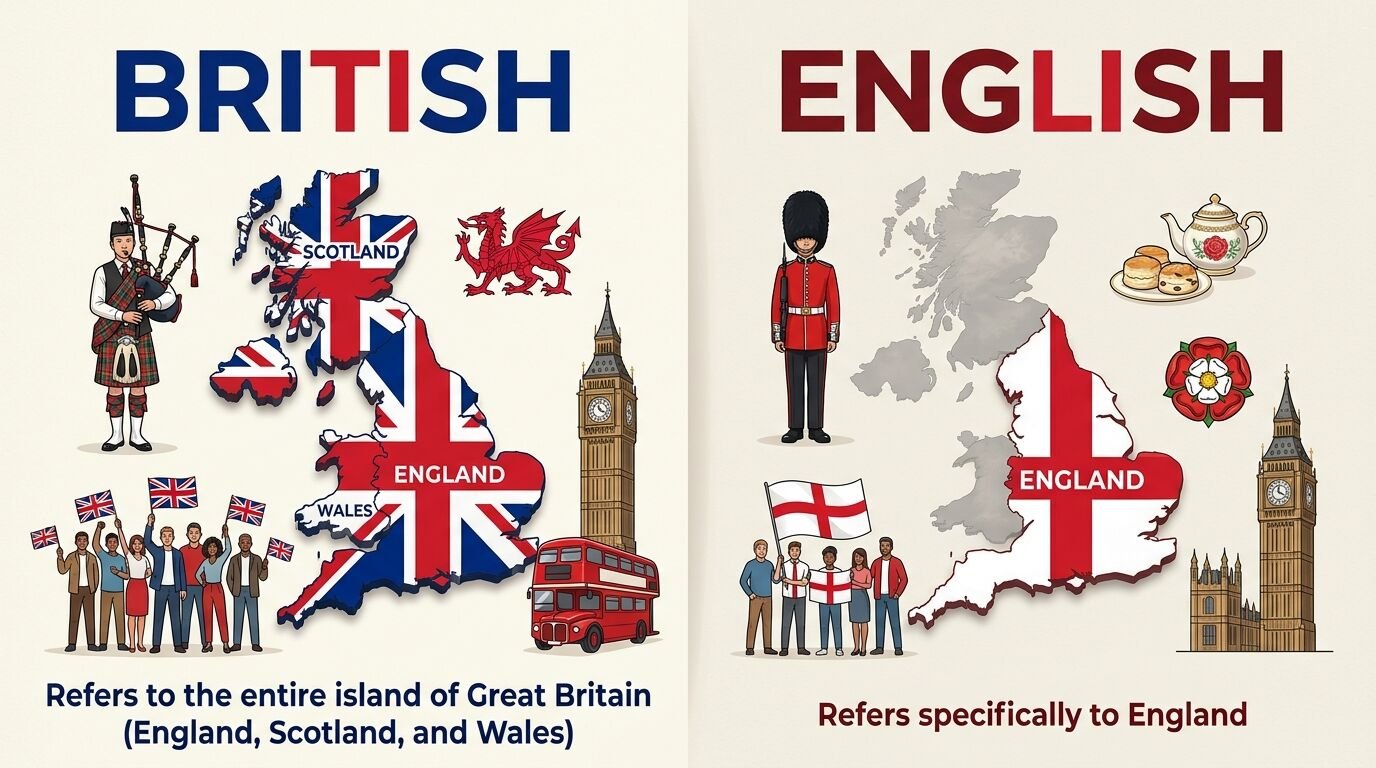
British refers to the United Kingdom or its people, while English mainly refers to England, its people, or the English language.
Imagine you meet someone named James at a café. He tells you he lives in Manchester. You may call him English because Manchester is in England. You may also call him British because England is part of the United Kingdom. But if James is from Edinburgh, he is British but not English. This small difference causes a lot of confusion.
The word British can describe people, culture, places, accents, and things linked to the United Kingdom. The word English can describe people and things from England. It is also the name of a major world language. So, saying “I speak British” is not correct. You speak English. You can, however, speak British English.
People often search for British or English because these words are close but do not have the same meaning. Knowing the difference helps you avoid mistakes in school, travel, work, and everyday conversation. It also helps you describe nationality and language correctly.
Pronunciation
- British
- US: /ˈbrɪtɪʃ/
- UK: /ˈbrɪtɪʃ/
- English
- US: /ˈɪŋɡlɪʃ/
- UK: /ˈɪŋɡlɪʃ/
british
/ˈbrɪtɪʃ/
Give feedback
The two words have similar pronunciation in American and British English. The main difference is their meaning, not their sound.
LEARN MORE ABOUThttps://personaor.com/peaked-or-peeked/
Difference Between British or English
1. Geographic Meaning
British relates to the United Kingdom.
English relates specifically to England.
Example 1:
A person from Wales is British.
Example 2:
A person from London is English and British.
2. National Identity
British can describe a wider national identity. English describes identity connected with England.
Example 1:
“She is British.”
This does not tell us whether she is English, Scottish, Welsh, or Northern Irish.
Example 2:
“He is English.”
This tells us that he is from England.
3. Language Meaning
English is the name of a language. British is not normally the name of a language.
Example 1:
“I am learning English.”
Example 2:
“She speaks British English.”
4. Country or Region
The United Kingdom contains four countries: England, Scotland, Wales, and Northern Ireland.
Example 1:
Scotland is British but not English.
Example 2:
Wales is British but not English.
5. Culture
British culture can include traditions from different parts of the UK. English culture focuses on England.
Example 1:
British culture includes Scottish traditions.
Example 2:
English culture includes traditions connected with England.
6. Sports
The words can have different meanings in sports.
Example 1:
A Scottish athlete can compete as a British athlete in some international events.
Example 2:
An English football team represents England, not the whole of Britain.
7. Accent
There are many British accents. English accents are only a part of them.
Example 1:
A London accent is an English accent.
Example 2:
A Glasgow accent is British but Scottish, not English.
8. Food and Traditions
British food can refer to food from across the UK. English food is more specific.
Example 1:
Fish and chips are strongly linked with English culture.
Example 2:
Welsh rarebit is a Welsh dish and can be described as British food.
9. Political Meaning
British often relates to the United Kingdom as a state. English usually relates to England.
Example 1:
“The British government” refers to the UK government.
Example 2:
“The English regions” refers to areas within England.
10. Everyday Use
People sometimes use British and English as if they mean the same thing. This is not always correct.
Example 1:
“British English” means a form of English used in Britain.
Example 2:
“English people” means people from England.
Nature and Behaviour of British and English
British
British is a broad word. It can describe people, institutions, culture, products, and customs connected with the United Kingdom.
A British person may be English, Scottish, Welsh, or Northern Irish.
For example:
- A person from Cardiff can be British.
- A person from Edinburgh can be British.
English
English is more specific when it describes people or things from England. It is also the name of the language spoken around the world.
For example:
- A person from Birmingham can be English.
- A person from England can speak English.
The word can also describe literature, food, history, sports, and culture from England.
Why People Get Confused About British or English
The confusion comes from geography.
England is not the same as the United Kingdom. England is one country within the United Kingdom.
The United Kingdom includes:
- England
- Scotland
- Wales
- Northern Ireland
So, every English person is British in the normal national sense, but not every British person is English.
There is another source of confusion. English is also a language. People from many countries speak English.
For example, someone from Canada speaks English but is not English.
Comparison Table
| Point | British | English |
|---|---|---|
| Main meaning | Related to the UK | Related to England |
| Geography | UK | England |
| People | People from the UK | People from England |
| Language | Not normally a language name | A major world language |
| Scotland | British | Not English |
| Wales | British | Not English |
| England | British | English |
| Culture | Wider UK culture | England-specific culture |
| Example | British passport | English literature |
| Relationship | Broader term | More specific term |
The Origin of British or English
The word British comes from the old name for Britain. The Romans used forms such as Britannia for the island and its people. Over time, related forms developed into the modern word British.
The word English has a different history. It comes from the Angles, one of the Germanic groups that settled in Britain. Old English used forms related to Englisc to describe their language and people.
Over many centuries, the language changed greatly. Old English developed into Middle English and later Modern English.
This history explains why English is closely tied to England and its early Germanic roots, while British has a wider connection with Britain.
British vs American English
British English and American English are two major forms of the English language.
They share most grammar and vocabulary, but some spelling and word choices differ.
Spelling
British English often uses -our:
- colour
- favour
- behaviour
American English often uses -or:
- color
- favor
- behavior
More Examples
| British English | American English |
|---|---|
| colour | color |
| centre | center |
| organise | organize |
| travelling | traveling |
| programme | program |
| cheque | check |
The differences do not mean one form is correct and the other is wrong. Both are standard varieties.
Which One Should You Use?
English when you mean the language.
Use English when you specifically mean England.
Use British when you mean something connected with the United Kingdom.
For US usage, say “British English” when discussing the English variety used in Britain.
For UK usage, be careful with the words England and Britain. They are not always interchangeable.
For global usage, choose the word that gives the clearest meaning. If you mean the language, use English. If you mean the wider UK identity, use British.
Common Mistakes
Mistake 1: Calling all British people English
Wrong: “Scottish people are English.”
Correct: “Scottish people are British.”
Mistake 2: Calling the language British
Wrong: “I am studying British.”
Correct: “I am studying English.”
Mistake 3: Treating England and Britain as the same place
Wrong: “Wales is in England.”
Correct: “Wales is part of the United Kingdom.”
Mistake 4: Using British for every English-speaking person
Wrong: “All English speakers are British.”
Correct: “Many people around the world speak English.”
Mistake 5: Assuming British English means a single accent
Wrong: “All British people have the same accent.”
Correct: “Britain has many different accents.”
Everyday Usage Examples
In Emails
“I am using British English for this report.”
Here, British English identifies the language variety.
On Social Media
“I love English football.”
Here, English means football connected with England.
In News
“The British government announced a new policy.”
Here, British refers to the United Kingdom.
In Formal Writing
“English literature has influenced writers around the world.”
Here, English refers to literature from England.
Usage Trends
Both words are used widely around the world.
English is much broader because it is the name of a global language. It is used in education, business, science, travel, media, and technology.
British is often used when people need to identify a UK connection.
You may see terms such as:
- British English
- British culture
- British history
- British citizens
- English literature
- English language
- English culture
- English football
Modern global English also means that many English varieties now exist. British English is one important variety among them.
Metaphors and Similes
These words can also appear in figurative comparisons.
British
“His manners were as British as afternoon tea.”
This uses British as a symbol of a traditional British image.
English
“The English language is like a river.”
This suggests that English keeps changing as it moves across countries and cultures.
Another Example
“Her English was as clear as glass.”
This does not describe nationality. It describes the quality of her language.
Connotative Meaning
British
Positive:
“British manners” may suggest politeness or good manners.
Negative:
In some contexts, “British” may be linked to old colonial history.
Neutral:
“British passport” is simply a factual description.
English
Positive:
“Excellent English” suggests strong language skills.
Negative:
“English snobbery” can suggest an unfriendly social attitude.
Neutral:
“English literature” simply identifies a field of literature.
The exact meaning depends on the sentence and context.
Idioms and Proverbs
There are many expressions connected with British or English culture, although most do not use the two words directly.
“Keep calm and carry on”
This phrase is strongly linked with British wartime culture.
Example:
“When the computer stopped working, she tried to keep calm and carry on.”
“It’s raining cats and dogs”
This is a famous English expression for heavy rain.
Example:
“It was raining cats and dogs, so we stayed home.”
“Mind your manners”
This expression is often associated with polite British speech.
Example:
“Please mind your manners when you meet the guests.”
Literature and Movies
English literature has a long history and includes many famous writers.
Pride and Prejudice by Jane Austen was published in 1813. It is an English novel and one of the best-known works of English literature.
Great Expectations by Charles Dickens was published in 1861. It is another major English novel.
British culture has also had a major impact on film.
The King’s Speech was released in 2010 and was produced in the United Kingdom. The film focuses on King George VI and his struggle with public speaking.
Harry Potter and the Philosopher’s Stone was released in 2001 and is a British-American film based on J. K. Rowling’s English-language novel.
These works show why the terms can overlap. English literature can be part of the wider British cultural story.
Why This Difference Matters
The difference matters because words about nationality can carry meaning.
Calling a Scottish person English may be incorrect and can cause offense. The same problem can happen when someone calls the English language British.
For English learners, the difference is useful because it improves accuracy. It helps learners write better sentences and understand news, books, and conversations.
For travelers, it can make communication easier.
For writers, it helps avoid geographical mistakes.
The key idea is simple:
England is part of the UK. English is connected with England and is also a global language. British is the wider UK term.
Usefulness in Daily Life
You may need these words in many situations.
When discussing language, say English.
As discussing the UK as a whole, say British.
When talking about someone from England, say English.
As talking about someone from Scotland, say Scottish and, when appropriate, British.
When discussing spelling, you may say British English or American English.
These small choices make your communication clearer.
Situational Preference
Use English when you are talking about the language, England, English people, or English culture. Use British when you mean something connected with the wider United Kingdom. For example, “English literature” is better when discussing writers from England, while “British literature” can be used for literature from Britain more broadly. In language lessons, “British English” is the best choice when you want to compare UK English with American English. If you are unsure about someone’s nationality, avoid guessing. Say “British” only when a UK connection is clear.
Possible short question
1. Is English the same as British?
No. English can refer to England or the English language. British refers to the United Kingdom or things connected with it.
2. Are English people British?
Yes. People from England are normally British because England is part of the United Kingdom.
3. Are Scottish people English?
No. Scottish people are not English. They are Scottish. They can also be British.
4. Is British a language?
No. British is not normally the name of a language. English is the language.
5. What is British English?
British English is the form or variety of English commonly used in Britain. It has some differences from American English.
6. Is England part of Britain?
Yes. England is part of Great Britain, and it is also part of the United Kingdom.
7. Which word should English learners use?
Use English for the language. British for things connected with the wider UK. Use English for things specifically connected with England.
Conclusion
The difference between British and English is simple once you understand the geography. English mainly refers to England, its people, its culture, and its language. British has a wider meaning and usually refers to the United Kingdom or its people and culture.England is one of the four countries of the United Kingdom. Scotland, Wales, and Northern Ireland are also part of the UK. Therefore, someone from Scotland can be British but is not English. A person from England can be both English and British.The word English also has a special role because it names a global language. People in many countries speak English, but they are not necessarily English or British.For everyday writing, remember one simple rule: English is specific to England or the language, while British is broader and relates to the UK.

I’m Daim Abbas, an English language enthusiast, content writer, and SEO writer. I create clear and practical content about word meanings, synonyms, vocabulary, and commonly confused English words. I’m passionate about making English easy to understand while creating helpful, reader-friendly, and SEO-optimized content.











2 thoughts on “British or English: Understanding the Difference in Simple Words”