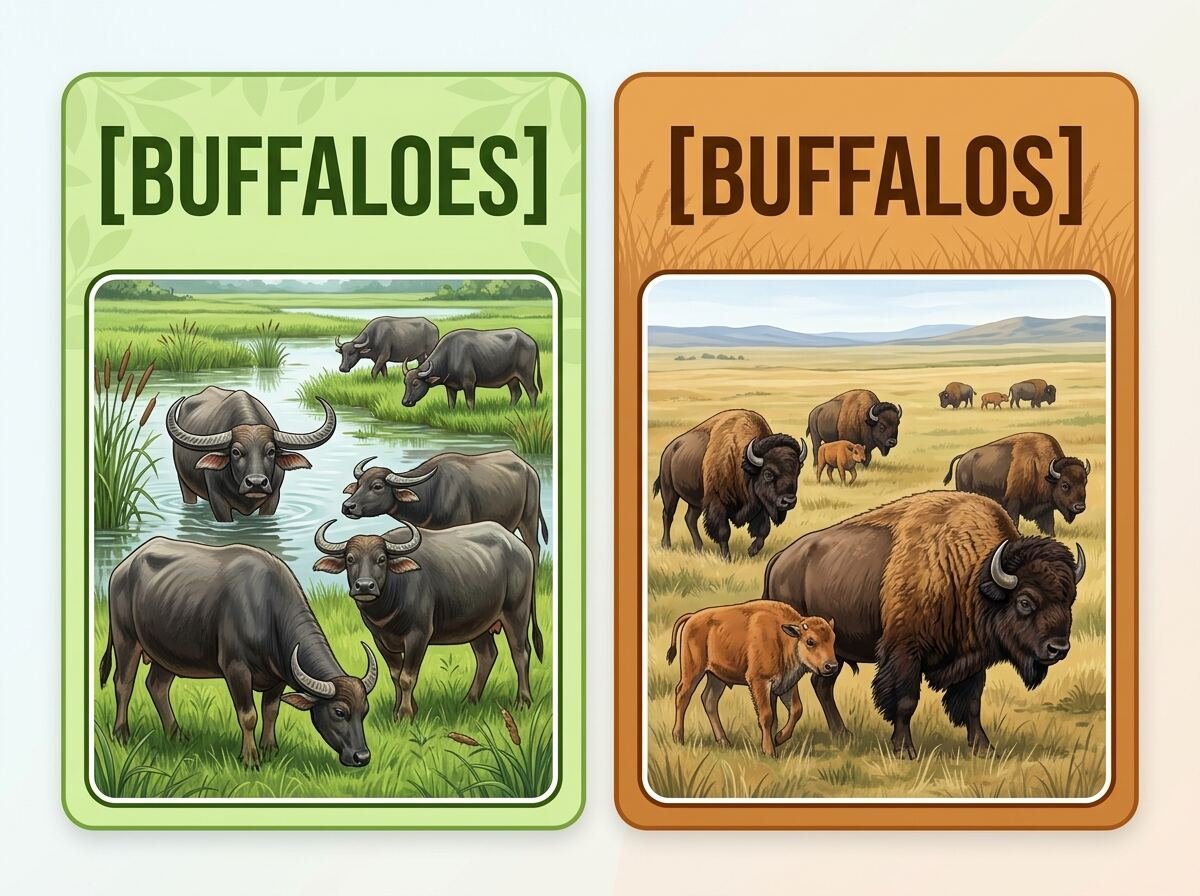
Both “buffaloes” and “buffalos” are correct plural forms of “buffalo,” but “buffaloes” is the safer choice for formal and general writing.
Imagine you are writing a school essay about animals. You type, “We saw several buffaloes near the river.” Then you stop and wonder: should it be “buffalos” instead? This is a common English spelling question. The word ends in -o, and English has no single rule for every noun ending in -o.
Both buffaloes and buffalos can mean more than one buffalo. Major dictionaries list these forms, and some dictionaries also accept the unchanged plural buffalo.
People search for buffaloes or buffalos because they want to know which spelling is correct, which form sounds more natural, and which one is better for formal writing. The good news is simple: buffaloes or buffalos does not represent two different animals. The two spellings are plural forms of the same word.
If you need one safe choice, use buffaloes. If you see buffalos, do not assume it is wrong. It is also an accepted plural form.
Pronunciation
Buffaloes
US: /ˈbʌf.ə.loʊz/
UK: /ˈbʌf.ə.ləʊz/
Buffalos
US: /ˈbʌf.ə.loʊz/
UK: /ˈbʌf.ə.ləʊz/
The two plural spellings have the same basic pronunciation. The difference is mainly in spelling, not sound. The singular word is pronounced differently in the final vowel in US and UK English.
Now let us look at the spelling, grammar, history, and real-life use of these two forms.
READ MORE ABOUThttps://personaor.com/england-or-britain/
Difference Between Buffaloes or Buffalos
1. Both forms are correct
The biggest difference is that both spellings are accepted.
Example 1:
We saw several buffaloes near the lake.
Example 2:
We saw several buffalos near the lake.
Both sentences are correct.
2. Buffaloes uses “-es”
The form buffaloes adds -es to the singular word.
This follows a common pattern for some nouns ending in -o.
Example 1:
One buffalo → two buffaloes.
Example 2:
The farmer keeps five buffaloes.
This form is widely recognized and is a good choice in careful writing. Cambridge lists buffaloes as a plural form.
3. Buffalos uses only “-s”
The form buffalos adds only -s.
This is another accepted plural spelling.
Example 1:
The buffalos crossed the field.
Example 2:
We photographed three buffalos.
Merriam-Webster lists buffaloes and buffalos as plural forms.
4. Buffaloes is often the safer choice
If you are unsure, buffaloes is a strong choice.
It looks natural in formal and educational writing.
Example 1:
The report studied the behavior of water buffaloes.
Example 2:
The farmers raised several buffaloes.
It is also easy for readers around the world to understand.
5. Buffalos is also standard English
Do not treat buffalos as a spelling mistake.
It is listed by major dictionaries.
Example 1:
The buffalos moved toward the water.
Example 2:
Several buffalos were grazing nearby.
Oxford lists buffalo, buffaloes, and buffalos as plural forms in its American English dictionary.
6. Buffalo can also be plural
English sometimes allows buffalo to stay unchanged in the plural.
So you may see:
- one buffalo
- two buffalo
- two buffaloes
- two buffalos
Example 1:
A herd of buffalo crossed the plain.
Example 2:
We saw several buffaloes on the farm.
This is another reason the word can seem confusing.
7. The meaning does not change
Buffaloes and buffalos mean the same thing when they are plural nouns.
Example 1:
The buffaloes were resting.
Example 2:
The buffalos were resting.
There is no special animal called a “buffaloes” and another called a “buffalos.”
8. The choice can depend on style
Writers may choose one form because it fits their style guide or audience.
Example 1:
A science article may use buffaloes.
Example 2:
A casual post may use buffalos.
This is a style choice, not a difference in meaning.
9. The word is different from “bison”
People often use buffalo for the American bison. In strict zoological terms, true buffalo and bison are different animals. Dictionaries note that American English commonly uses “buffalo” for the North American bison.
Example 1:
The American bison lives in North America.
Example 2:
Water buffaloes are common in parts of Asia.
10. Both work after numbers
A number can be followed by either plural form.
Example 1:
The zoo has six buffaloes.
Example 2:
The zoo has six buffalos.
If you want a simple rule, remember this: both are correct, but buffaloes is the safer general choice.
Nature and Behaviour of Buffaloes and Buffalos
There is no behavioral difference between buffaloes and buffalos. They are simply two plural spellings.
Buffaloes
The word buffaloes refers to more than one buffalo. Depending on context, it may refer to water buffalo, Cape buffalo, or animals that English speakers commonly call buffalo. Cambridge describes buffalo as a large animal of the cattle family and also notes the common North American use for bison.
Example:
The buffaloes moved together as a herd.
Buffalos
Buffalos has the same basic meaning.
Example:
The buffalos rested near the water.
The spelling does not change the animal’s nature, size, habitat, or behavior.
Why People Get Confused About Buffaloes or Buffalos
The main problem is the ending -o.
English nouns ending in -o do not follow one simple plural rule.
For example:
- tomato → tomatoes
- hero → heroes
- potato → potatoes
- piano → pianos
- photo → photos
Because buffalo ends in -o, learners often wonder whether the correct plural should be buffaloes or buffalos.
Both are accepted. Dictionaries confirm this.
The extra confusion comes from the fact that buffalo can also be used as a plural noun.
Comparison Table
| Feature | Buffaloes | Buffalos |
| Singular | buffalo | buffalo |
| Plural | buffaloes | buffalos |
| Correct? | Yes | Yes |
| Meaning | More than one buffalo | More than one buffalo |
| Pronunciation | Same basic plural sound | Same basic plural sound |
| Formal writing | Excellent choice | Acceptable |
| Casual writing | Excellent | Excellent |
| Global use | Very safe | Acceptable |
| US English | Used | Used |
| UK English | Strong choice | Less typical |
| Meaning difference | None | None |
Major dictionaries support buffaloes, buffalos, and, in some cases, unchanged buffalo as plural forms.
The Origin of Buffalo
The history of buffalo is much older than modern English.
The English word came through European languages. Merriam-Webster traces it through Italian bufalo and Spanish búfalo to Late Latin bufalus/bubalus, with an earlier Greek connection to boubalos.
The Online Etymology Dictionary gives a similar path. It traces the word through Portuguese, Medieval Latin, French, and earlier Greek forms.
English later used buffalo for the North American bison. That use has been common for centuries, even though bison and true buffalo are different animals.
The two modern plural spellings developed from English plural patterns:
- buffalo → buffaloes
- buffalo → buffalos
British vs American English
There is a useful regional difference to remember.
British English
Buffaloes is a natural and safe choice.
Example:
The buffaloes moved across the grassland.
American English
American dictionaries accept buffalo, buffaloes, and buffalos as plural forms.
Example:
The buffaloes crossed the road.
Example:
The buffalos crossed the road.
Both are acceptable.
Simple rule
Do not think that American English makes buffalos the only correct form. It does not. Both forms are accepted in American English.
Which One Should You Use?
For most writers, buffaloes is the best default.
For UK English
Use buffaloes when you want a traditional and natural form.
For US English
You can use buffaloes or buffalos. Both are accepted.
For global English
Use buffaloes if you want the safest choice for a broad audience.
For academic writing
Follow your school, university, journal, or style guide. If there is no special rule, buffaloes is a clear choice.
For SEO writing
You can use the main keyword buffaloes or buffalos naturally. Do not force both spellings into every paragraph.
Common Mistakes
Mistake 1: Writing “buffalo’s” for the plural
Incorrect:
The buffalo’s are eating grass.
Correct:
The buffaloes are eating grass.
The apostrophe shows possession, not a normal plural.
Mistake 2: Thinking “buffalos” is always wrong
Incorrect idea:
“Buffalos” is never correct.
Correct idea:
Buffalos is an accepted plural form.
Mistake 3: Thinking “buffaloes” is the only correct form
Both forms are accepted.
Correct:
We saw several buffaloes.
Correct:
We saw several buffalos.
Mistake 4: Confusing buffalo with bison
A North American bison is commonly called a buffalo in American English, but zoologically, bison and true buffalo are different.
Mistake 5: Assuming every -o word uses the same rule
English does not have one simple plural rule for all nouns ending in -o.
Everyday Usage Examples
In Emails
“During our field visit, we observed several buffaloes near the river.”
This sounds clear and professional.
On Social Media
“Spotted a group of buffalos today!”
This casual style is fine.
In News Writing
“Local farmers reported that several buffaloes had moved into the open field.”
In Formal Writing
“The study examined the feeding patterns of water buffaloes.”
In School Writing
“We learned about buffaloes and their role in farming.”
In Conversation
“I saw some buffaloes on the farm.”
All these examples use the plural naturally.
Usage Trends
The main point is not that one spelling is correct and the other is wrong. Both have a place in English.
Buffaloes is a very established plural form and appears widely in formal, academic, news, and general writing. Cambridge’s corpus examples include buffaloes in many contexts.
Buffalos is also recognized, especially in American English dictionaries. Oxford and Collins both list it as an accepted American English plural.
For a global audience, buffaloes is a simple default. For an American audience, either form can work.
Metaphors and Similes
The word buffalo can appear in figurative language because buffalo often suggest strength, size, endurance, or wild nature.
Simile
“He stood like a buffalo in the field.”
This suggests strength and stillness.
Metaphor
“She was a buffalo in the face of danger.”
This can suggest courage and strength.
Another example
“The workers moved like buffaloes through the heavy snow.”
This creates an image of strong, steady movement.
These are creative uses. They do not change the spelling rule for the plural noun.
Connotative Meaning
The word buffalo can carry different feelings depending on context.
Positive meaning
It can suggest:
- strength
- endurance
- power
- resilience
- connection with nature
Example:
“The buffalo represents strength and endurance.”
Negative meaning
In some contexts, buffalo can suggest something large, rough, or difficult to control.
Example:
“He pushed through the crowd like a buffalo.”
This may sound critical.
Neutral meaning
In a science or farming context, the word may have no emotional meaning.
Example:
“The researchers studied water buffaloes.”
Here, the word is simply factual.
Idioms and Proverbs
There are not many common English idioms that specifically require the plural forms buffaloes or buffalos.
However, buffalo has an interesting figurative verb in American English. To buffalo someone can mean to confuse, baffle, intimidate, or overwhelm them. Merriam-Webster and Dictionary.com record this verb sense.
Example:
“The complicated question buffaloed the student.”
A famous word puzzle is:
“Buffalo buffalo Buffalo buffalo buffalo buffalo Buffalo buffalo.”
It uses several meanings of Buffalo and buffalo, including the city name, the animal, and the verb. The sentence became a famous example of English word ambiguity.
Literature and Movies
Buffalo has appeared often in literature, poetry, film, and popular culture.
Literature
E. E. Cummings wrote “Buffalo Bill’s,” a Modernist poem first published in 1920. It reflects on the death of Buffalo Bill and uses the famous figure as a way to think about death and fame.
Buffalo also appears in nature poetry. For example, Thomas McGrath wrote “The Buffalo Coat,” published in Poetry in 1964. The poem connects the buffalo with memory, history, and the changing American landscape.
Joseph Bruchac published The Buffalo in the Syracuse Zoo and Other Poems in 1972.
Movies
American Buffalo is a 1996 drama film based on David Mamet’s 1975 play. It was a British-American production directed by Michael Corrente.
The title uses Buffalo as part of a proper name, not as a plural spelling.
Why This Difference Matters
Knowing the difference between buffaloes and buffalos helps English learners write with confidence.
It also teaches an important lesson about English spelling. Not every word follows one perfect rule.
If you learn only one thing, learn this:
Both buffaloes and buffalos are correct plural forms.
This matters in:
- school assignments
- blogs
- emails
- reports
- academic writing
- news writing
- social media
- everyday conversation
It also prevents unnecessary corrections. A person who writes buffalos has not automatically made a spelling mistake.
Usefulness in Daily Life
You may need the plural when talking about:
- farms
- wildlife
- agriculture
- travel
- documentaries
- school lessons
- animal research
- news reports
For example:
Farm:
“The farmer owns ten buffaloes.”
Travel:
“We saw buffaloes near the river.”
Science:
“The researchers studied several buffaloes.”
Social media:
“Look at these beautiful buffalos!”
Both plural forms can work.
Situational Preference
If you need one form for most situations, choose buffaloes. It is clear, familiar, and widely accepted. It works well in school work, formal reports, academic writing, and global English. Buffalos is also correct and can be useful when following an American English style or a house style that prefers the shorter form. In casual writing, either form is fine. The most important rule is consistency. Do not switch between forms without a reason in the same piece of writing. If your teacher, editor, publisher, or style guide gives a specific preference, follow that rule.
POSSIBLE SHORT QUESTION
1. Is buffaloes correct?
Yes. Buffaloes is a correct plural form of buffalo.
2. Is buffalos correct?
Yes. Buffalos is also an accepted plural form, especially recognized in American English dictionaries.
3. Which is more common: buffaloes or buffalos?
Buffaloes is a very established and widely used form. It is a good default when you are writing for a broad audience.
4. Can buffalo be plural?
Yes. Some dictionaries also list unchanged buffalo as a plural form.
For example:
“Several buffalo crossed the road.”
5. Is buffaloes British English?
Buffaloes is fully acceptable in British English and is a safe choice for UK writing. Collins lists buffaloes as the British plural form.
6. Is buffalos American English?
Buffalos is accepted in American English, but it is not the only correct form. American dictionaries also list buffaloes and sometimes unchanged buffalo.
7. What should I use in formal writing?
Use buffaloes unless your style guide says otherwise. It is a clear and widely accepted choice.
Conclusion
The question of buffaloes or buffalos is easier than it first appears. Both buffaloes and buffalos are correct plural forms of buffalo. They have the same basic meaning. The difference is spelling, not the animal.Buffaloes is the safest choice for formal writing, school work, academic content, and a global audience. Buffalos is also correct and is especially recognized in American English. Some dictionaries also allow buffalo as an unchanged plural.The confusion happens because English nouns ending in -o do not all follow the same plural rule. Some take -s, some take -es, and some accept both.So, if you are unsure, remember this simple rule: buffalo → buffaloes or buffalos.If your goal is clear and professional writing, choose buffaloes. If you see buffalos in American English, you can accept it as correct. The key is to use the form consistently and focus on clear communication.

I’m Daim Abbas, an English language enthusiast, content writer, and SEO writer. I create clear and practical content about word meanings, synonyms, vocabulary, and commonly confused English words. I’m passionate about making English easy to understand while creating helpful, reader-friendly, and SEO-optimized content.












2 thoughts on “Buffaloes or Buffalos: Which Plural Form Is Correct?”