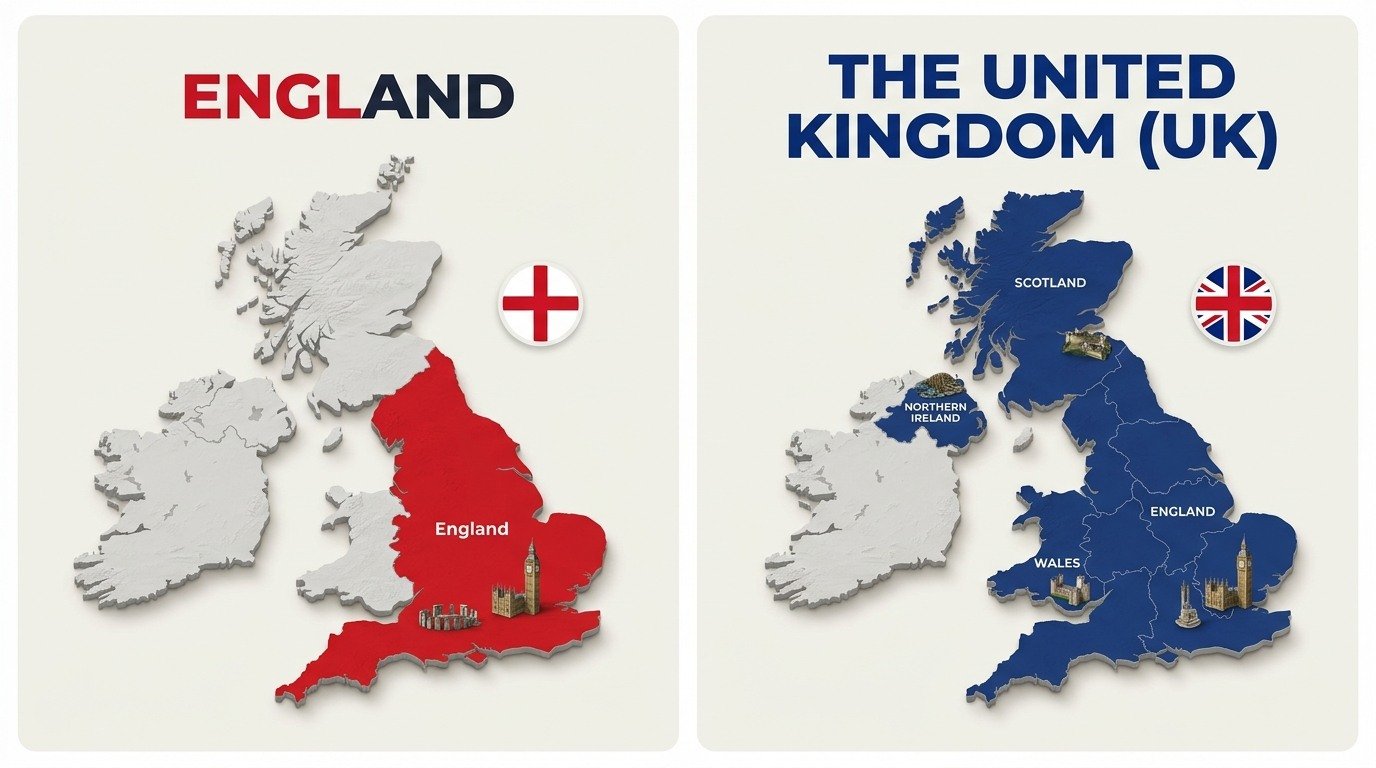
England is one country within the United Kingdom, while the UK is the whole country made up of four nations: England, Scotland, Wales, and Northern Ireland.Imagine you are planning a trip to London. You tell a friend, “I am going to the UK.” That is correct. London is in England, and England is part of the UK. But if someone asks which country London is in, you can say England. This simple example shows why England or UK can be confusing.
People often use these names as if they mean the same thing. They do not. England or UK is a common search because people want to know whether England and the United Kingdom are the same place. The confusion often comes from sports, travel, passports, addresses, and everyday speech.
In simple terms, England is one part of the UK. The UK includes England, Scotland, Wales, and Northern Ireland. So, when choosing between England or UK, the right word depends on what you mean.
Pronunciation
England
- US: /ˈɪŋɡlənd/
- UK: /ˈɪŋɡlənd/
UK
- US: /ˌjuːˈkeɪ/
- UK: /ˌjuːˈkeɪ/
The spelling “sengland” is not a standard English word. If you meant “England,” use that spelling.
LEARN MORE ABOUT https://personaor.com/lovie-or-lovey/
Difference Between England or UK
1. Size
England is smaller than the UK.
The UK contains four countries. England is only one of them.
Example 1: London is in England.
Example 2: Edinburgh is in Scotland, which is also part of the UK.
2. Number of Countries
England is one country.
The UK is a sovereign state made up of four countries.
These are England, Scotland, Wales, and Northern Ireland.
Example 1: Wales is not England.
Example 2: Wales is part of the UK.
3. Capital
England’s capital is London.
The UK’s capital is also London.
This can cause confusion because both have the same capital.
Example 1: London is the capital of England.
Example 2: London is also the capital of the UK.
4. Government
England does not have a separate national parliament like Scotland, Wales, and Northern Ireland do.
The UK has the UK Parliament at Westminster.
Example 1: UK-wide laws can be made by the UK Parliament.
Example 2: Some matters in Scotland are handled by the Scottish Parliament.
5. Flag
England has the St George’s Cross.
The UK has the Union Flag, often called the Union Jack.
Example 1: An English flag has a red cross on a white background.
Example 2: The UK flag combines symbols linked to England, Scotland, and Ireland.
6. Sports Teams
England often competes separately in international sports.
The UK is not always the sports team name.
Example 1: England has its own football team.
Example 2: England also has its own cricket team.
7. National Identity
Someone can identify as English and British.
English refers to England. British usually refers to the UK.
Example 1: A person from Manchester may be English.
Example 2: That same person may also be British.
8. Geography
England occupies the southern and central part of Great Britain.
The UK includes Great Britain plus Northern Ireland.
Example 1: Manchester is in England.
Example 2: Belfast is in Northern Ireland and therefore in the UK.
9. Travel
A traveler may visit England without visiting every part of the UK.
Visiting England does not mean visiting Scotland, Wales, and Northern Ireland.
Example 1: A trip to London is a trip to England.
Example 2: A trip covering London, Cardiff, Edinburgh, and Belfast covers different parts of the UK.
10. Meaning in Addresses
“England” can identify the country within the UK.
“United Kingdom” identifies the sovereign state.
Example 1: An address can include “London, England.”
Example 2: An international form may ask for “United Kingdom” as the country.
Nature and Behaviour of England or UK
England
England is one of the four countries in the UK. It has its own history, culture, traditions, food, accents, cities, and regional identities.
London, Manchester, Liverpool, Birmingham, Bristol, and Leeds are English cities.
UK
The United Kingdom is a sovereign state. It includes England, Scotland, Wales, and Northern Ireland.
Each part has its own culture and identity. They also share institutions and a common UK-wide government.
Why People Get Confused About England or UK
The main reason is that England is the largest and most populous part of the UK.
Many people also use “England” when they really mean “Britain” or “the UK.” This is common in casual conversation, especially outside the UK.
Another reason is that London is both the capital of England and the capital of the UK.
The names are connected, but they are not interchangeable.
Comparison Table
| Feature | England | United Kingdom |
| What is it? | One country | A sovereign state |
| Countries included | England only | England, Scotland, Wales, Northern Ireland |
| Capital | London | London |
| Flag | St George’s Cross | Union Flag |
| Location | Part of Great Britain | Great Britain + Northern Ireland |
| People | English | British |
| Language | English is dominant | English plus other local languages |
| Government | Part of UK system | UK government and Parliament |
| Sports | Often separate teams | Not always one UK team |
| Abbreviation | ENG in some contexts | UK |
The Origin of England or UK
England has a long history that developed through different kingdoms and peoples. The name “England” comes from the Angles, a Germanic people who settled in parts of Britain.
The political union that created the modern United Kingdom developed over several centuries.
England and Scotland joined politically in 1707. Great Britain later united with Ireland in 1801. After most of Ireland became independent in the early twentieth century, Northern Ireland remained part of the United Kingdom.
The modern name is United Kingdom of Great Britain and Northern Ireland.
British vs American English
The words “England” and “UK” have the same basic meaning in British and American English.
The main difference is often how people use related terms.
| British English | American English |
| UK | UK |
| British | British |
| England | England |
| postcode | ZIP code |
| holiday | vacation |
| football | soccer |
Example:
British English: “She lives in England.”
American English: “She lives in England.”
The geographical meaning does not change.
Which One Should You Use?
Use England when you mean England specifically.
Use UK when you mean the whole United Kingdom.
For example, say “I live in England” if you live in Manchester. Say “I live in the UK” when you want to describe the wider sovereign state.
For international forms, travel documents, and global communication, United Kingdom or UK is often the safer choice when the whole state is meant.
Do not use England to describe Scotland, Wales, or Northern Ireland.
Common Mistakes
Mistake 1: Calling the UK England
Wrong: Scotland is in England.
Correct: Scotland is in the UK.
Mistake 2: Calling every British person English
Wrong: A person from Wales is English.
Correct: A person from Wales is Welsh and can also be British.
Mistake 3: Thinking Great Britain means the UK
Great Britain is the island containing England, Scotland, and Wales.
The UK also includes Northern Ireland.
Mistake 4: Writing “sengland”
Wrong: Sengland
Correct: England
“Sengland” is not the standard spelling of the country.
Mistake 5: Using England for all four nations
Wrong: England has four countries.
Correct: The UK has four constituent countries.
Everyday Usage Examples
In an Email
“I am traveling to England next month.”
On Social Media
“London, England, was amazing!”
In News
“The UK government announced a new policy.”
In Formal Writing
“England is one of the four constituent countries of the United Kingdom.”
In Conversation
“Are you from England?”
“Yes, I am from Manchester.”
Usage Trends
The terms England, Britain, Great Britain, and the UK are widely used around the world.
“England” is especially common in sports and tourism. “UK” is common in business, government, travel, and international communication.
Online searches often mix these terms. People may search for “England or UK” when they need to fill out a form, understand a location, or learn about British geography.
The safest approach is simple: use the most specific name that matches the place you mean.
Metaphors and Similes
England and the UK can also appear in figurative language.
Example: “England is the heart of the UK.”
This is a metaphor. It suggests that England is very important to the UK.
Example: “The UK is like a family of four nations.”
This simile compares the UK to a family.
These expressions are useful for explaining the relationship in simple terms.
Connotative Meaning
England
“England” can have neutral, cultural, historical, or emotional meanings.
Neutral: “England is part of the UK.”
Positive: “England has a rich literary history.”
Negative: “The history of England includes periods of conflict.”
UK
“UK” often sounds more official or formal.
Neutral: “The UK has four constituent countries.”
Positive: “The UK has many famous universities.”
Negative: “The UK has faced economic challenges.”
The meaning depends on the sentence and context.
Idioms and Proverbs
There are many sayings linked to England and British culture.
“An Englishman’s home is his castle”
This old saying highlights the idea of privacy and personal space.
Example: “He loves his quiet home. An Englishman’s home is his castle.”
“When in Rome, do as the Romans do”
This is not specifically English, but it is widely used in British English.
It means that you should follow local customs when visiting another place.
Example: “I am visiting England, so I want to learn local customs.”
Literature and Movies
England has had a major influence on English literature.
William Shakespeare wrote many famous plays during the late sixteenth and early seventeenth centuries. His works include Romeo and Juliet, Hamlet, and Macbeth.
Jane Austen was another major English writer. Her novel Pride and Prejudice was published in 1813.
English places and British identity also appear often in movies.
Harry Potter and the Philosopher’s Stone was released in 2001 and is a British-American film.
The King’s Speech was released in 2010 and is a British film based on the story of King George VI.
Why This Difference Matters
Knowing the difference between England and the UK helps you communicate clearly.
It matters when you talk about geography, travel, politics, sports, culture, and people.
For English learners, this distinction is especially useful. Calling Scotland “England” can sound incorrect or disrespectful to Scottish people.
The difference also helps when completing forms. A form may ask for your country. In that case, someone in England may need to select the United Kingdom.
Small geographic terms can prevent big misunderstandings.
Usefulness in Daily Life
This difference is useful when:
- Booking flights.
- Filling out online forms.
- Writing addresses.
- Talking about travel.
- Discussing sports.
- Reading international news.
- Learning British history.
- Describing someone’s nationality.
- Talking about cities.
- Studying English.
For example, if you visit Manchester, you are visiting England. You are also visiting the UK.
Situational Preference
Use England when your topic is specifically about English cities, culture, history, or people. Use UK when you mean all four countries together. For travel, choose the name that matches your destination. London means England, while Edinburgh means Scotland. Both are in the UK. In formal writing, be precise because England and the UK have different meanings. For global readers, “UK” is often clearer when discussing the whole state. Never use England as a general replacement for Scotland, Wales, or Northern Ireland.
Possible short question
Is England the same as the UK?
No. England is one of the four countries in the UK.
How many countries are in the UK?
The UK contains four countries: England, Scotland, Wales, and Northern Ireland.
Is London in England or the UK?
London is in England and is also the capital of the UK.
Is someone from England British?
Yes. A person from England can be described as English and British.
Is Scotland part of England?
No. Scotland is a separate country within the UK.
Is Great Britain the same as the UK?
No. Great Britain is the island containing England, Scotland, and Wales. The UK also includes Northern Ireland.
Is “sengland” correct?
No. “Sengland” is not the standard English spelling. If you mean the country, the correct spelling is “England.”
Conclusion
The difference between England and the UK is simple once you understand the relationship. England is one country, while the United Kingdom is a sovereign state made up of England, Scotland, Wales, and Northern Ireland.London makes the difference easy to remember. London is a city in England, and England is part of the UK. The same idea applies to other places. Edinburgh is in Scotland, Cardiff is in Wales, and Belfast is in Northern Ireland. All four are connected to the UK, but only London is in England.When choosing between England or UK, think about what you want to describe. Use England for England itself. Use UK when you mean the entire United Kingdom.Remember the simple rule: England is part of the UK, but England and the UK are not the same thing.

I’m Daim Abbas, an English language enthusiast, content writer, and SEO writer. I create clear and practical content about word meanings, synonyms, vocabulary, and commonly confused English words. I’m passionate about making English easy to understand while creating helpful, reader-friendly, and SEO-optimized content.











1 thought on “England or UK: Understanding the Difference in Simple English”