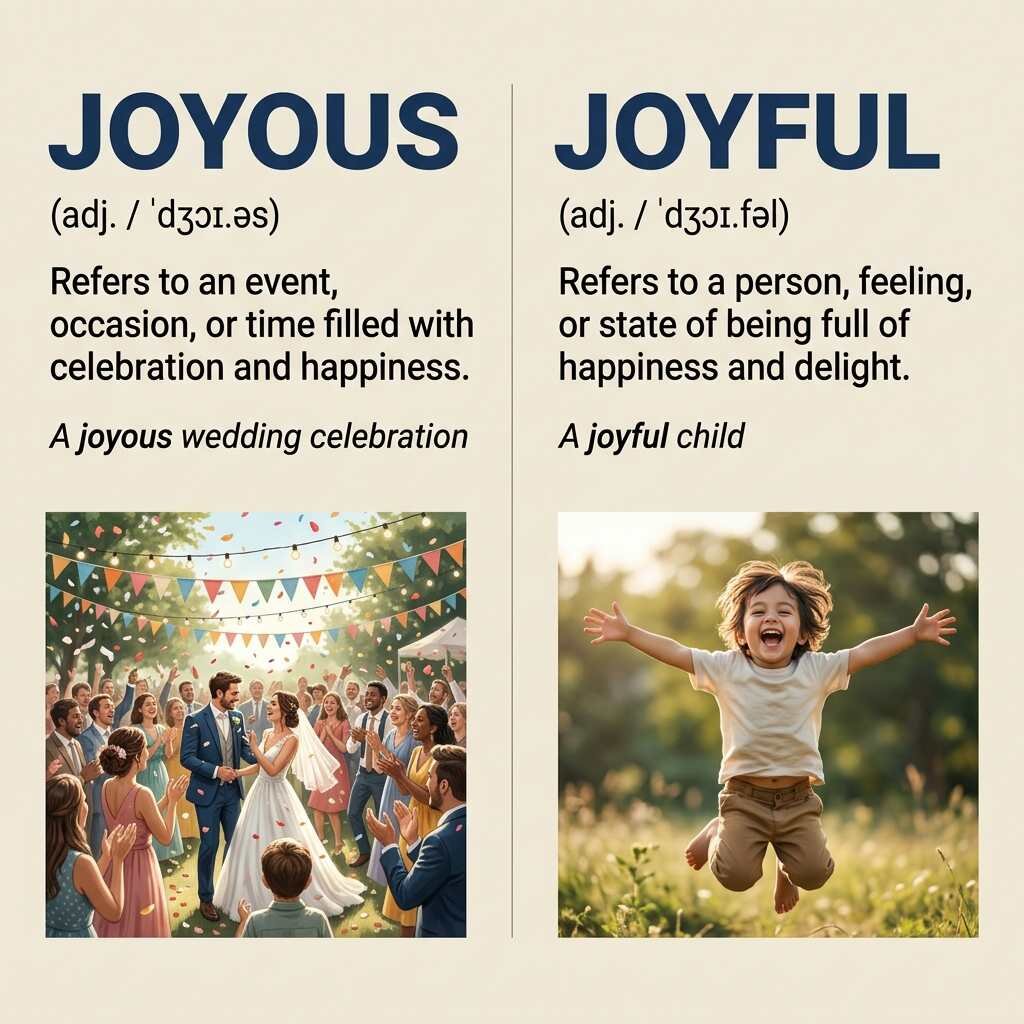
Joyous and joyful both describe happiness, but they are used in slightly different ways. Joyous often describes a happy event or special moment, while joyful usually describes a person, feeling, or state of happiness.
Imagine attending a wedding. You may call it a joyous celebration because everyone is happy. You may also describe a person as joyful because they show great happiness. Both words have a positive meaning, but their use can change with the sentence.
Many English learners search for joyous or joyful because these words look similar and share almost the same meaning. This can make it hard to know which word sounds more natural. The good news is that both are correct English words. You can use them to talk about happiness, pleasure, and good feelings. In this guide, you will learn their meanings, differences, pronunciation, history, and everyday use with simple examples.
Pronunciation of Joyous and Joyful
| Word | US Pronunciation | UK Pronunciation |
|---|---|---|
| Joyous | /ˈdʒɔɪ.əs/ | /ˈdʒɔɪ.əs/ |
| Joyful | /ˈdʒɔɪ.fəl/ | /ˈdʒɔɪ.fəl/ |
Both words have two syllables. The main stress is on the first syllable.
Learn more abouthttps://personaor.com/idyl-or-idyll/
Difference Between Joyous and Joyful
Joyous and joyful both express happiness. However, they often appear in different situations. Here are 10 simple differences.
1. Basic Meaning
Joyous: Describes something full of happiness and celebration.
Joyful: Describes someone or something that feels great happiness.
Examples:
- The family had a joyous celebration.
- She felt joyful after hearing the news.
2. Use with Events
Joyous is often used for happy events and special occasions.
Joyful can also describe events, but it often focuses on the happy feeling.
Examples:
- It was a joyous wedding.
- We shared a joyful moment together.
3. Use with People
Joyful is very common when describing happy people.
Joyous can describe people too, but it is less common in everyday speech.
Examples:
- She is a joyful person.
- The joyous children played outside.
4. Emotional Meaning
Joyful often describes a person’s inner feeling of happiness.
Joyous often highlights happiness that people share or show.
Examples:
- He felt joyful inside.
- The crowd made a joyous sound.
5. Common Usage
Joyful is common in daily English.
Joyous is often used in stories, speeches, celebrations, and formal writing.
Examples:
- I had a joyful day.
- It was a joyous occasion.
6. Tone
Joyous often sounds warm, festive, and celebratory.
Joyful sounds personal, cheerful, and emotional.
Examples:
- They enjoyed a joyous festival.
- Her joyful smile made me happy.
7. Grammar
Both words are adjectives. They describe nouns.
Examples:
- We enjoyed a joyous evening.
- It was a joyful experience.
8. Common Word Combinations
Joyous often appears with words about events and celebrations.
Joyful often appears with words about feelings and people.
Examples:
- A joyous reunion.
- A joyful heart.
9. Formal and Informal Writing
Joyous is often found in formal or expressive writing.
Joyful works well in both everyday and formal English.
Examples:
- The school held a joyous event.
- She shared her joyful thoughts.
10. Overall Use
Use joyous when you want to highlight a happy occasion or shared celebration.
Use joyful when you want to describe happiness, a person, or a feeling.
Examples:
- The town had a joyous festival.
- The child looked joyful.
Nature and Behaviour of Joyous and Joyful
Although these words have similar meanings, their use is not always the same.
Nature of Joyous
Joyous describes something filled with great happiness. It often relates to celebrations, special events, and shared experiences.
It gives a warm and festive feeling.
Examples:
- Christmas was a joyous time for us.
- Everyone enjoyed the joyous celebration.
Nature of Joyful
Joyful describes a feeling of happiness and pleasure. It often relates to a person’s emotions, attitude, or behaviour.
It gives a sense of peace and cheer.
Examples:
- She has a joyful personality.
- His joyful face showed his excitement.
Why People Get Confused About Joyous and Joyful
People often confuse joyous and joyful because both words come from the same root word, “joy.”
They also describe positive emotions and can sometimes be used in similar sentences.
For example:
- It was a joyous day.
- It was a joyful day.
Both sentences are correct. However, joyous may place more focus on the special nature of the day, while joyful highlights the happiness connected with it.
Another reason for confusion is that both words are adjectives. They describe people, feelings, events, and experiences.
The easiest way to remember the difference is this:
- Joyous = full of celebration and happiness.
- Joyful = full of happy feelings.
Comparison Table
Here is a simple table showing the main differences.
| Feature | Joyous | Joyful |
|---|---|---|
| Meaning | Full of happiness | Feeling great happiness |
| Part of speech | Adjective | Adjective |
| Main use | Events and occasions | People and feelings |
| Tone | Warm and festive | Happy and cheerful |
| Common use | Celebrations | Daily life |
| Emotion | Shared happiness | Personal happiness |
| Formality | Often expressive | General use |
| Example | Joyous wedding | Joyful person |
| Positive meaning | Yes | Yes |
| Correct spelling | J-O-Y-O-U-S | J-O-Y-F-U-L |
Similarity: Both words express happiness, have positive meanings, and come from the word “joy.”
The Origin of Joyous and Joyful
Both words are connected to the Old French word joie and the Latin word gaudia, which relate to happiness and pleasure.
The word joy entered English through Old French. It became a common word for deep happiness.
The word joyous developed from joy with the suffix “-ous.” This suffix means full of or having a quality.
The word joyful developed from joy with the suffix “-ful.” This suffix also means full of.
Both endings help create adjectives. That is why joyous and joyful have similar meanings.
Over time, both words became part of everyday English. Today, writers use them to describe happy people, feelings, events, and experiences.
British vs American English
There is no spelling difference between joyous and joyful in British and American English.
Both forms are correct in the UK and the US.
| Word | American English | British English |
|---|---|---|
| Joyous | Joyous | Joyous |
| Joyful | Joyful | Joyful |
Examples:
American English:
- We had a joyful weekend.
- It was a joyous celebration.
British English:
- She had a joyful childhood.
- The village enjoyed a joyous festival.
The meanings and spelling remain the same in both forms of English.
Which One Should You Use?
Your choice depends on the sentence and the meaning you want to express.
- For US English: Both words are correct. Joyful is common in daily conversations.
- For UK English: Both words are also accepted. Their spelling and meanings do not change.
- For global English: Use joyful for general feelings and joyous for happy events or celebrations.
If you are unsure, joyful is a useful choice for everyday writing. However, joyous may sound better when describing a special occasion.
Common Mistakes
English learners sometimes use these words incorrectly. Here are some common mistakes and their corrections.
| Incorrect Sentence | Correct Sentence |
|---|---|
| She is a joyously person. | She is a joyful person. |
| It was a joyfull day. | It was a joyful day. |
| We had a joyus event. | We had a joyous event. |
| He feels joyousness today. | He feels joyful today. |
| They enjoyed a joyfull party. | They enjoyed a joyful party. |
Remember:
- Joyous is spelled without an extra “i.”
- Joyful has one “l” at the end.
- Joyously and joyfully are adverbs.
- Joyous and joyful are adjectives.
Everyday Usage Examples
Both words are useful in daily communication. Here are some examples from different situations.
1. In Emails
- We wish you a joyful holiday season.
- Thank you for making this a joyous occasion.
2. On Social Media
- Enjoy every joyful moment of life.
- What a joyous day with my family!
3. In News
- The city celebrated a joyous national event.
- The joyful children welcomed their new school.
4. In Formal Writing
- The ceremony was a joyous occasion.
- Her joyful attitude inspired the entire team.
5. In Daily Conversation
- I had a joyful morning.
- It was a joyous family gathering.
Usage Trends
Both joyous and joyful are used in modern English. However, they do not always appear in the same situations.
Joyful is widely used in everyday writing, social media, personal messages, and general conversation. It is a simple way to describe happiness.
Joyous is often used in news stories, holiday messages, religious writing, speeches, and descriptions of celebrations.
For example, people may write “a joyful life” or “a joyous celebration.”
Both words are understood around the world. Neither is limited to British or American English.
Metaphors and Similes
Joyous and joyful can also be used in creative language. They help writers describe happiness in a more interesting way.
Metaphors
A metaphor describes something by comparing it to something else.
Examples:
- Her heart was a joyful garden.
- The wedding was a joyous sea of smiles.
- His soul was full of sunshine.
Similes
A simile compares two things using “like” or “as.”
Examples:
- She smiled like a joyful child.
- The crowd was as joyous as a festival.
- His face shone like the morning sun.
These expressions make writing more colourful and emotional.
Connotative Meaning
Connotation means the feeling or idea connected with a word.
Both joyous and joyful have positive meanings.
1. Positive Meaning
Both words express happiness, pleasure, and excitement.
Examples:
- It was a joyous celebration.
- She has a joyful heart.
2. Negative Meaning
Neither word has a negative meaning by itself. However, a writer can use them in a sad or ironic situation.
Examples:
- His forced joyful smile hid his sadness.
- The supposedly joyous event ended in tears.
3. Neutral Meaning
Both words can simply describe a happy situation without adding a deeper emotion.
Examples:
- We had a joyful afternoon.
- The school held a joyous event.
Idioms and Proverbs
There are no widely used idioms that depend only on the words joyous or joyful. However, several English expressions relate to their meanings.
1. On Cloud Nine
Meaning: To feel extremely happy.
Example: She was on cloud nine after winning the prize.
2. Over the Moon
Meaning: To be very pleased.
Example: He was over the moon about his new job.
3. Full of the Joys of Life
Meaning: To feel happy and enjoy life.
Example: The children were full of the joys of life.
4. A Joy to Behold
Meaning: Something very pleasant to see.
Example: The beautiful garden was a joy to behold.
Literature and Movies
Writers and filmmakers often use ideas of joy and happiness to create emotional scenes.
Literature
1. Ode on a Grecian Urn – John Keats (1820)
This poem explores beauty, emotion, and human experience. It connects with the idea of lasting happiness.
2. A Christmas Carol – Charles Dickens (1843)
This famous story explores kindness, love, and the joy of giving.
3. The Joy Luck Club – Amy Tan (1989)
This novel explores family, culture, relationships, and emotional experiences.
Movies
1. The Sound of Music (1965, USA)
This musical film shows family love, hope, and happy moments through music.
2. Life Is Beautiful (1997, Italy)
This film explores love, hope, and happiness during difficult times.
3. Happy Feet (2006, USA/Australia)
This animated movie shares a message about music, friendship, and self-expression.
These works show how happiness can appear in different forms.
Why This Difference Matters
Knowing the difference between joyous and joyful helps you use English more clearly.
Both words describe happiness, but choosing the right one can make your sentence sound more natural.
For example, “a joyful person” sounds natural when describing someone’s personality. Similarly, “a joyous celebration” works well when talking about a special event.
This difference is useful for students, teachers, bloggers, and content writers. It can also help you improve your vocabulary and avoid repeating the same words.
When you understand these small differences, your writing becomes clearer and more interesting.
Usefulness in Daily Life
You can use joyous and joyful in many everyday situations.
- At home: Describe a happy family moment.
- At school: Talk about a joyful learning experience.
- At work: Write about a successful event.
- At weddings: Describe a joyous celebration.
- On social media: Share happy memories.
- In emails: Send warm wishes to others.
Learning these words gives you more ways to express happiness. It also makes your English sound more natural.
Situational Preference
Choose joyful when describing a person’s feelings, personality, or general happiness. For example, “She is a joyful teacher” sounds natural. Choose joyous when describing a special event, celebration, or shared moment. For example, “It was a joyous wedding” fits well. In formal writing, both words are useful. In everyday conversation, joyful is often the easier choice. However, you do not need to follow a strict rule. Both words can describe people and events when the sentence sounds natural.
Possible short question
1. What is the main difference between joyous and joyful?
Joyous often describes happy events and celebrations. Joyful often describes people, feelings, and happiness.
2. Are joyous and joyful synonyms?
Yes. Both words are synonyms because they describe happiness and pleasure.
3. Is joyous a real English word?
Yes. Joyous is a correct English adjective. It means full of happiness or celebration.
4. Is joyful better than joyous?
Neither word is better. The right choice depends on your sentence and meaning.
5. Can I use joyous for a person?
Yes. You can use joyous to describe a happy person, but joyful is more common.
6. Can I use joyful for an event?
Yes. For example, “We had a joyful celebration” is a correct sentence.
7. Do British and American English use the same spelling?
Yes. Both British and American English use the spellings joyous and joyful.
Conclusion
Joyous and joyful are two useful English words that describe happiness, pleasure, and positive feelings. They have similar meanings, but their use can be slightly different.Joyous is often used for special events, celebrations, and shared happy moments. For example, you can say “a joyous wedding” or “a joyous festival.” Joyful is more common when describing people, emotions, and everyday experiences. For example, “a joyful child” or “a joyful life.”Both words are correct in British and American English. Their spelling and basic meanings remain the same. You can use either word when the sentence fits its meaning.For English learners, knowing the difference between joyous and joyful can improve vocabulary, writing, and speaking skills. Remember one simple tip: use joyous for a happy occasion and joyful for a happy feeling. With practice, you will find it easier to use both words naturally in daily life.

I’m Daim Abbas, an English language enthusiast, content writer, and SEO writer. I create clear and practical content about word meanings, synonyms, vocabulary, and commonly confused English words. I’m passionate about making English easy to understand while creating helpful, reader-friendly, and SEO-optimized content.