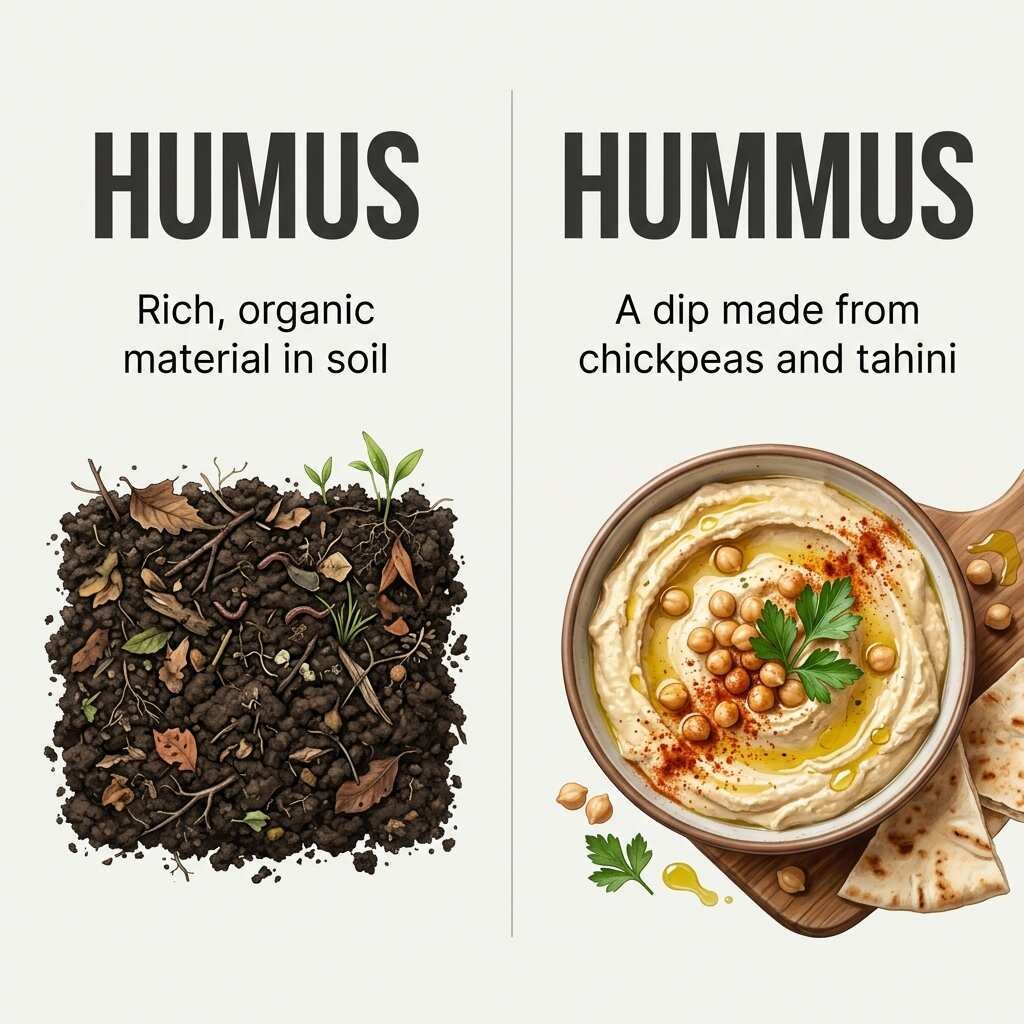
Hummus is the food dip. Humus is dark soil.Last spring, Sara wrote a menu for her small cafe. She typed “humus with warm pita.” A customer laughed and asked, “Are we eating dirt?” Sara blushed. One missing letter had turned her menu into a garden joke.
This is why people search for humus or hummus. The words sound close. They look close too. But they mean very different things. Hummus is a creamy dip made from chickpeas, tahini, lemon, and garlic. Humus is the rich, dark part of soil made from old leaves and plants. Gardeners love it.
People want to know which spelling is right. They fear a silly mistake in a menu, an essay, or a post. This guide clears up the confusion. You will learn the meaning, sound, and use of humus or hummus. Soon you will never mix them up again.
Pronunciation
Hummus
- US: HUM-us (/ˈhʌməs/). Some say HOOM-us (/ˈhʊməs/).
- UK: HUM-us or HOOM-us. Both are common.
Humus
- US: HYOO-mus (/ˈhjuːməs/)
- UK: HYOO-mus (/ˈhjuːməs/)
Say the “hy” in humus like the start of “huge.”
Learn more about https://personaor.com/damn-or-danm/
Difference Between Humus and Hummus
1. Meaning
Hummus is food. Humus is soil matter.
- “I bought hummus for lunch.”
- “The farm has rich humus.”
2. Spelling
Hummus has two m’s. Humus has one.
- “Hummus” has two m’s, like a double scoop.
- “Humus” has one m, like a single seed.
3. Pronunciation
Humus starts with a “hyoo” sound. Hummus starts with “hum.”
- “Humus” rhymes with “fumes.”
- “Hummus” rhymes with “chum us.”
4. Part of Speech
Both are nouns. Both are uncountable in most uses.
- “Hummus is tasty.”
- “Humus is rich.”
5. Where You Find It
Hummus is in kitchens and shops. Humus is in gardens and forests.
- Hummus sits in a fridge.
- Humus lies under fallen leaves.
6. Main Ingredients
Hummus is made from chickpeas. Humus comes from rotted plants and animals.
- Hummus: chickpeas, tahini, lemon.
- Humus: dead leaves, roots, and bugs broken down.
7. Can You Eat It?
You can eat hummus. You should not eat humus.
- Dip a carrot in hummus.
- Do not put humus on a plate.
8. Field of Use
Hummus belongs to cooking. Humus belongs to farming and science.
- A chef talks about hummus.
- A soil scientist talks about humus.
9. Smell and Look
Hummus is creamy and beige. Humus is dark brown and crumbly.
- Hummus smells of garlic.
- Humus smells like wet earth.
10. Origin Language
Hummus comes from Arabic. Humus comes from Latin.
- Hummus: Arabic word for chickpeas.
- Humus: Latin word for ground or earth.
Nature and Behaviour of Humus and Hummus
Humus
Humus is the last stage of rot. Tiny living things break down leaves and roots. What is left is dark and soft. It holds water well. It feeds plants slowly. Theyalso keeps soil loose, so roots can breathe. Good humus makes a garden strong.
Hummus
Hummus is a smooth, thick dip. You blend cooked chickpeas with tahini, lemon juice, garlic, and salt. It is often topped with olive oil. People scoop it with bread or veggies. It keeps for several days in the fridge. It is high in plant protein and fiber, and many people eat it as a snack or in sandwiches.
Why People Get Confused About Humus or Hummus
There are three simple reasons.
- They look alike. Only one letter is different.
- Spellcheck helps little. Both are real words, so the tool sees no error.
- Many people only hear hummus. They never see it written. So they guess the spelling.
Also, hummus is now very popular. Humus is a quieter word. People see “hummus” more, then wrongly drop a letter.
Comparison Table
| Feature | Humus | Hummus |
|---|---|---|
| Meaning | Dark soil matter | Chickpea dip |
| Spelling | One “m” | Two “m”s |
| US sound | HYOO-mus | HUM-us |
| Origin | Latin | Arabic |
| Edible? | No | Yes |
| Field | Gardening, science | Cooking, food |
| Similarity | Both are nouns | Both are nouns |
| Similarity | Both come from old words | Both are common in English |
| Example use | “Add humus to the soil.” | “Add hummus to the wrap.” |
The Origin of Humus and Hummus
Humus comes from the Latin word for earth or soil. English writers began using it for rich garden soil in the late 1700s. Gardeners and farmers have used it ever since.
Hummus comes from Arabic. The Arabic word means chickpeas. The dip has long been part of food in the Middle East. English speakers started using the word “hummus” mostly in the 20th century. Its use grew fast as the dip spread across stores and restaurants worldwide.
So the words are unrelated. They only look like cousins.
British vs American English
Good news: the spelling does not change between the two. Both use humus for soil and hummus for the dip.
Some small points:
- Some dictionaries also list “houmous” as a UK spelling for the dip. You may see it on British food labels.
- “Humus” is spelled the same in the US and UK.
- The sound of hummus can differ. Many Americans say HUM-us. Many Brits say HOOM-us.
Examples:
- UK shop sign: “Houmous and carrot sticks.”
- US menu: “Hummus plate.”
Which One Should You Use?
US: Use “hummus” for the dip. Use “humus” for soil.
UK: Use “hummus” or “houmous” for the dip. Use “humus” for soil. Follow the style of your brand or publisher.
Global: “Hummus” is the safest spelling for the dip. It is the most widely seen. Keep “humus” only for soil and science.
Common Mistakes
| Mistake | Correction |
|---|---|
| “I ate humus with pita.” | “I ate hummus with pita.” |
| “The soil is full of hummus.” | “The soil is full of humus.” |
| “Spread hummus on your garden.” | “Spread humus on your garden.” |
| “Humus sandwich” | “Hummus sandwich” |
| Saying “HYOO-mus” for the dip | Say “HUM-us” |
Everyday Usage Examples
Email: “Please order hummus and pita for Friday’s lunch.”
Social media: “Homemade hummus tonight. Best snack ever! 😋”
News: “Farmers say humus helps soil hold more water in dry months.”
Formal writing: “Humus improves soil structure and supports healthy plant growth.”
Usage Trends
Hummus is used far more than humus in daily life. It is on menus, in grocery stores, and across social media. Its use has grown worldwide as more people choose plant-based snacks.
Humus is used less, but steadily. You find it in farming, gardening, and soil science. It gets more attention when people talk about healthy soil and climate-friendly farming.
Metaphors and Similes
Humus
- “Her old stories were the humus of his new ideas.” (Old things feed new growth.)
- “Failure is humus. Success grows from it.”
- “Like humus, good memories feed what comes next.”
Hummus
- “Her voice was smooth as hummus.”
- “The talk was a plain bowl of hummus: simple, warm, and shared.” (Hummus is often shared, so it can stand for togetherness.)
Connotative Meaning
Humus
- Positive: Richness, growth, life. “Humus makes the garden thrive.”
- Negative: Decay or rot, if used loosely. “The old plan turned to humus.”
- Neutral: Science. “The test measured humus levels.”
Hummus
- Positive: Healthy, fresh, friendly. “A hummus platter for the guests.”
- Negative: Rarely negative. Some may call it bland or “trendy.”
- Neutral: A food item. “There is hummus in the fridge.”
Idioms and Proverbs
Neither word has a famous idiom of its own. But some close ideas fit humus:
- “Down to earth” means practical and humble. “She is rich, but very down to earth.”
- “Salt of the earth” means a good, honest person. “My grandfather was salt of the earth.”
- “What goes around comes around.” Like humus, old things return to feed new life.
For hummus, people often say “a hummus kind of day” in casual talk. It is slang, not a true idiom.
Literature and Movies
Literature
- An Agricultural Testament by Sir Albert Howard, 1940. Nonfiction. It praises humus for healthy farming.
- The Formation of Vegetable Mould Through the Action of Worms by Charles Darwin, 1881. Science. It studies how worms build rich soil.
- The Book of Middle Eastern Food by Claudia Roden, 1968. Cookbook. It helped bring dishes like hummus to English readers.
Movies
- You Don’t Mess with the Zohan, 2008, USA. A comedy with hummus jokes.
- Dirt! The Movie, 2009, USA. A documentary about soil.
- Kiss the Ground, 2020, USA. A documentary about healthy soil and farming.
Why This Difference Matters
For learners, one letter can change the whole meaning. Knowing both words builds spelling skill and trust.
For society, clear words matter. A cafe, a school, or a news site looks careful when it spells well. A mix-up can cause laughs, or worse, confusion in labels and instructions. Good spelling also respects food culture and science.
Usefulness in Daily Life
- Cooking: Read recipes with care. Hummus is for the plate.
- Shopping: Look for “hummus” on food labels.
- Gardening: Look for “humus” or “compost” when you want better soil.
- Writing: Check menus, posts, and emails before sending.
- School: Use the right word in science and food reports.
Situational Preference
Use hummus when you talk about food, menus, recipes, parties, or shopping. It is the right word for the dip every time. Use humus when you talk about soil, farming, gardens, or science. In a casual chat, listeners will guess from context, but writing is less forgiving. A menu or label, always choose hummus. In a school or garden guide, always choose humus. If you write for readers around the world, keep both words clear and use a short note if needed. When unsure, ask yourself: “Can I eat it?” If yes, use hummus.
Possible short question
1. Is it humus or hummus for the food?
Hummus. Two m’s.
2. What does humus mean?
It is the dark, rich part of soil made from rotted plants and animals.
3. Can I spell the dip as “houmous”?
Yes. It is a common UK variant, but “hummus” is the most widely used.
4. Is hummus healthy?
It can be. It has plant protein and fiber. Portion size and added oil matter.
5. Is humus the same as compost?
Not exactly. Compost is rotting material on the way to becoming humus. Humus is the final, stable result.
6. How do I say hummus?
Most Americans say HUM-us. Many Brits say HOOM-us. Both are fine.
7. Does spellcheck catch the mistake?
Often not. Both are real words, so always check by meaning.
Conclusion
Humus or hummus? The answer is simple. Hummus is the creamy chickpea dip. Humus is the dark, rich part of soil. They look alike, but they have different meanings, different sounds, and different roots. One comes from Arabic. The other comes from Latin.Remember three easy tips. First, if you can eat it, use two m’s. Second, if it grows plants, use one m. Third, say HUM-us for the dip and HYOO-mus for the soil.Spelling this right helps you in many places. It keeps menus clear. Keeps school work correct. It keeps your emails and posts sharp. A tiny letter can change a lunch into a lawn. So take one extra second to check. Now you know the difference between humus or hummus. Use it with confidence, and share this guide with a friend who might make the same mistake.

I’m Daim Abbas, an English language enthusiast, content writer, and SEO writer. I create clear and practical content about word meanings, synonyms, vocabulary, and commonly confused English words. I’m passionate about making English easy to understand while creating helpful, reader-friendly, and SEO-optimized content.