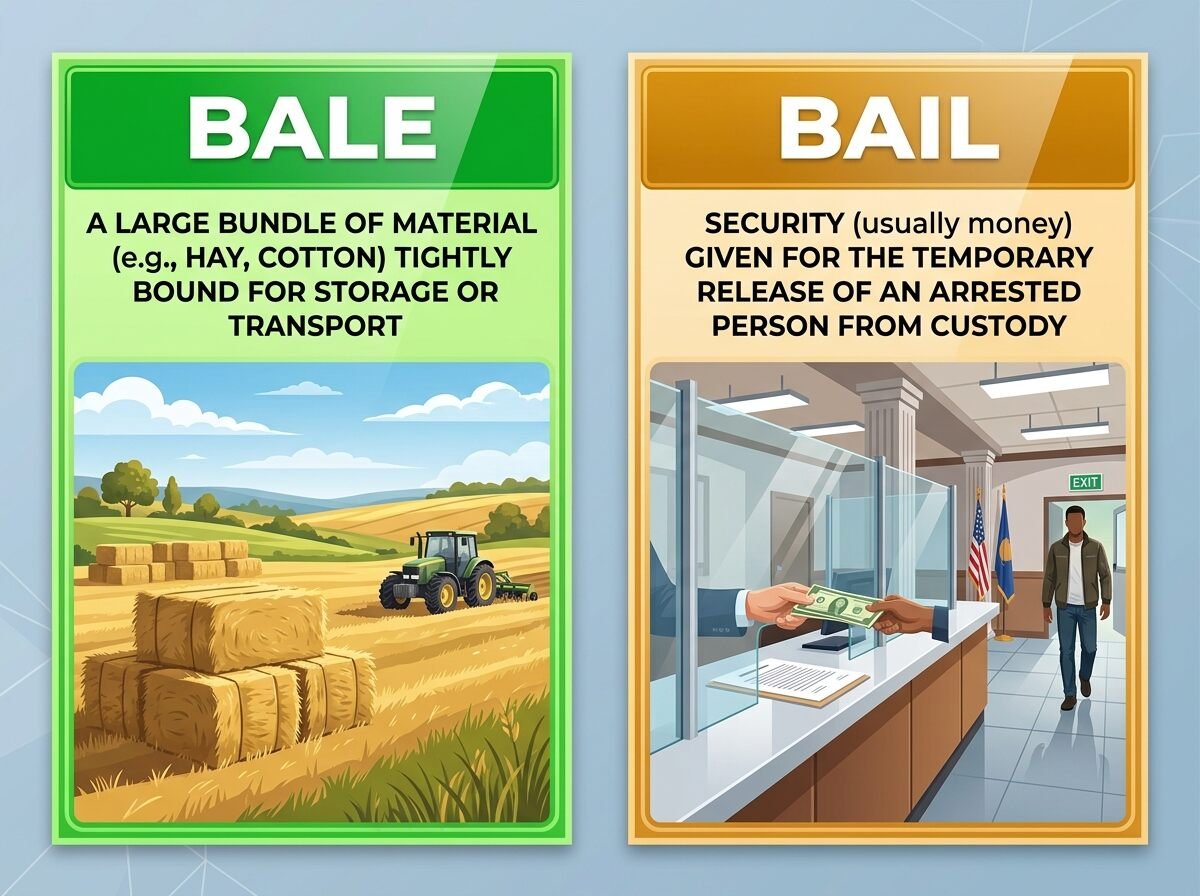
Bale usually means a bundle of goods or to remove water from a boat, while bail usually means money paid for someone’s release or to leave a place quickly.
Imagine you are reading a news story about a person released from jail. You see the word bail and wonder if it should be bale. Later, you read about a farmer selling a large bale of hay. The two words sound almost the same, but their meanings are very different.
Bale or bail is a common spelling question because both words are pronounced almost the same in modern English. The main difference is their meaning and use. Bale is often linked to farming, goods, bundles, and boats. Bail is linked to law, leaving suddenly, and removing water from a boat.
People search for bale or bail because one small letter changes the meaning of the sentence. Knowing the difference helps English learners, writers, students, and anyone who wants to avoid spelling mistakes.
Pronunciation
- Bale
- US: /beɪl/
- UK: /beɪl/
- Bail
- US: /beɪl/
- UK: /beɪl/
bale
bayl
Give feedback
Bale and bail are homophones. They have the same common pronunciation but different meanings and spellings.
Difference Between Bale and Bail
1. Basic Meaning
Bale usually means a tightly packed bundle of material.
Bail often means money paid to allow a person accused of a crime to leave jail while waiting for court.
Examples:
- The farmer made a bale of hay.
- The judge set bail at $5,000.
2. Use in Farming
Bale is common in farming. Hay, straw, cotton, and similar materials can be made into bales.
Examples:
- We loaded three bales of hay.
- The farmer tied the straw into a bale.
Bail is not normally used for a farm bundle.
3. Use in Law
Bail is strongly connected with law and courts.
Examples:
- The suspect was released on bail.
- His family paid his bail.
Bale does not have this legal meaning.
4. As a Noun
Both words can be nouns, but their meanings differ.
Bale can mean a bundle.
Bail can mean money paid for temporary release from custody.
Examples:
- The worker moved a bale of cotton.
- She paid the bail for her brother.
5. As a Verb
Bale can also be a verb. It can mean to make something into a bale.
Bail can be a verb. It can mean to release someone after payment or to remove water from a boat.
Examples:
- They baled the hay.
- We had to bail water out of the boat.
6. Meaning “Leave Quickly”
Bail can have an informal meaning: to leave or stop participating.
Examples:
- I have to bail early tonight.
- Tom bailed on the meeting.
Bale does not normally mean “leave.”
7. Meaning “Remove Water”
Bail can mean removing water from a boat.
Examples:
- We used a bucket to bail water.
- The crew bailed the boat after the storm.
However, bale can also appear in older or regional uses connected with removing water, so context matters.
8. Spelling
The spelling is easy to remember if you connect each word with its common meanings.
Bale → bundle.
Bail → law, leaving, or removing water.
Examples:
- A bale of wool was on the floor.
- The man was released on bail.
9. Formality
Bail is common in both formal and informal English.
Bale is also common, but it is often used in farming, trade, manufacturing, and shipping.
Examples:
- The court granted bail.
- The factory packed the material into a bale.
10. Context
The sentence usually makes the correct word clear.
Examples:
- The farmer lifted a bale of hay.
- The lawyer asked the court for bail.
If the sentence is about a bundle, choose bale. If it is about legal release, choose bail.
Nature and Behaviour of Bale and Bail
Bale
Bale is mainly a concrete word. It often describes a physical bundle of material. It is common in farming and industry.
For example:
- a bale of hay
- a bale of cotton
- a bale of straw
As a verb, bale can mean packing material into a bundle.
Bail
Bail has several meanings. The best-known meaning is legal. It refers to money or a legal arrangement connected with temporary release from custody.
It can also be a verb:
- to bail someone out
- to bail water from a boat
- to bail on a plan
So, bail has a wider range of meanings than bale.
Why People Get Confused About Bale and Bail
People confuse these words because they sound the same.
The letters -ale and -ail look different, but both are normally pronounced /eɪl/.
English has many homophones. These words have different spellings but the same sound.
The easiest way to remember them is:
Bale = bundle
Bail = legal release, leave, or remove water
Comparison Table
| Feature | Bale | Bail |
|---|---|---|
| Main meaning | A bundle | Legal release |
| Common field | Farming and trade | Law |
| Verb use | Make into a bundle | Release, leave, remove water |
| Pronunciation | /beɪl/ | /beɪl/ |
| Spelling | Bale | Bail |
| Sounds like | Bail | Bale |
| Example | A bale of hay | Pay bail |
| Informal use | Limited | “Bail on a plan” |
| Water meaning | Rare/older use | Common |
| Legal meaning | No | Yes |
The Origin of Bale and Bail
Bale has old roots connected with words for a bundle or package. English developed the word through forms found in Middle English and related Germanic and French influences.
Bail has a different history. Its legal sense is linked to the idea of delivering or releasing a person into someone’s care. The word also developed other meanings over time.
Although the two words now sound alike, they did not begin with the same meaning. Their similar pronunciation is one reason modern English speakers often confuse them.
British vs American English
The spelling of bale and bail is generally the same in British and American English.
There is no major US-versus-UK spelling change here.
Examples in both varieties:
- The farmer stacked a bale of hay.
- The court granted bail.
- We had to bail water from the boat.
The legal use of bail is common in both varieties, although legal systems and exact procedures differ between countries.
Which One Should You Use?
Use bale when you mean a bundle of material.
Use bail when you mean legal release, leaving suddenly, or removing water from a boat.
US English, use the same spellings.
UK English, use the same spellings.
For global English, the same rule works well:
Bundle = bale
Legal release = bail
This simple connection can prevent most spelling mistakes.
Common Mistakes
Mistake 1: Using “bale” for legal release
❌ He was released on bale.
✅ He was released on bail.
Mistake 2: Using “bail” for hay
❌ The farmer loaded a bail of hay.
✅ The farmer loaded a bale of hay.
Mistake 3: Confusing “bail out” with “bale out”
❌ She decided to bale out of the project.
✅ She decided to bail out of the project.
Mistake 4: Mixing the words in legal writing
❌ The judge set the bale at $10,000.
✅ The judge set the bail at $10,000.
Everyday Usage Examples
In Emails
- “Please arrange payment of the bail as soon as possible.”
- “The warehouse received a new bale of cotton.”
On Social Media
- “I had to bail on the party.”
- “Look at this huge bale of hay!”
In News
- “The court denied bail.”
- “Farmers prepared thousands of bales of straw.”
In Formal Writing
- “The accused was released on bail.”
- “The material was compressed into a large bale.”
Usage Trends
Both words remain active in modern English.
Bale is especially useful in agriculture, shipping, recycling, textiles, and manufacturing.
Bail is much more common in everyday speech because of its legal and informal meanings.
The phrase “bail out” is also widely used. It can mean leaving a situation, helping someone financially, or removing water from a boat.
Metaphors and Similes
Bale is sometimes used in figurative language when something is treated like a tightly packed bundle.
Example:
- The old clothes were packed like a bale.
Bail appears more often in figurative expressions.
Example:
- “I need to bail before the traffic gets worse.”
Here, bail means leave quickly.
Another example:
- “She bailed out her friend.”
This can mean she helped her friend escape a difficult situation.
Connotative Meaning
Bale
Positive tone: A bale can suggest useful farm products or successful production.
- The farmer sold a valuable bale of cotton.
Negative tone: A bale can suggest heavy work or difficult handling.
- The worker struggled to move the heavy bale.
Neutral tone: It can simply describe a bundle.
- There was a bale of straw in the barn.
Bail
Positive tone: Bail can suggest freedom or temporary release.
- His family helped him obtain bail.
Negative tone: Bail can suggest crime, arrest, or legal trouble.
- The suspect was held without bail.
Neutral tone: It can simply describe leaving or removing water.
- We stopped to bail water from the boat.
Idioms and Proverbs
There are several common expressions with bail.
Bail out
To bail out can mean to help someone in trouble or leave a difficult situation.
- My brother bailed me out when I needed help.
Bail on Someone
To bail on someone means to leave or fail to do something you agreed to do.
- Don’t bail on your friends at the last minute.
Jump Bail
To jump bail means to fail to appear in court after being released on bail.
- The accused jumped bail and left the country.
There are no equally common modern idioms built around bale.
Literature and Movies
The word bale appears naturally in literature about farming, rural life, trade, and physical labor. Agricultural writing and rural fiction often describe bales of hay, straw, or cotton.
The word bail appears often in crime fiction, legal novels, newspapers, and courtroom stories. Legal dramas use bail because arrests and court cases are common themes.
In movies, bail is especially common in crime and courtroom films from the United States and other English-speaking countries. Bale is more likely to appear in stories set on farms or in rural areas.
Why This Difference Matters
Knowing the difference between bale or bail matters because a spelling mistake can change the meaning of a sentence.
Imagine writing that someone was released on bale. A reader will know what you probably mean, but the spelling is wrong.
English learners need to recognize these small differences. Writers also need them because correct word choice makes writing clear and professional.
This difference also matters in school, work, journalism, legal writing, and online communication. A single wrong letter can make a sentence confusing.
Learning homophones like bale and bail helps improve spelling, reading, and vocabulary.
Usefulness in Daily Life
You may see bale in:
- farm reports
- product descriptions
- textile news
- shipping documents
- agricultural articles
You may see bail in:
- court reports
- news stories
- legal documents
- movies
- everyday conversations
Remember the simple rule:
A bale is usually a bundle.
Bail is usually about release, leaving, or water.
Situational Preference
Use bale when you are talking about hay, straw, cotton, paper, or another tightly packed bundle. Use bail when the situation involves court, money for release, leaving a place, leaving a plan, or removing water from a boat. In US English and UK English, these spellings are the same. In global English, the same rule is safe. If you are writing about a farmer, bale is likely correct. If you are writing about a person leaving jail, bail is correct. Always check the meaning before choosing the spelling.
Possible Short question
Is bale and bail the same word?
No. They are different words with different meanings, although they usually have the same pronunciation.
What is the difference between bale and bail?
Bale usually means a bundle. Bail usually means legal release, leaving, or removing water.
Is it “bale of hay” or “bail of hay”?
The correct phrase is “bale of hay.”
Is it “released on bale” or “released on bail”?
The correct phrase is “released on bail.”
Are bale and bail homophones?
Yes. In standard modern English, they are pronounced the same.
Is bail British or American English?
Bail is used in both British and American English.
How can I remember bale vs bail?
Remember bale = bundle. Think of a bale of hay. Remember bail = legal release.
Conclusion
The difference between bale or bail is simple once you connect each spelling with its main meaning. Bale usually means a tightly packed bundle of material. You may see a bale of hay, cotton, straw, or paper. Bail has several meanings, but its most common meanings include legal release, leaving a situation, and removing water from a boat.The two words sound the same in standard English, so spelling is the key difference. This makes them easy to confuse, especially for English learners. However, the context usually tells you which word you need.When talking about a bundle, choose bale. When talking about court or release, choose bail. Use bail for expressions such as “bail out” and “bail on someone.”This small spelling rule can make your writing clearer and more accurate. Once you remember bale = bundle and bail = release or leave, you can use both words with confidence.

I’m Daim Abbas, an English language enthusiast, content writer, and SEO writer. I create clear and practical content about word meanings, synonyms, vocabulary, and commonly confused English words. I’m passionate about making English easy to understand while creating helpful, reader-friendly, and SEO-optimized content.