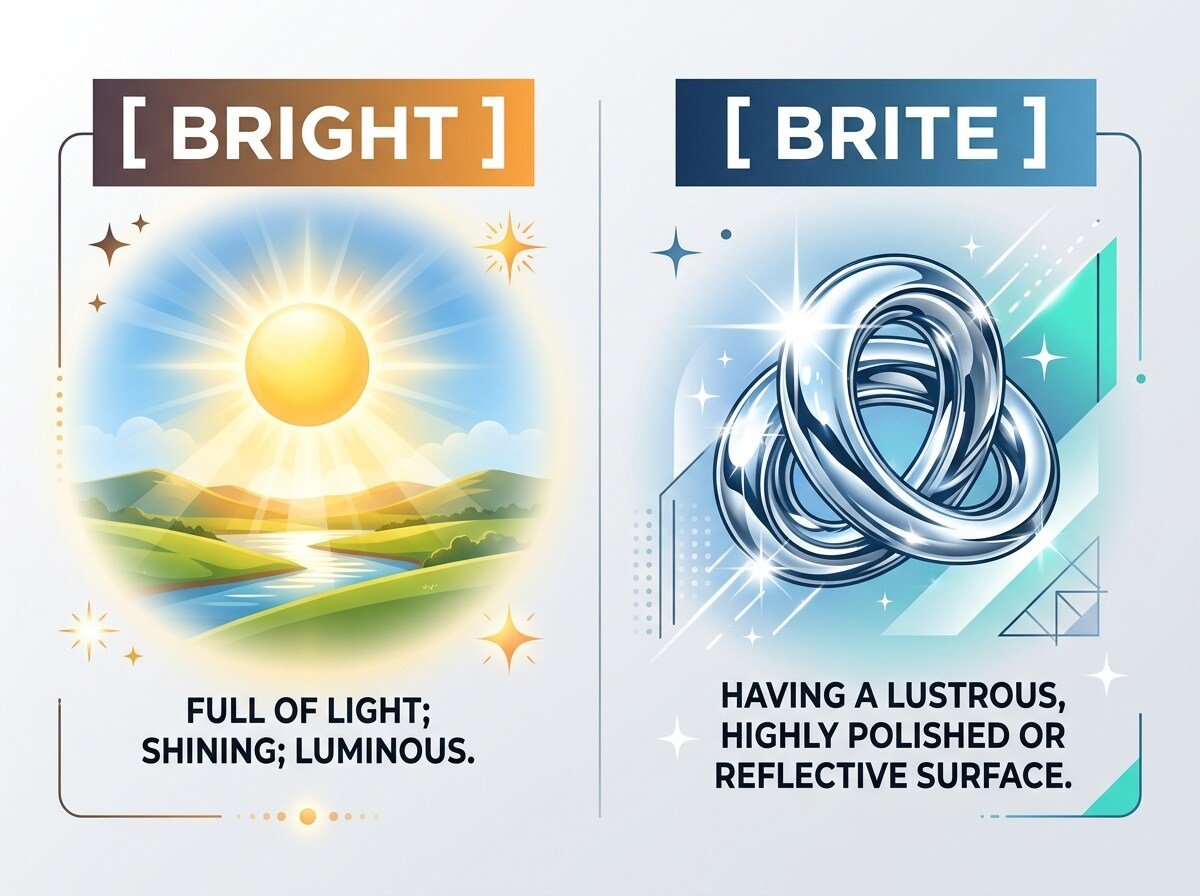
Bright” is the standard English spelling, while “brite” is mainly an informal, stylized, or brand spelling.
Imagine you are writing a message about a sunny morning. You type, “It is a very brite day,” and then stop. You wonder if the word should have an -gh at the end. This is a common spelling question because bright and brite sound the same in most English varieties, but they do not have the same status in standard writing.
The standard word is bright. It can describe strong light, a vivid color, a smart person, or something full of hope. Brite is not normally used as the standard spelling of the adjective. However, you may see it in brand names, product names, slogans, informal writing, or creative names.
Pronunciation
| Word | US Pronunciation | UK Pronunciation |
| bright | /braɪt/ | /braɪt/ |
| brite | /braɪt/ | /braɪt/ |
From Spelling to Usage
Now let us look at how bright and brite differ in meaning, spelling, history, and everyday use.
Difference Between Bright or Brite
1. Standard Spelling
Bright is the standard English spelling.
Brite is not the normal spelling in standard English.
Examples:
- The room is bright.
- She has a bright smile.
2. Dictionary Use
Bright is a regular English adjective and also has other grammatical uses.
Brite is usually found in special names, brands, or informal forms.
Examples:
- He wore a bright shirt.
- The shop used Brite in its name.
3. Meaning
Bright has several meanings. It can mean full of light, vivid, intelligent, or hopeful.
Brite usually does not create a new standard meaning. Its meaning depends on the name or context where it appears.
Examples:
- The bright light hurt my eyes.
- She is a bright student.
4. Formal Writing
Use bright in formal writing.
Avoid replacing it with brite unless Brite is part of an official name.
Examples:
- The room was bright and clean.
- The report described the bright colors.
5. Informal Writing
People sometimes use brite for a short or modern look.
This is more common in names and advertising than in normal sentences.
Examples:
- A company may use Brite in its brand name.
- A creative project may use Brite as its title.
6. Silent Letters
The spelling bright contains gh. The letters are not pronounced in modern English.
This is one reason learners may prefer the simpler-looking brite.
Examples:
- Bright sounds like “brite.”
- Night also has silent gh.
7. Scrabble and Word Games
In ordinary English word games, bright is the standard word.
Brite may not be accepted when a game requires standard dictionary words.
Examples:
- Bright is a normal English word.
- Brite may be rejected depending on the game’s dictionary.
8. Brand Names
Brite can appear in company names, product names, and trademarks.
In such cases, the unusual spelling is intentional.
Examples:
- A company may call a product Brite.
- A business may use Brite as part of its name.
9. Search Results
When people search for brite, they may find brands, websites, names, or creative products.
When they search for bright, they usually find the standard English word.
Examples:
- Search bright colors for the normal adjective.
- Search Brite when looking for a specific name.
10. Best Choice
For normal English, choose bright.
Use brite only when it is an intentional name, title, trademark, or stylized spelling.
Examples:
- Correct: “The sun is bright.”
- Correct: “The company is called Brite.”
Nature and Behaviour of Bright or Brite
Bright
Bright is a flexible English word. It can describe light, colors, people, ideas, and feelings.
It often has a positive meaning.
For example:
- a bright room
- a bright color
- a bright student
- a bright future
Brite
Brite has a different role. It is usually a stylized spelling rather than the normal adjective.
It may be used to make a name look shorter, modern, or memorable.
For example:
- a brand called Brite
- a product called Brite
- a creative title using Brite
Why People Get Confused About Bright or Brite
The main reason is pronunciation.
Bright and brite can sound exactly the same. The difference is mainly in spelling and usage.
The letters gh in bright are silent. English has many words with silent letters.
Compare:
- bright / brite
- night / nite
- light / lite
- right / rite
Some of these pairs have special meanings or informal uses. That can make learners wonder whether brite is also a standard alternative.
For normal English writing, it is safer to use bright.
Comparison Table
| Feature | Bright | Brite |
| Standard English spelling | Yes | No |
| Common adjective | Yes | No |
| Pronunciation | /braɪt/ | Usually /braɪt/ |
| Means full of light | Yes | Not normally |
| Means intelligent | Yes | No |
| Used in formal writing | Yes | Only as a proper name |
| Used in brands | Yes | Yes |
| Used in creative names | Sometimes | Common |
| Used in school writing | Yes | Usually no |
| Used in everyday English | Very common | Limited |
The Origin of Bright or Brite
Bright is an old English word. It comes from Old English beorht, which meant shining, clear, or bright.
Over time, the spelling changed. Middle English forms included spellings such as bright. The gh spelling became established in English.
The sound changed over many centuries. In modern English, the gh in bright is silent.
Brite is best understood as a later simplified or stylized spelling. It follows the sound of the word rather than its traditional spelling.
This is similar to other English spellings where people simplify words for informal or commercial use.
British vs American English
There is no major British-American spelling difference between bright and brite.
Both British and American English normally use bright.
British English:
- The room is bright.
- She has a bright future.
American English:
- The room is bright.
- She has a bright future.
Brite can appear in names or brands in either variety.
The important point is that brite is not the normal American alternative to bright.
Which One Should You Use?
For almost every normal English sentence, use bright.
For US English
Use bright in school, work, emails, and general writing.
For UK English
Use bright in the same situations.
For Global English
Use bright when writing for an international audience. It is clear and widely understood.
Use Brite only when it is part of an official name, product, title, or brand.
Common Mistakes
Here are some common errors:
- ❌ The sun is brite.
✅ The sun is bright. - ❌ She is a brite student.
✅ She is a bright student. - ❌ We had a brite room.
✅ We had a bright room. - ❌ He has a brite future.
✅ He has a bright future. - ❌ The colors are very brite.
✅ The colors are very bright.
When Brite Is Correct
If Brite is an official name, keep its original spelling.
For example:
- The product is called Brite.
- The company uses Brite in its name.
Everyday Usage Examples
In Emails
The office has a bright and welcoming design.
I hope you have a bright and successful week.
On Social Media
What a bright and beautiful morning!
These bright colors make me happy.
In News
The city welcomed a bright new star to its sports team.
In Formal Writing
The study found that bright light can affect the appearance of colors.
In Conversation
Your room looks very bright.
She is a bright young student.
Usage Trends
Bright is the normal and widely used spelling around the world.
It appears in books, websites, newspapers, education, business writing, and daily conversation.
Brite has a much smaller role. It is often chosen for branding because it looks short and simple.
The internet has also made creative spellings more common. Companies may change traditional spelling to create a memorable name. This does not mean the new spelling has replaced the standard English word.
So, in normal writing, bright remains the best choice.
Metaphors and Similes
The word bright is often used in figurative language.
Bright as a Metaphor
Bright future means a future that looks successful or hopeful.
Example:
She has a bright future in science.
Bright idea means a clever or useful idea.
Example:
That is a bright idea.
Bright as a Simile
Example:
Her smile was as bright as the morning sun.
Another example:
His eyes shone like bright stars.
These expressions usually give bright a positive feeling.
Connotative Meaning
Positive Meaning
Bright often suggests hope, intelligence, beauty, or success.
Example:
He has a bright future.
Here, bright suggests success.
Negative Meaning
Sometimes bright can have a negative meaning.
Example:
The bright light hurt my eyes.
Here, too much light is uncomfortable.
Neutral Meaning
It can simply describe light or color.
Example:
The wall is bright yellow.
The word does not always express an emotion.
Idioms and Proverbs
Bright appears in several common expressions.
Bright and Early
This means very early in the morning.
We arrived bright and early.
Bright-Eyed
This means looking lively, alert, or excited.
The children were bright-eyed on the first day of school.
A Bright Idea
This means a clever or useful idea.
She came up with a bright idea.
The Bright Side
This means the positive part of a difficult situation.
Look on the bright side. At least nobody was hurt.
Literature and Movies
The word bright is common in literature because it can describe light, hope, intelligence, beauty, and the future.
In poetry, writers often use bright images to create feelings of hope or beauty. For example, William Shakespeare frequently used images of light and brightness in his plays and poems.
A famous example is Romeo and Juliet, a tragedy first published around 1597. Light and brightness are used as powerful images throughout the work.
In movies, Bright was also used as the title of a 2017 American fantasy crime film. The title uses the ordinary spelling of the word.
The unusual spelling Brite is more likely to appear in product names, company names, or creative titles than as a normal literary word.
Why This Difference Matters
Knowing the difference helps you write clearly.
A spelling mistake can make formal writing look careless. This matters in:
- school assignments
- job applications
- emails
- reports
- websites
- professional documents
Using bright also helps readers understand that you know the standard form.
At the same time, recognizing Brite is useful because you may see it in advertisements, business names, and products.
The key is context. You should not “correct” an official name simply because it uses an unusual spelling.
Usefulness in Daily Life
Knowing when to use bright is useful in many situations.
You can use it to describe:
- sunlight
- rooms
- colors
- clothing
- lights
- smart people
- ideas
- hopes
- future plans
- happy expressions
For example:
The kitchen is bright.
She bought a bright dress.
He is a bright student.
We have a bright future.
If you see Brite in a brand name, keep the spelling exactly as the brand uses it.
Situational Preference
In school work, use bright. Formal emails and business documents, use bright. Newspapers and general online writing, bright is also the correct choice. In casual writing, bright remains the safest option. Use Brite when you are referring to a specific brand, company, product, title, or creative name that officially uses that spelling. Do not change Brite to bright when it is a proper name. Likewise, do not replace the standard word bright with brite just to make your writing look modern. Context decides the right choice.
Possible question answers
Is bright the correct spelling?
Yes. Bright is the standard spelling in English.
Is brite a real word?
Brite can be used as a name, brand, or stylized spelling, but it is not the normal spelling of the standard adjective.
Do bright and brite sound the same?
Yes. When brite represents the same word, both are normally pronounced /braɪt/.
Can I use brite in formal writing?
Usually no. Use bright unless Brite is an official name.
Is brite American English?
No. Brite is not a standard American spelling of bright.
Is bright British English?
Yes. Bright is standard in British English and American English.
Why does bright have “gh”?
The gh comes from the historical spelling of the word. It is silent in modern pronunciation.
Conclusion
The choice between bright and brite is simple in most cases. Bright is the standard English spelling. It is used to describe strong light, vivid colors, intelligent people, good ideas, and hopeful situations. Correct in British English, American English, and general international English.Brite is different. It is usually a stylized spelling. You may see it in brand names, product names, company names, advertisements, or creative titles. It can look modern and short, but it should not normally replace bright in standard English.The pronunciation can cause confusion because the two forms may sound the same. The silent gh in bright makes its spelling less obvious to learners. Still, the traditional spelling is the one to use in normal writing.

I’m Daim Abbas, an English language enthusiast, content writer, and SEO writer. I create clear and practical content about word meanings, synonyms, vocabulary, and commonly confused English words. I’m passionate about making English easy to understand while creating helpful, reader-friendly, and SEO-optimized content.